|
VOOZH | about |
|
VOOZH | about |
How to make what people want
by Jake Knapp and John Zeratsky, founders and general partners at Character Capital
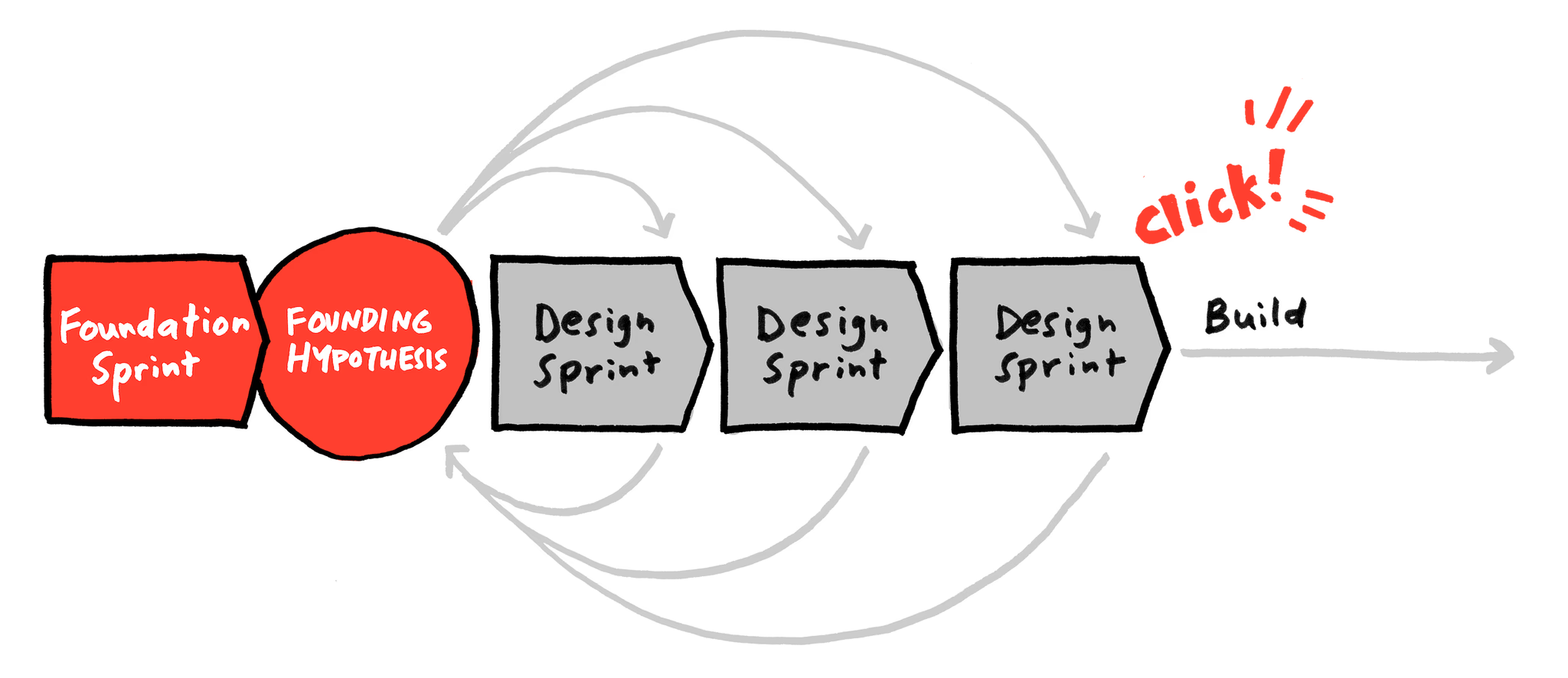
The Foundation Sprint is our two-day workshop for a team at the beginning of a big project. On the morning of day one, you’ll define the basics of your project; then, in the afternoon, you’ll craft differentiation to help you stand out from the competition. On day two, you’ll evaluate multiple options and choose an approach to solving your customer’s problem. By the end, you’ll have a Founding Hypothesis: a clear statement of what you believe that can be tested in a Design Sprint.
In a Foundation Sprint, you will:
But the Foundation Sprint is not just about aligning your team. In the age of AI, when you can build anything fast, Foundation Sprint is a proven, practical method for deciding what to build. And because everyone else has the same capability, this method will help you stand out from competitors in a world that's becoming noisier every day.
You can run your own Foundation Sprint using our Miro template, our book Click, and this guide.
First, you'll need to get ready.
Gather the leaders of the team: no more than five people, including the Decider (the real decision maker on the team).
Six hours per day provides plenty of breathing room to finish the activities and take ample breaks. Some teams will finish these activities faster, but it’s good to have the full time available to ensure you can get into deep focus mode.
You’ll need a real or virtual whiteboard, sticky notes, blank white paper, and dot stickers for voting.
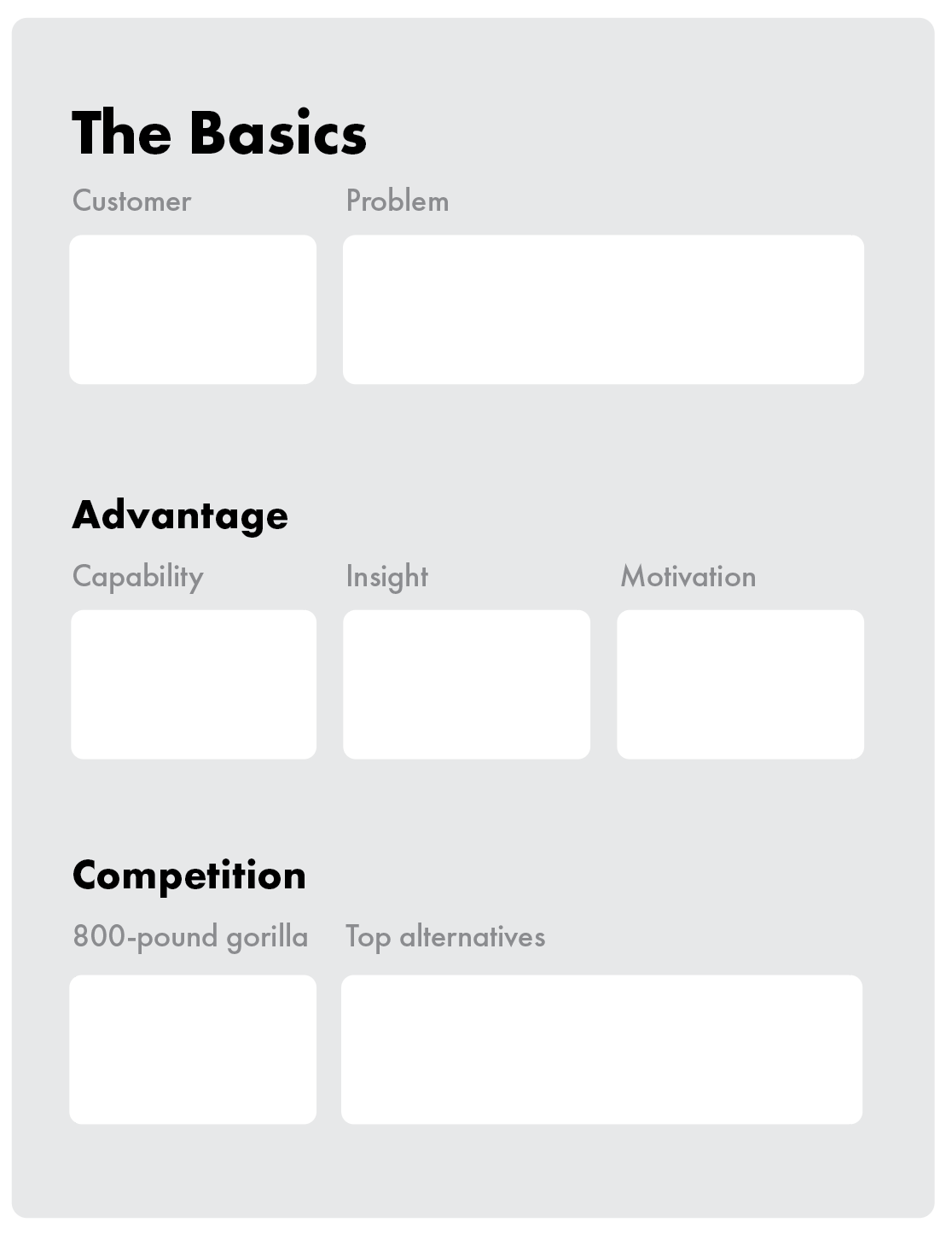
The Foundation Sprint starts with the Basics. The Basics are the so-obvious-they-get-ignored fundamentals that should inform every big decision about your project. Who, precisely, is your customer? What problem are you solving for them? What’s your advantage? Who or what are you up against? On the morning of day one, you’ll make it all crystal clear.
Use plain language to make sure you’re talking about real people (for example, instead of “distributed enterprise orgs,” just say “teams with people in different locations”).
Trying a new solution will cost your customers time, energy, and/or money. What problem causes enough pain to justify that cost? What is the biggest way you can help them?
What gives you and your team an advantage over anyone else who might try to solve this problem? What capability, insight, and motivation set you far apart?
What options do customers have for solving the target problem? These might be other products, workarounds, or even “do nothing” (which can be a warning sign, since it indicates the problem may not be important enough to merit a solution). Be sure to identify the most challenging competitor—the 800-pound gorilla that will be most difficult for your product to beat.
Use our Note-and-Vote technique for all of the above steps, and throughout the sprint: For each question, give everyone five minutes to think in silence and write answers on separate sticky notes. Then review the answers in silence, using dot stickers to vote for the best. Finally, the Decider calls for a short debate and makes a decision (regardless of the votes).
Get a snack or lunch. Stand up and stretch or take a walk.
Next is the crux of your hypothesis: differentiation. How can you best use your advantage? How can you reframe the decision for customers and make the 800-pound gorilla look like junk?
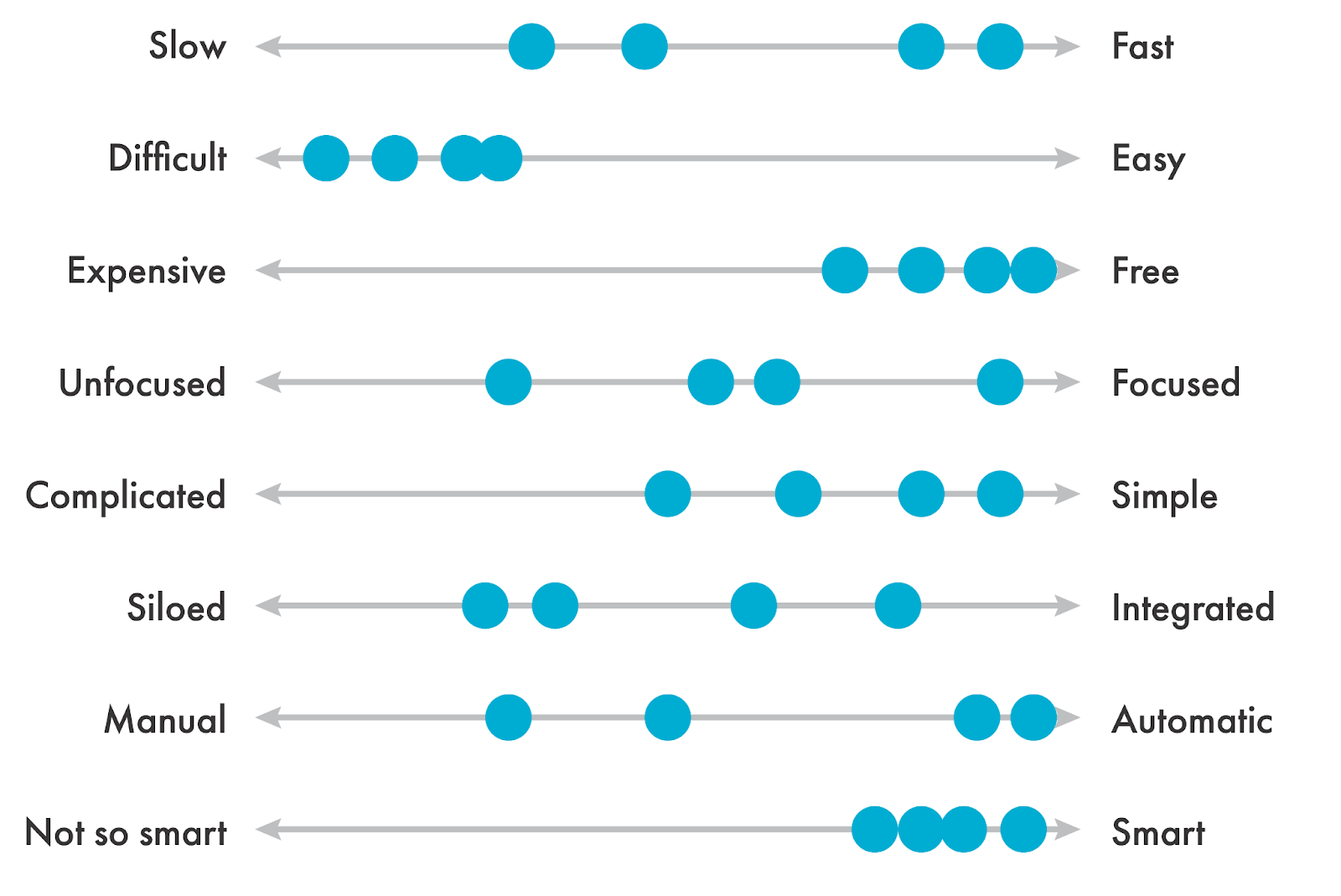
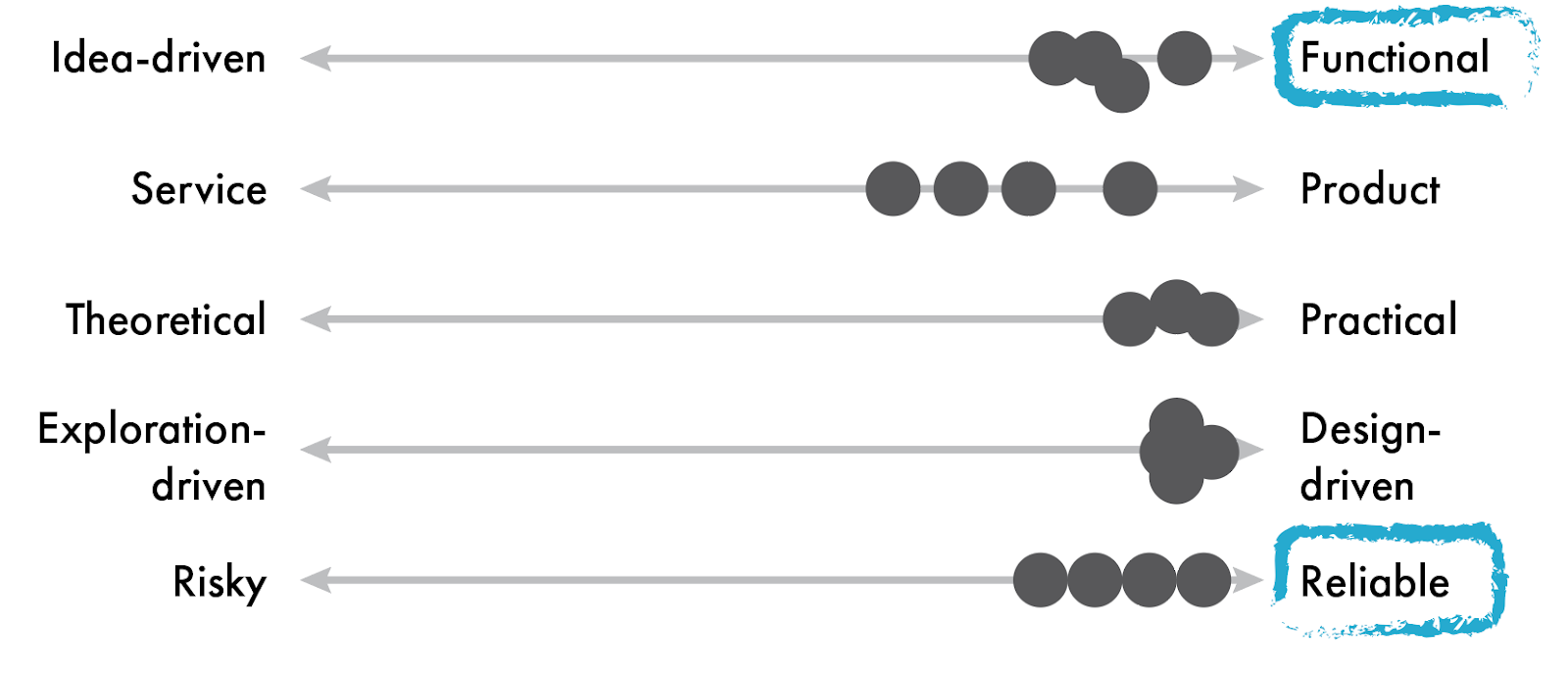
Use dot voting to mark where your solution could stack up against the competition on these classic differentiators. Be very optimistic and aggressive—but also realistic.
Next, write your own differentiators, using criteria at which your solution could excel—and which would make the competition look crummy.
Review the custom differentiators. Once again, mark where your solution could stack up against the competition.
Vote in silence, then the Decider chooses two differentiators to try first.
Get a snack or lunch. Stand up and stretch or take a walk.
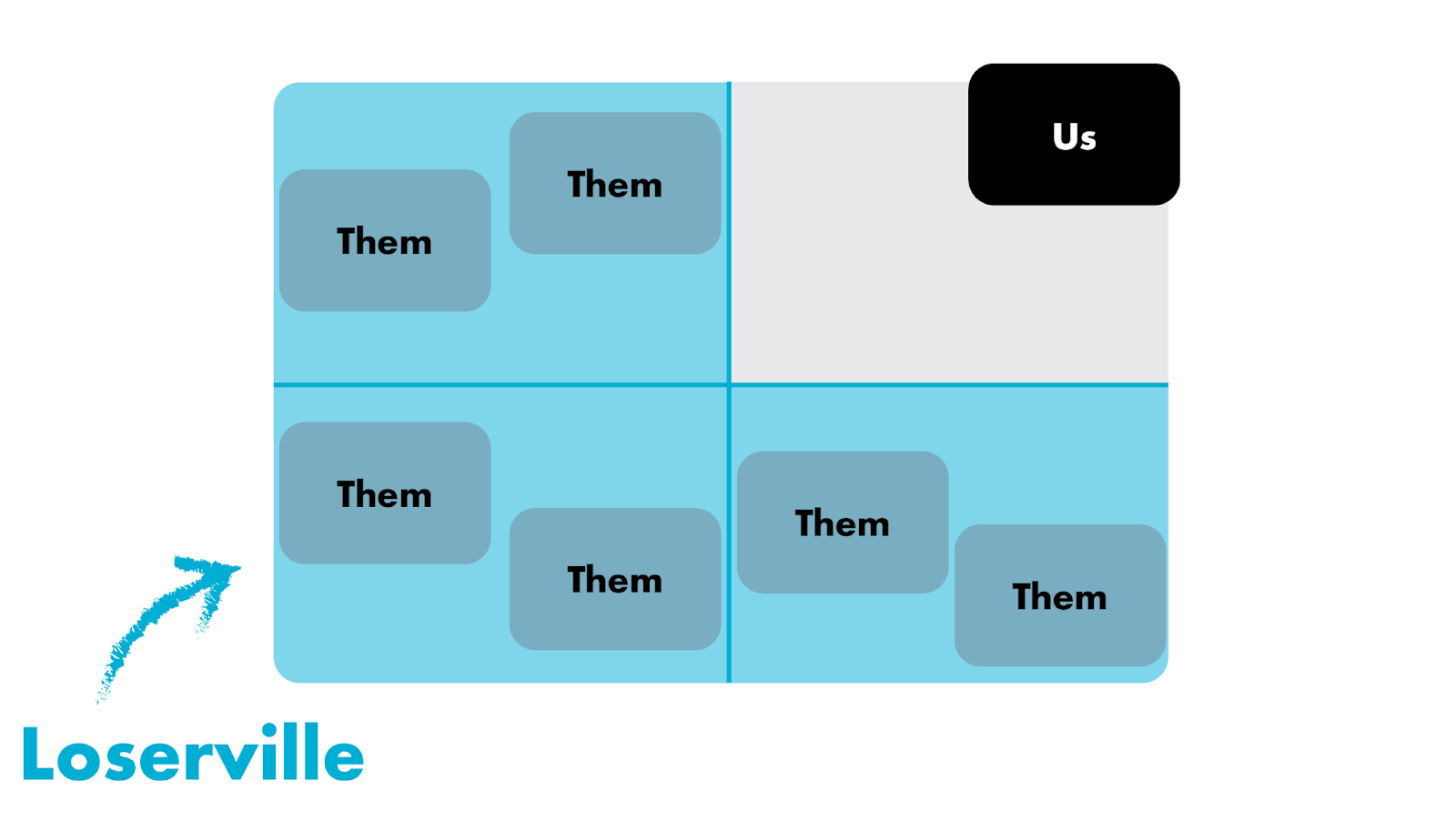
Differentiation charts are typically unhelpful slide deck filler. But a 2x2 chart focused on customer perception can be a powerful expression of your product hypothesis. Keep experimenting until you find differentiators that put you all alone in that top right quadrant and push the competition into the other three quadrants (which form an “L” shape that I like to think of as Loserville). But be honest. Differentiation only works if you can deliver what you promise.
To end the day, use the Note-and-Vote method to write two or three practical principles that will help you make decisions and deliver on your differentiation. For example, if one of your differentiators is “fast,” you might choose the principle “Fast is better than slow” to guide your future decisions.
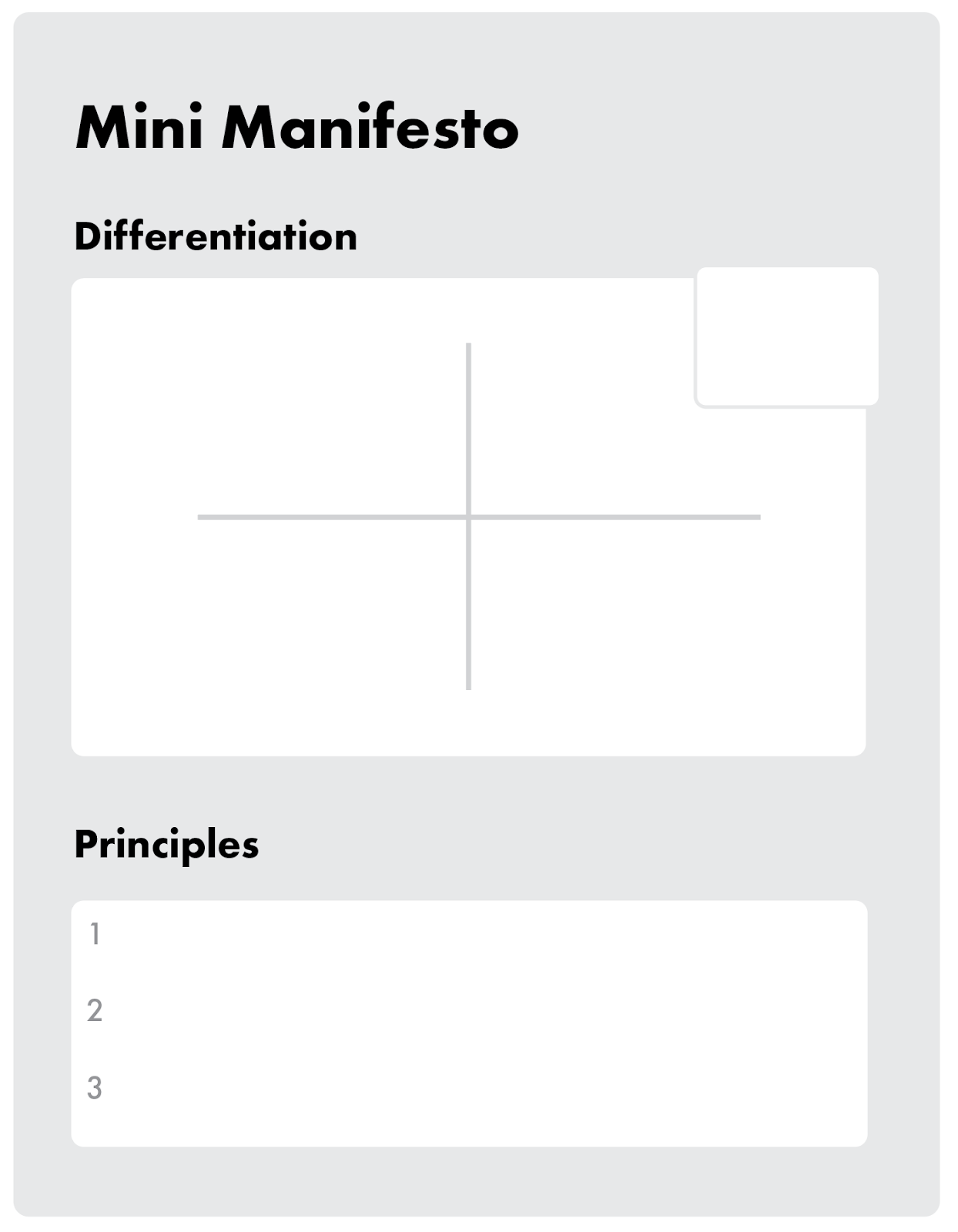
Combine your differentiation and principles on one page. Hang it on the wall—this is the Mini Manifesto for your first prototype.
On day two of the Foundation Sprint, you’ll execute what you might think of as a “pre-pivot.” Before you commit to one direction, you’ll generate alternatives and consider which is best. By the end of the day, you’ll choose an approach and be ready to experiment.
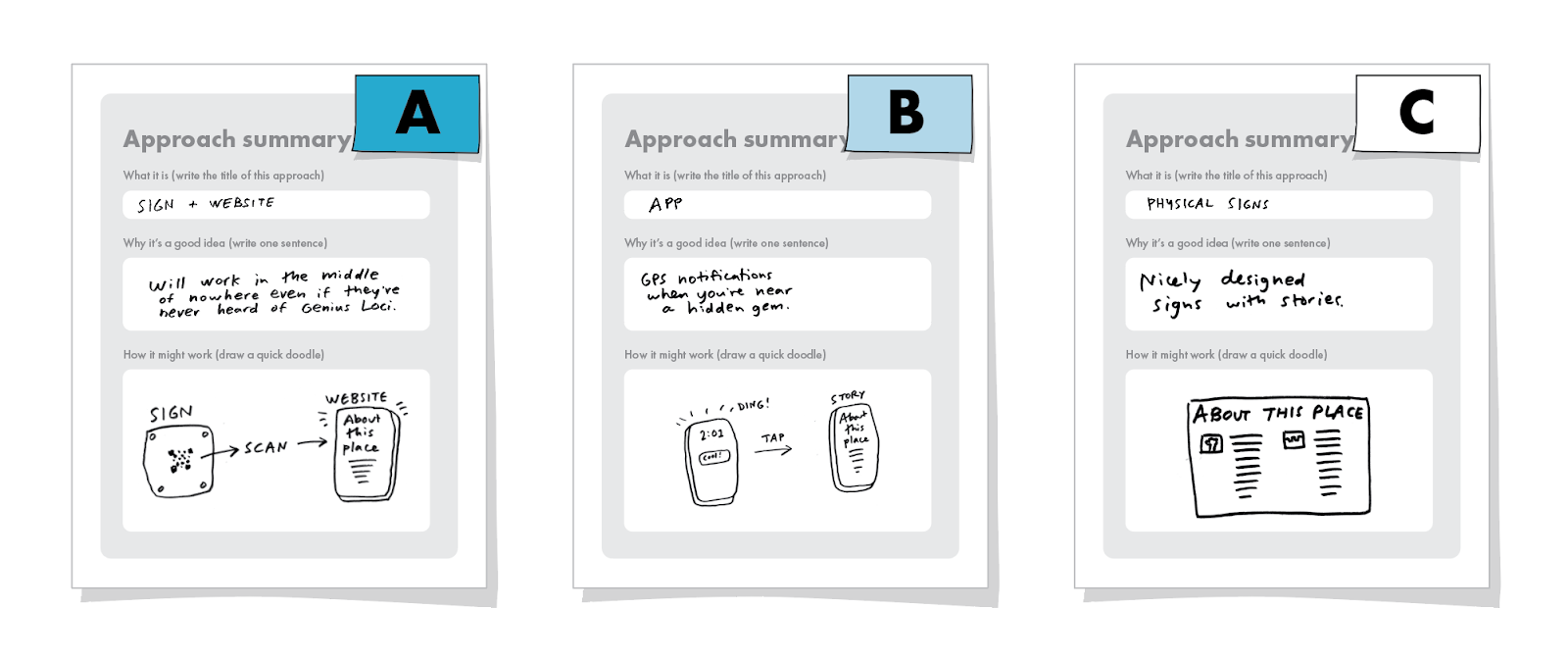
Use a Note-and-Vote to generate multiple alternative approaches to the project. These might be approaches you’ve previously considered or brand-new ideas. Write a one-page summary of each approach (what it is, why it’s a good idea in one sentence, and a doodle that shows how it might work).
The Decider chooses up to seven options. Assign each a letter or a color (or both). This will make it easier to spot patterns later.
Get a snack or lunch.
In the afternoon, you’ll choose an approach using our “Magic Lenses” technique. We developed Magic Lenses to help teams make complex decisions. Instead of trying to hold different perspectives and arguments in your head, you can use Magic Lenses to see those perspectives, then analyze, compare, and make a quick but good decision.
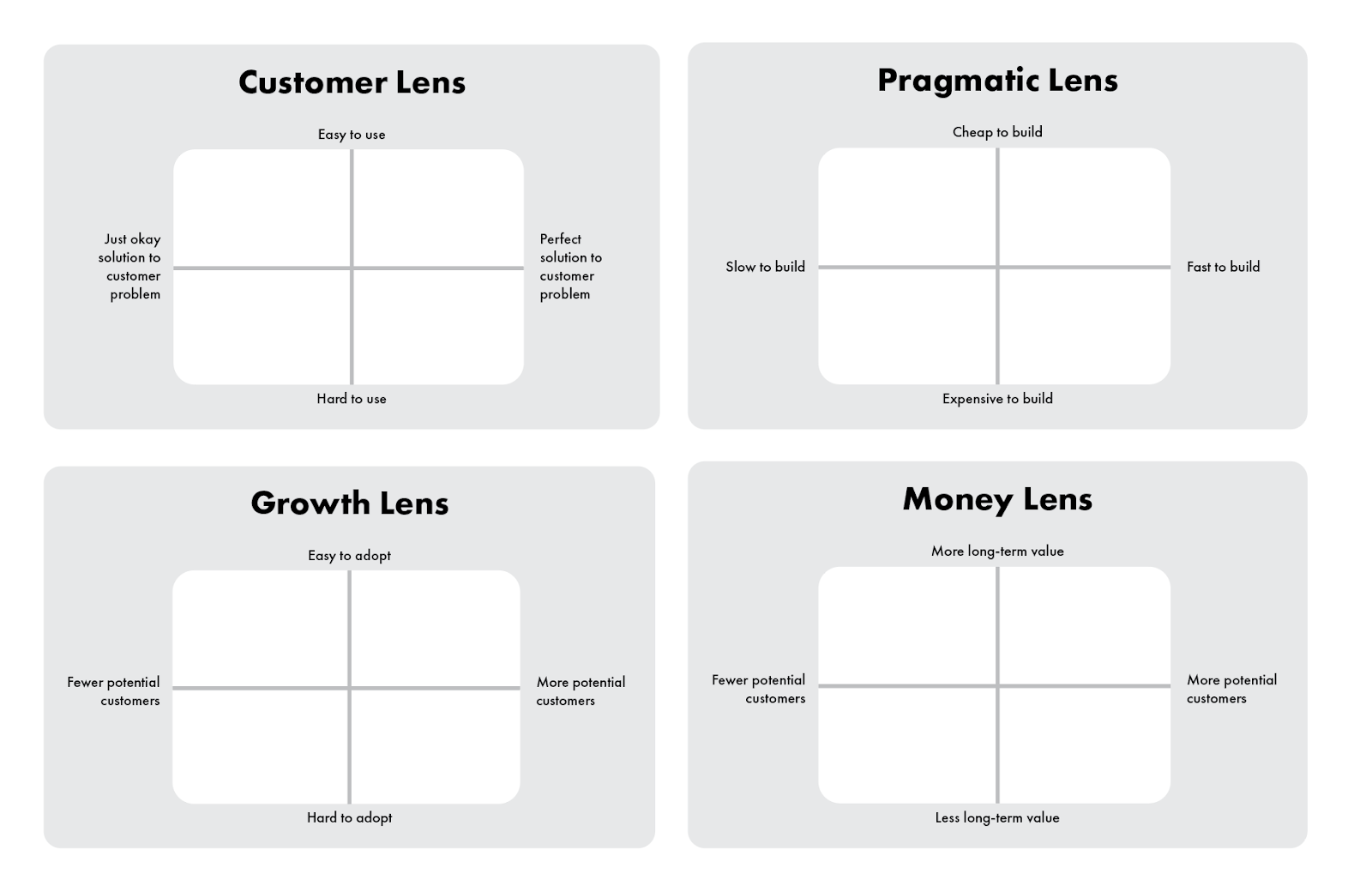
Start with four classic perspectives: customer lens, pragmatic lens, growth lens, and money lens. Make a 2x2 chart for each, like this:
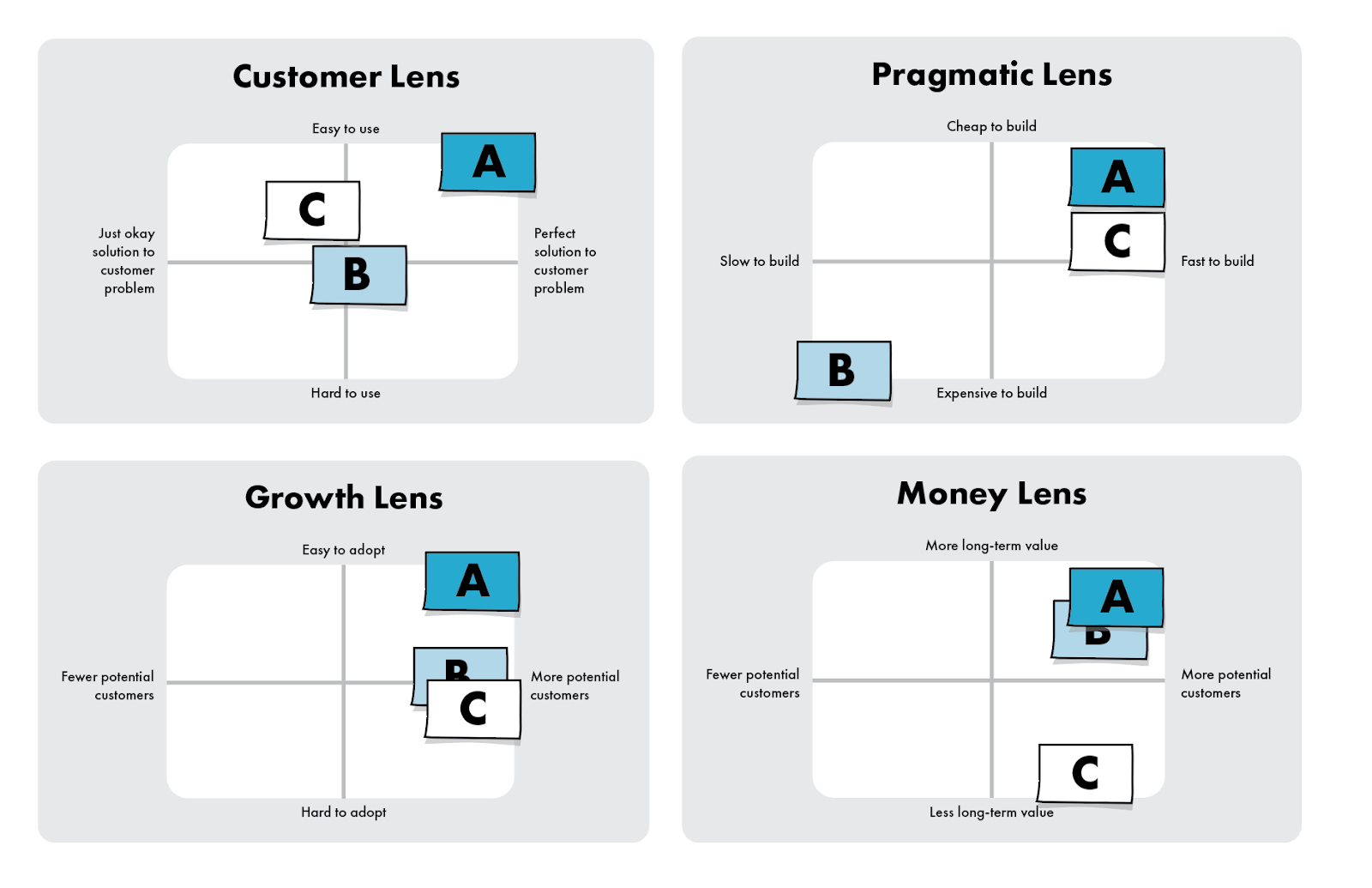
We find it easiest to plot one axis at a time, asking an expert on the team or the Decider to help with relative placement. “Where does this go? Higher or lower than this one? Sounds like more of a six than a five?” Feel free to adjust the criteria on the charts as you go—the default labels above are just a starting point.
Get a snack or lunch.
What other perspectives could help you decide which approach is best? Consider what criteria might make for a good decision. We’ve seen teams plot their options using all kinds of criteria, from no advertising required to founder excitement, customer pain, unique to us, or delivers on our mission. It can also be interesting to try plotting your options using your differentiation chart from day one. Most teams try at least one or two additional charts beyond the four classics.
Stand back or zoom out in your whiteboard software. Look for patterns. Does one approach win every time? Does one 2x2 strike you as the most useful lens? Do one or more contradict the others?
Choose one top bet (your first-choice approach for the project) and one backup plan (the next approach to consider if you need to pivot).
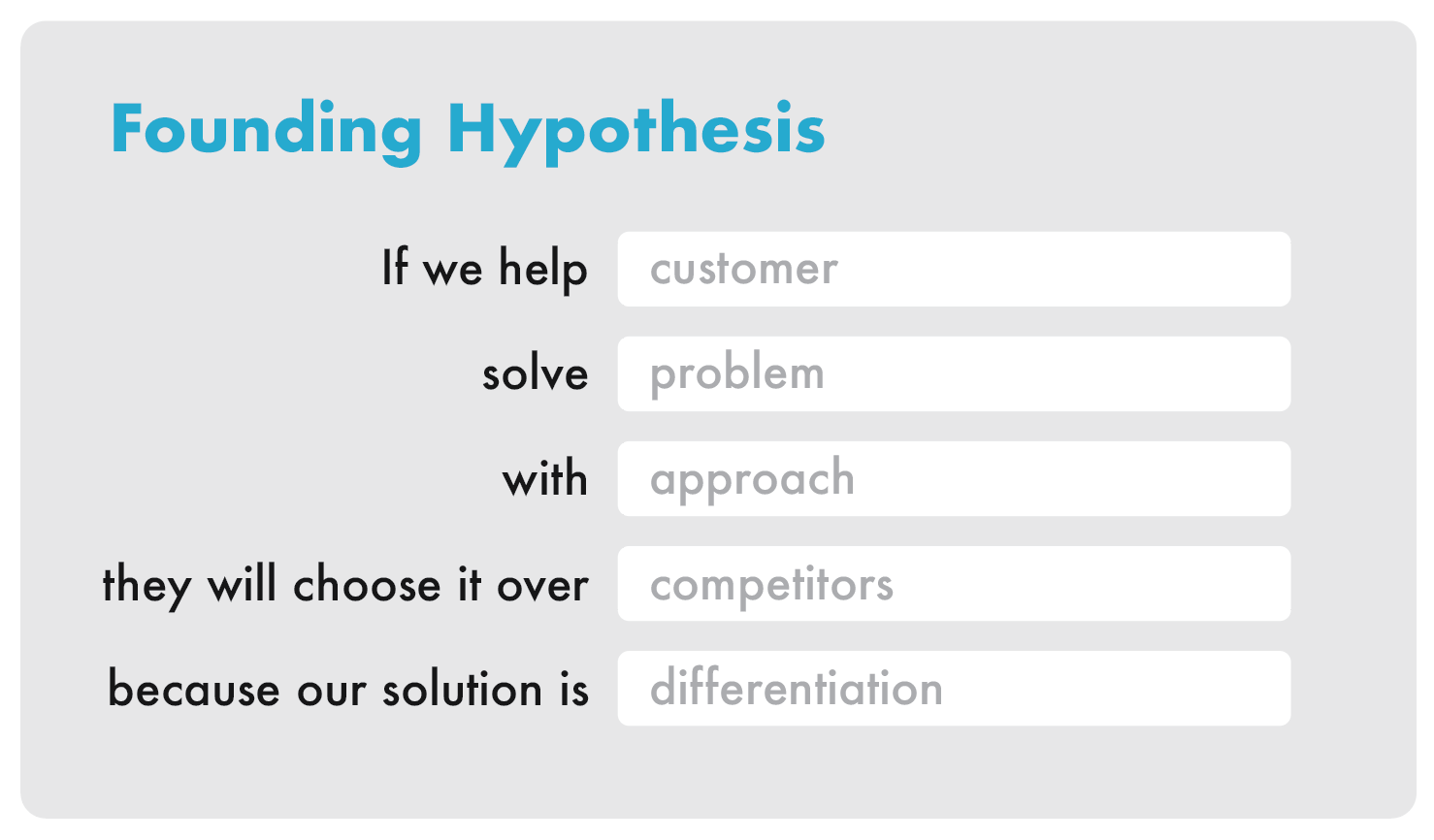
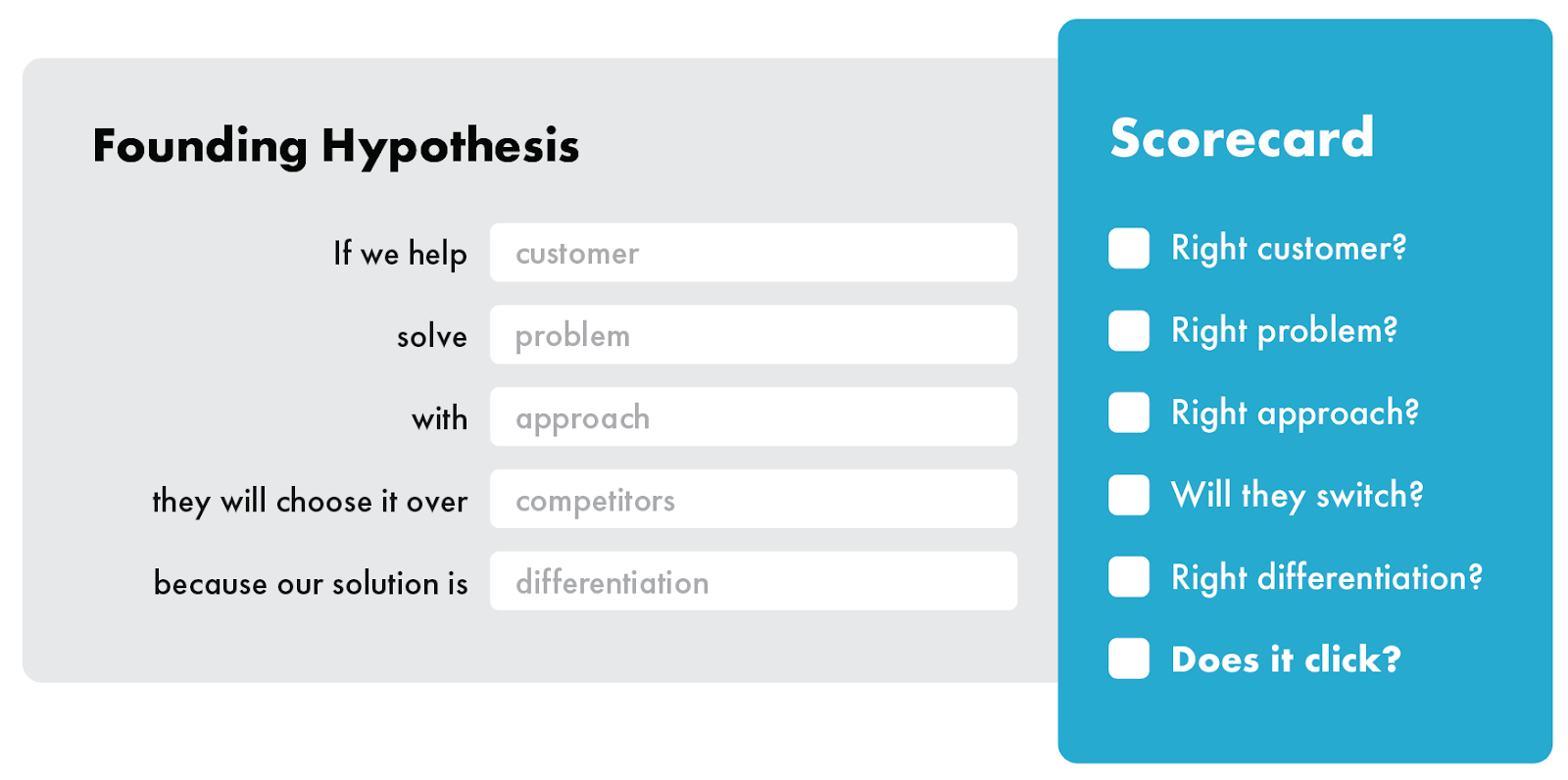
At the end of day two, you have all the elements for your Founding Hypothesis. Fill out this sentence: If we help [customer] solve [problem] with [approach], they will choose it over [competitors] because our solution is [differentiators].
A good Founding Hypothesis should pass the common-sense test. But that’s not enough. Every time I look at a Founding Hypothesis, I think, “Prove it!” Each prediction in the Founding Hypothesis lends itself to an existential, testable question about the project.
To make these questions plain, we give startup founders a scorecard that adds a question to each prediction: Do you have the right customer? Right problem? Right approach? Will people really choose your solution over the competition? Do they care about your chosen differentiators, and will they believe your solution is radically better when judged by those criteria? And of course, above all: Does it click?
At the beginning of a big project, every team’s top priority should be identifying their Founding Hypothesis and running experiments to check off those damn boxes. You shouldn’t have to waste two years — like I did — and wait until your project is about to fail to figure this out. You, and your team and your customers, deserve better.
Here’s how we do it with the startups in our portfolio: After a Foundation Sprint, we run Design Sprints to answer the questions on the scorecard and prove — or disprove — the Founding Hypothesis. Every week, founders test prototypes adjusting and repeating until the product clicks with customers.
We'd love to learn about what you're building.