

Cloud Security
End-to-End Cloud Security and Compliance Management Software
Prevent security incidents and maintain compliance across your cloud-native assets.
Chef Cloud Security - End to End Cloud Security Software
Secure Your Cloud with Chef
Streamline Audits
Streamline audits to uncover cloud security risks and misconfigurations, enabling unified multi-cloud protection.
Maintain Continuous Compliance
Close the loop between audits and remediation to keep assets compliant with CIS benchmarks.
Leverage CSPM and Cloud-Native Security
Scan systems across all environments (Dev, Pre-Prod, Prod), platforms (Cloud, Kubernetes, VMs, Containers, Windows, Linux) and clouds (AWS, Azure, Google, Alibaba).
Enterprise-Level Integrations
Integrate with ServiceNow, Splunk and Slack, support Single Sign-On (SSO) with SAML 2.0 and LDAP and deliver RESTful APIs for custom integrations and workflow automation.
Core Features
Scan, monitor and remediate configuration issues in your multi-cloud accounts, across on-prem and cloud native environments.
Infrastructure-as-Code Template Scanning
Check Terraform templates for security issues before your applications are deployed. Applying “shift left” security reduces your risk and security incidents in production.
Premium Content
The Chef platform provides extensive CIS benchmark-based audit content out of the box, easily customizable to meet organizational needs for evaluating cloud account security and maintaining compliance.
Learn more about Continuous Compliance Audit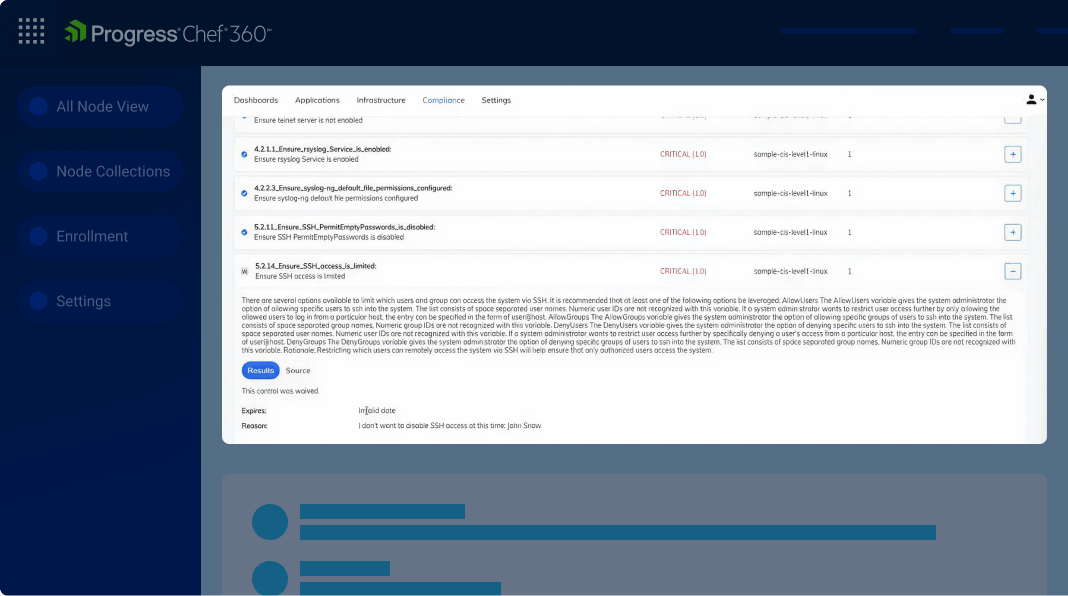
Policy as Code
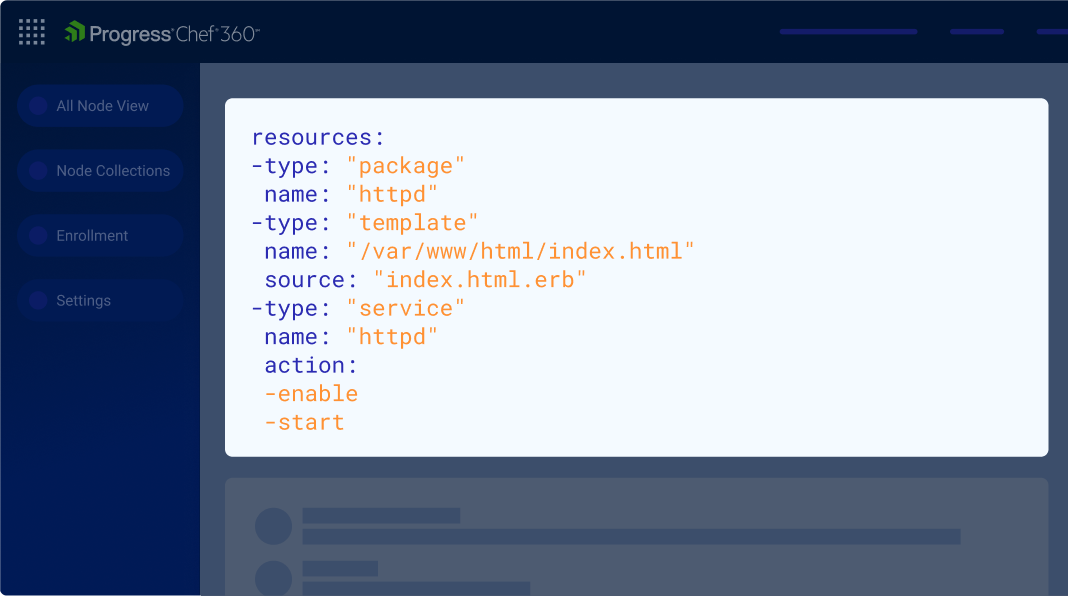
Policy as Code enables DevSecOps automation by using a common pipeline and framework to implement configuration changes while simultaneously maintaining compliance.
Learn more about Policy as Code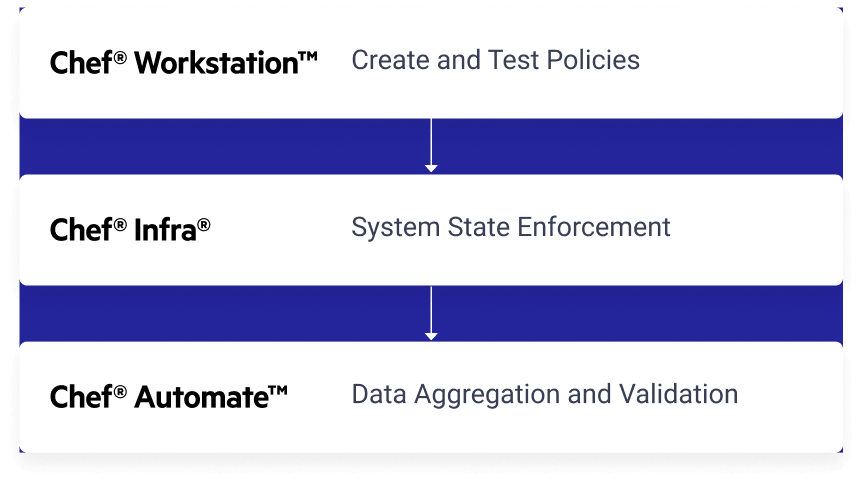
Jump Start Compliance Automation Efforts with Chef Premium Content
Access Chef-curated, trusted content for audit that is directly aligned to CIS (Center for Internet Security) benchmarks or DISA Security Technical Implementation Guides.
Chef Premium Content offers cloud target scanning that allows users to easily scan an extensive set of cloud resources across all major public cloud providers and container and Kubernetes deployments.
| Environment | Audit |
|---|---|
| CIS Amazon Web Services Foundation Benchmark - Level 1 & 2 | |
| CIS Azure Foundations Benchmark - Level 1 & 2 | |
| CIS Docker Community Edition Benchmark - Level 1 & 2 | |
| CIS Kubernetes Benchmark 1.6.1 - Level 1 & 2 | |
| CIS Google Kubernetes Engine | |
| CIS Redhat OpenShift Container Platform |
Latest from Chef


Chef Cloud Security Use Cases
Secure Hybrid Cloud Management
Manage both cloud and on-prem environments (Cloud Instances, VMs, Multi-Tier Apps, Jenkins, Azure DevOps, GitHub) using the same tools and processes
Multi-Cloud Audits
Continuously audit cloud accounts and services for security risks and misconfigurations. Achieve consistent security across AWS, Azure, Google and Alibaba Cloud
Cloud-Native CI/CD Pipeline Governance
End-to-end Cloud Native environment configuration and security validation (AWS, Azure, Google), scan live running containers, and Validate K8 settings
Compliance Audits
Automate CIS benchmark tests for Cloud Fundamentals, Kubernetes and Docker
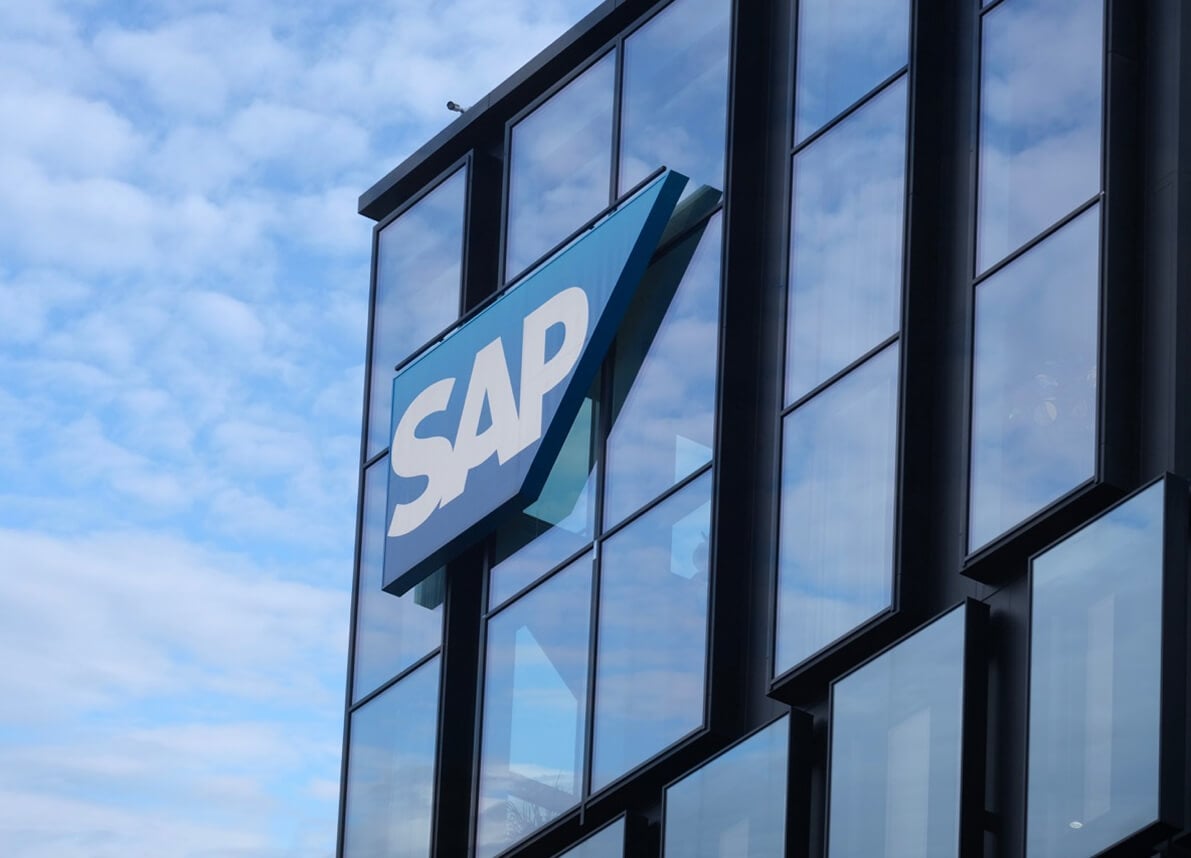

Taking Control with CSPM and Chef InSpec for the Public Cloud
Chef provides SAP with a highly flexible tool to manage the compliance of their cloud accounts. It allows teams using public cloud to “shift-left” and adopt DevSecOps practices for public cloud infrastructure, as well as verify the status of their cloud accounts whenever they want. SAP runs a fully private Chef InSpec Kubernetes cluster of three nodes that scanned the entire landscape (around 8 million cloud resources) in three hours while taking over 900 exceptions (or waivers).
Top 3 Benefits of Implementing Cloud Security with Chef
Overcome Technical Skill Gaps
Chef provides out-of-the-box resources, built-in validation tools, CIS/DIS STIG compliance profiles, a visual UI for management, automated waivers to expedite approvals, free learning to bridge skill gaps and direct assistance from the support team.
Optimize ROI with Adoption
Chef delivers a unified, extensible platform for hybrid and multi-cloud environments, enabling consistent operations. It offers rich APIs and BI/AI integrations to automate insights and codified workflows, aligning KPIs and maximizing ROI across teams.
Limit Risk and Increase Speed
Chef hardens systems to reduce risk, feeding automated pipelines with codified artifacts and tests that maintain effective fixes. Shift-left checks at every pipeline stage provide users with visibility and control over system changes.
Recommended Content

FAQs
Cloud security management involves applying strategies and deploying security tools to help keep cloud applications, services, data and development projects safe from threats and vpnerabilities. On the strategy side, cloud security management involves policies, best practices and governance. Cloud security tools help safeguard everything from end-user application data to internal IT infrastructure interacting with the cloud.
There are myriad cloud security categories. Here are the types of protection:
- Access Management: Controls who can get to data and services.
- Encryption: Blocks hackers from using data they find.
- Privilege Management: Defines what users can or can’t access.
- Authentication: Makes users prove who they are.
- Disaster Recovery: Restores data that was compromised.
- Compliance: Adherence to regulations and legal and contractual obligations.
- Cloud Security Posture Management (CSPM): Manage security posture by discovering, blocking and responding to risk in cloud infrastructure.
- Data Loss Prevention (DLP): Stopping data theft and leakage from outsiders and insiders.
- Privacy: Keeping personal data away from those with no right to access it.
- Cloud Visibility: Provides insight into cloud infrastructure.
- Workload Security: Protects workloads including virtual and container-based workloads.
- Vulnerability Management: Discover and close vulnerabilities.
IT needs to understand what they are responsible for, versus what the cloud provider is responsible for. Under the Shared Responsibility Model, cloud providers protect their offerings, including:
- Physical Security
- Host Infrastructure
- Network Controls
For PaaS and SaaS solutions, providers also help protect:
- Application-Level Controls
- Identity and Access Management
- Client and Endpoint Protection
These three are shared responsibilities between providers and IT.
Top cloud security issues include:
- Misconfiguration
- Lack of visibility across all aspects of cloud infrastructure
- Data breaches
- Shortcomings in access control or unauthorized access
- Unsecured APIs and services
- Failures in security and compliance auditing
Here are five of the top areas:
Cloud Security Posture Management (CSPM): This requires security and compliance management products to help IT create and maintain a secure cloud infrastructure environment free from vulnerabilities and misconfigurations.
Incident detection, response and remediation: Incident detection and response applications can help secure your cloud environment, discovering threats and providing root cause analysis.
Additionally, hosting incident detection, response and remediation in the cloud can help provide greater security for on-premises and cloud-based assets. IT stakeholders, such as admins and security professionals, all have the same view of what is happening across the monitored cloud environment.
Cloud-based backup and recovery: On-premises storage hardware, software and networking components are immensely complex and have difficulty scaling to securely keep up with data storage needs that multiply over the years. Cloud backup, recovery, disaster recovery and business continuity store and protect data without IT having to manage and grow disk arrays, storage area networks and update the software that keeps it all.
Cloud backups for on-premises data systems help protect data from threats such as ransomware attacks.
Cloud security audits: Companies that face compliance challenges or that just want a clear record of security, rely on solutions such as Progress Chef to audit cloud accounts and discover and track security risks, such as misconfigurations.
Continuous compliance: Compliance is best done as a regular process. Even better as a continuous one. Continuous compliance closes the loop between audit and remediation, letting IT know their infrastructure assets are constantly in compliance with security frameworks such as CIS benchmarks.
There are countless cloud threats and new ones appear with alarming regularity. Not all threats are from the outside; some are organizational.
Not enough cloud security expertise: The rate of cloud changes creates new attack surfaces, making it tough for even the best pros to keep up.
Poor cloud visibility: The cloud, and now the move to having hybrid clouds and multi-cloud, presents a huge visibility challenge.
Account takeover attacks: Access and identity attacks, which often lead to escalation of privilege attacks, are one of the biggest cloud security risks.
Other issues include:
- Insecure coding
- Excess permissions
- Poor or poorly configured communication protocols
Here are a few more areas of cloud vulnerability:
- Misconfiguration
- Compliance risks and violations of compliance policies
- Employees not following compliance regulations
- Poor alerting and notification of security and compliance issues
- Denial-of-Service (DoS) attacks
- Data loss and leakage from hacks
- Vulnerable access control points
Here are 12 benefits of cloud security management:
- Maintained compliance
- Improved information privacy
- Tighter access control
- Increase cloud visibility
- Threat mitigation
- Advanced threat detection
- DDoS protection
- Data encryption
- Data recovery
- Fewer misconfigurations
- Better cloud availability
- Improved Access Management
Progress Chef® Cloud Security™ makes it possible for you to scan, monitor and remediate configuration issues in your multi-cloud accounts, across on-premises and cloud-native environments. It is easier than ever to maintain and enforce compliance with standards-based audit. You can tune baselines to adapt to the organization’s requirements, maintain visibility and control across hybrid environments.
Chef Cloud Security can:
- Runs regular audit scans across all cloud infrastructure including containers
- Supports key security benchmarks and controls such as SOC2 and PCI DSS
- Helps with creating and implementing compliance policies
- Discovers issues and guides remediation
- Discovers misconfigurations
- Measures security and compliance postures
- Enforces compliance for cloud assets
- Tracks metric and KPIs via trend and historical views

Start Your Journey Today
Try Chef Cloud Security free for 30 days or connect with our team to see how we support your frameworks, workflows, and scale requirements.