
How CloudZero’s OpenAI Integration Provides Unprecedented AI Unit Economic Insights
AI spending continues to accelerate. In 2025, experts projected that companies will collectively spend about $644 billion on generative AI alone — a whopping 76.4% increase from 2024. This puts it a mere $79 billion behind the public cloud as a whole, signaling the most seismic interval of new infrastructure investment since the dawn of the public cloud.
But about half of the companies investing in generative AI aren’t sure it’s producing real ROI. In CloudZero’s recently published State Of AI Costs In 2025, we found that 49% of companies aren’t confident in their ability to calculate AI ROI, and that the largest single area for future AI investment is AI explainability. AI spending may still be in its early, experimental phase, but in the long run, the companies with the strongest AI unit economics will be the ones who prevail.
What that means: Companies need to understand how much they’re spending on which dimensions of AI — and how much they’re getting in return.
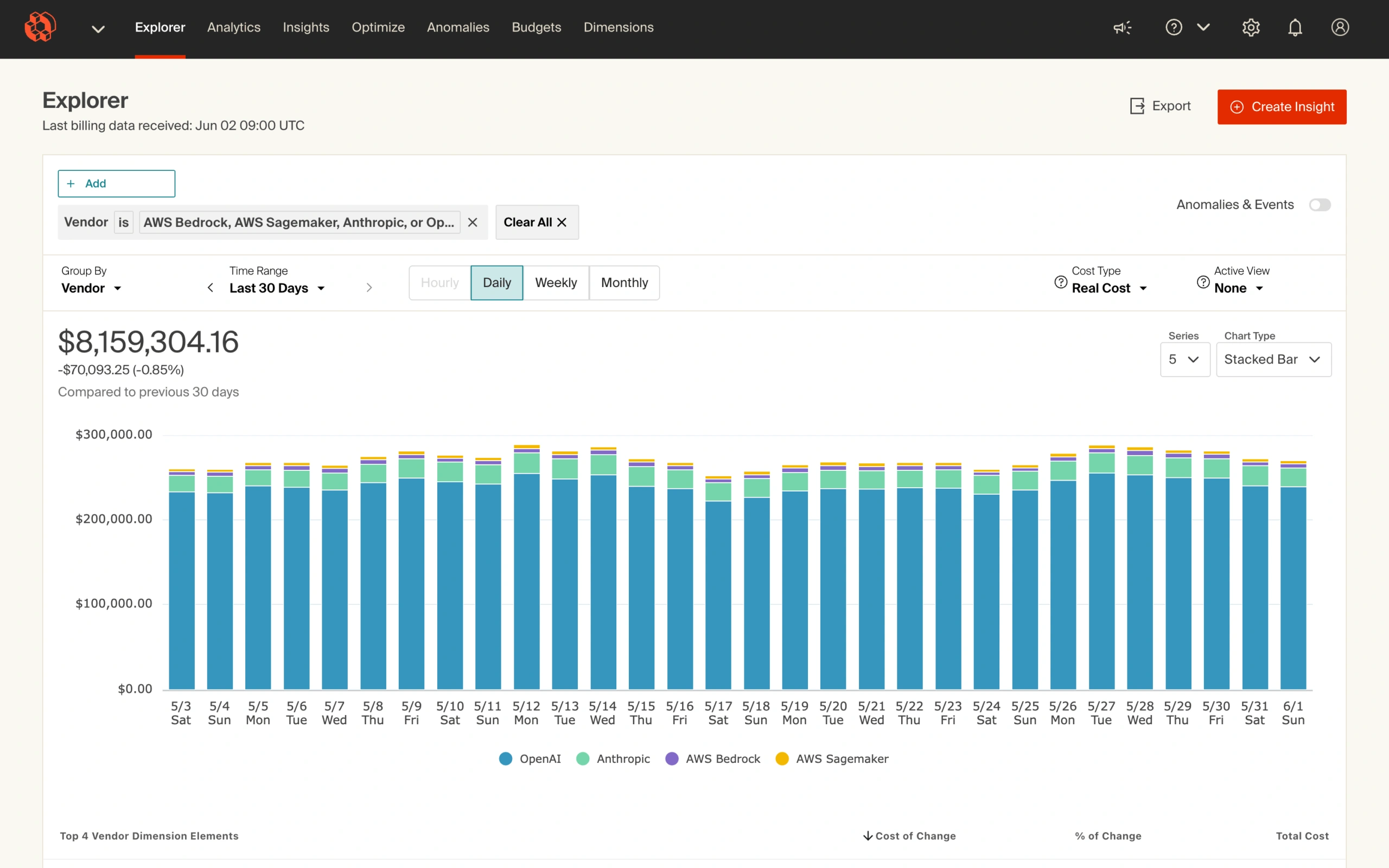
That’s why CloudZero is hard at work on custom-built adapters that ingest and allocate AI costs. At the beginning of the year, CloudZero announced an OpenAI integration that leverages OpenAI’s APIs to feed OpenAI cost data into CloudZero. Now, OpenAI customers can see and analyze their OpenAI costs alongside all their other public cloud and SaaS costs.
Delivering AI Unit Economics
👁 Image
One of CloudZero’s fundamental differentiators is our ability to give the world’s most sophisticated cloud spenders a clear image of their cloud unit economics — how much each workout costs a digital exercise platform; how much each order costs a food delivery app; how much each shipment costs a shipping logistics company; etc. Combining unit economics with precisely allocated, maximally granular data, companies can understand the precise efficiency (or inefficiency) of every dimension of their business.
Now, this includes OpenAI. In addition to ingesting cost data from OpenAI, CloudZero can also ingest usage data, giving customers unprecedented clarity into their AI cost management strategy and generative AI unit economics. This includes precious metrics like:
- Cost per user
- Cost per model
- Cost per token
This also includes layered metrics like cost per user per model per token type. This is the most granular generative AI cost optimization analysis offered by anyone, anywhere.
playbook
The AI Cost Optimization Playbook
Traditional cloud cost management is broken. Here’s why — and how to make the switch to cloud cost intelligence.
How Customers Are Seeing Value
Numerous CloudZero customers have already deployed the OpenAI integration. These include a financial services company valued at $85B, a smart building technology company valued at $26 billion, and a writing software tool valued at $13B.
One existing customer, a digital media company with more than $35M of annual cloud spend, deployed the OpenAI adapter in a matter of minutes. Within 48 hours, CloudZero Explorer displayed 12 months’ worth of historical OpenAI cost data. All this customer had to do to enable a successful deployment was to share their API key with their CloudZero FinOps Account Manager (FAM). After that quick and easy setup process, this enterprise now has full visibility into all of their OpenAI spend, including weekly and monthly views of spend per AI initiative.
Another customer, an AI-powered search tool, was also able to deploy the OpenAI integration within minutes. Previously, they had little to no visibility into their OpenAI spend, which accounts for 25% of their total cloud spend. Blind spots like that can make it very difficult to understand usage patterns, track AI spend, manage costs, or gauge the financial health of a business. With the integration now live, this customer can view and analyze that spend in granular detail, right alongside the rest of their cloud costs. They now have precise cost allocations broken down by token type and can track monthly cost trends across each GenAI provider in their environment, allowing them to monitor usage patterns, optimize spend, and make informed decisions with confidence.
Lay A Foundation For Long-Term AI Efficiency
The State Of AI Costs In 2026 also revealed that more than 90% of companies tracking AI costs in third-party platforms reported high confidence in calculating AI ROI. If the economically rocky post-pandemic years taught the tech world anything, it’s that sound unit economics will always decide who, in the end, wins the day.
Optimizing AI costs may not be at the top of your organizations’ priority lists right now, but proactively laying a foundation for sound AI unit economics can only benefit the space’s most forward-thinking innovators.
Curious to see the OpenAI integration in action? Schedule a demo today.

Author Spotlight
ROI in the AI Era: A Critical Recalibration
Suggested Articles
See more






see cloudzero in action