

Biomedical Visualization
Ends soon! Keep adding new skills with 10,000+ programs for $239 (usually $399). Save now.



535 reviews
Recommended experience
535 reviews
Recommended experience
What you'll learn
Create accurate, ethical biomedical visuals using modern digital tools and evidence‑based design.
Use advanced 3D modelling and imaging skills (with Blender) to build clear, anatomically accurate visuals for education and practice.
Evaluate and apply accessibility, inclusivity, and communication principles to design biomedical media for diverse users.
Develop a professional portfolio showing technical skill, reflective practice, and adherence to biomedical visualisation standards.
Skills you'll gain
- 3D Modeling
- Augmented Reality
- Computer Graphic Techniques
- Animations
- Disabilities
- Medical Imaging
- Anatomy
- Scientific Visualization
- Technical Communication
- Data Visualization
- 3D Assets
- Software Visualization
- Visual Design
- Biomedical Technology
- Virtual Environment
- Web Content Accessibility Guidelines
- Virtual Reality
- Augmented and Virtual Reality (AR/VR)
- Medical Terminology
- Simulations
Details to know

12 assignments
See how employees at top companies are mastering in-demand skills

There are 4 modules in this course
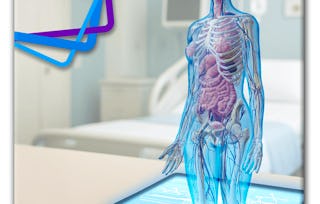
Visualization is a rapidly progressive specialty in academia, research and industry, and becoming the future of science. With the advancement of digital technologies and their applications, biomedical visualization is an evolving and popular field. With new techniques and technologies to image, process and analyze data related to the human body, and its biological processes, it is at the forefront of the digital revolution. Why not view our course trailer video.
By the end of this course, you will be able to: 1. Create accurate, ethical biomedical visuals using modern digital tools and evidence based design. 2. Use advanced 3D modeling and imaging skills to build clear, anatomically accurate visuals for education and practice. 3. Evaluate and apply accessibility, inclusivity, and communication principles to design biomedical media for diverse users. 4. Develop a professional portfolio showing technical skill, reflective practice, and adherence to biomedical visualization standards. This course is the first of its kind on Coursera. It explores the structure and function of the human body including terminology used. It showcases visualization techniques available using technology to image and display data related to the body and biological processes. It also provides training in the creation of animations, and examines the applicability of different types of reality. You will learn from experts in these fields and with the knowledge you will gain from this course, be able to evaluate and apply how best to use visualization in your own discipline. No prior experience is necessary but should be able to learn at an intermediate level.
Module 1 will cover introductory material of visualization and its applications, as well as exploring the basis of human anatomy. You will learn about a historical journey of "visualization" to the present day advances and uses with biomedical science. Exploring the human body, you will learn its structure and function; the body systems and their roles; as well as learning frequently used terminology within anatomy. Examples of visualization techniques will be covered, and as a learner you will be able to name examples as and evaluate their advantages and disadvantages.
What's included
5 videos10 readings3 assignments
5 videos•Total 19 minutes
- Introduction to Biomedical Visualization and Human Anatomy•0 minutes
- Organisational Levels of the Human Body•5 minutes
- Anatomical Planes, Positions and Directional Terms•6 minutes
- Types of Muscle Movements in Human Anatomy•5 minutes
- Musculoskeletal Visualisation Applications in Sport Science with Prof. Niall MacFarlane•3 minutes
10 readings•Total 180 minutes
- Meet the Course Educators•20 minutes
- Reflect and Discuss: Visualization in Practice•15 minutes
- What Do We Mean by Visualization?•20 minutes
- Terminology Tables•20 minutes
- Body Systems•20 minutes
- The Musculoskeletal System•20 minutes
- Reflect and Discuss: Musculoskeletal Case Studies•15 minutes
- Introduction to Applications in Biomedical Visualization•15 minutes
- Gross Visualization•15 minutes
- Microscopic Visualization•20 minutes
3 assignments•Total 60 minutes
- Structure and Terminology Formative Assessment •15 minutes
- The Body Systems Formative Assessment •15 minutes
- End of Week 1 Graded Assessment•30 minutes
Module 2 will give you an introductory lesson into 3D modeling software "Blender" and modeling terminology. By completion you will be able to create your own organic 3D models and animations using Blender. You will be briefly introduced to modeling and its vast variety of uses within Biomedical Science. The theory and process of segmentation from patient imaging data will be explored as another option to obtain realistic 3D models.
What's included
13 videos6 readings3 assignments1 discussion prompt
13 videos•Total 67 minutes
- Introduction to 3D Modeling and Animation in Biomedical Science•1 minute
- Blender Interface and Navigation for Biomedical Modeling•8 minutes
- 3D Organic Modeling Techniques in Blender•8 minutes
- Adding Reference Images in Blender for 3D Anatomical Modeling•5 minutes
- Creating Anatomical Models in Blender: Modeling the Body of the Femur•5 minutes
- Creating Anatomical Models in Blender: Modeling Head and Neck of the Femur•6 minutes
- Creating Anatomical Models in Blender: Modeling Distal End of the Femur•6 minutes
- Using Blender Modifiers for Biomedical 3D Models•5 minutes
- UV Mapping and Adding Textures in Blender for 3D Anatomy Modeling•6 minutes
- Adding Detail to 3D Anatomy Models Using Texture Painting in Blender•3 minutes
- Adding Lighting in Blender for 3D Anatomy Models•5 minutes
- Creating Basic Animations in Blender Using Rigid Bodies•3 minutes
- Animating Cameras and Render Animations in Blender•5 minutes
6 readings•Total 90 minutes
- Introduction to 3D Models and Animation•20 minutes
- Applications of 3D Models and Animations in Biomedical Science•20 minutes
- Segmentation of Medical Imaging•10 minutes
- Blender Keyboard Shortcuts and Terminology •10 minutes
- Other Resources to Find or Create Models and Textures•20 minutes
- Exercise: Share Your Femur Model•10 minutes
3 assignments•Total 60 minutes
- 3D Models and Animations Formative Assessment •15 minutes
- Formative Assessment: Modeling Terminology•15 minutes
- End of Week Summative Assessment•30 minutes
1 discussion prompt•Total 15 minutes
- Discussion of Modeling Workflows in Blender•15 minutes
Module 3 will introduce virtual (VR) and augmented reality (AR). The history and background of virtual reality will be explored, and how augmented reality rose in popularity within this field as well. This week will allow you as a learner to hear interviews with VR and AR experts. They will discuss their research, theory and some of the applications of this technology in biomedical science. The wide variety of applications will be taught, and why it has become such a popular tool in research, teaching and in other areas.
What's included
5 videos9 readings3 assignments1 plugin
5 videos•Total 19 minutes
- Introduction to Virtual Reality and Augmented Reality in Biomedical Science•1 minute
- Virtual Reality in Immersive Education: Project Mobius with Dr Neil McDonnell•4 minutes
- Transforming Confocal Microscopy Data into Virtual Reality with Dr Craig Daly•8 minutes
- The Future of Augmented Reality in Healthcare with Dr Neil McDonnell•3 minutes
- Immersive Learning Technologies: Virtual and Augmented Reality in Education with Dr Matthieu Poyade•4 minutes
9 readings•Total 106 minutes
- Definitions: The Realities and Background•15 minutes
- Applications of Virtual Reality•10 minutes
- Next: Key Note Lecture by Professor Paul Chapman - Introduction•1 minute
- Not all Medical: Other Unconventional Applications•10 minutes
- Applications of VR and AR•15 minutes
- Reflect and Discuss: The Future of Digital Realities•20 minutes
- The Downside of VR•10 minutes
- The Rise of Augmented Reality•15 minutes
- The Power of Immersion•10 minutes
3 assignments•Total 60 minutes
- Formative Assessment: VR Terms and Background •15 minutes
- Formative Assessment: Applications of Virtual Reality •15 minutes
- Summative Assessment •30 minutes
1 plugin•Total 60 minutes
- Keynote Lecture by Professor Paul Chapman•60 minutes
Module 4 is the concluding module for Biomedical Visualization. New theory that will be introduced are Mixed and 'Extended reality' as a whole, and what could potentially come of the realities in the future. This week is for the learner to reflect on what they have learned throughout this course. When to best use visualization techniques; their advantages and disadvantages; and how you could use what you have learned throughout the course for future projects in your area of interest.
What's included
13 videos11 readings3 assignments1 discussion prompt
13 videos•Total 47 minutes
- Introduction to Mixed Reality and Extended Reality in Healthcare•0 minutes
- HoloBrain in WebVR for Neuroanatomy Education with Dr Claudia Krebs•4 minutes
- From Medicine to Education: Dr Paul Rea's Journey into Anatomy and Digital Learning•6 minutes
- Digitising the Human Body: Using AR and VR in Anatomical Education•4 minutes
- The Effectiveness of AR and VR in Education: Evidence, Research and Reality•5 minutes
- The Promise and Limits of AR and VR in Anatomy Education•4 minutes
- Teaching Anatomical Variation with AR and VR•4 minutes
- Collaborative and Applied Uses of AR and VR in Medical and Life Sciences Education•3 minutes
- Student Experiences with AR and VR in Anatomy Education•5 minutes
- The Future of AR and VR in Anatomy and Medical Education•5 minutes
- Creating 3D and AR Models of Pelvic Anatomy with Dr Claudia Krebs•2 minutes
- Further Study - MSc in Medical Visualisation and Human Anatomy•2 minutes
- Course Completion: Next Steps in Biomedical Visualisation•2 minutes
11 readings•Total 185 minutes
- Mixed Reality: Where It Fits•10 minutes
- Mixed Reality in Minimally Invasive Surgery•20 minutes
- Augmented Reality in Hip‑Related Surgery•20 minutes
- Extended Reality•15 minutes
- Use of Extended Realities in Cardiology•20 minutes
- Advances in Realities with Professor Paul M. Rea•10 minutes
- Challenges of Immersive Technologies•20 minutes
- Where are we now and the future•20 minutes
- Beyond the Field of Science•20 minutes
- The Ethical Dilemma Using Technology in Healthcare•20 minutes
- A Special Thanks To...•10 minutes
3 assignments•Total 60 minutes
- Formative Quiz •15 minutes
- Formative Assessment: Various Realities •15 minutes
- End of Week 4 Assessment •30 minutes
1 discussion prompt•Total 20 minutes
- Reflective Exercise•20 minutes
Instructors
Offered by

Explore more from Health Informatics
- Status: Free Trial
Specialization
- Status: PreviewN
Northeastern University
Course
- Status: PreviewU
University of Illinois Urbana-Champaign
Course
- Status: Free Trial
Course


Why people choose Coursera for their career


Learner reviews
- 5 stars
69.34%
- 4 stars
24.11%
- 3 stars
4.29%
- 2 stars
1.49%
- 1 star
0.74%
Showing 3 of 535
Reviewed on Jun 1, 2026
The content is solid and insightful, giving me a broader perspective on immersive technologies. Turning 2D datasets into 3D models feels genuinely amazing in every way.
Reviewed on May 28, 2020
It is very useful for me . It helps me to understand the Future technology thank you University of Glasgow . Thank u so much.i am happy for your work of teaching
Reviewed on Jul 25, 2022
I absolutely loved the course. The contents were prepared to help us understand easier and opened many vistas of imagination about my biomedical field.




Frequently asked questions
To access the course materials, assignments and to earn a Certificate, you will need to purchase the Certificate experience when you enroll in a course. You can try a Free Trial instead, or apply for Financial Aid. The course may offer 'Full Course, No Certificate' instead. This option lets you see all course materials, submit required assessments, and get a final grade. This also means that you will not be able to purchase a Certificate experience.
When you purchase a Certificate you get access to all course materials, including graded assignments. Upon completing the course, your electronic Certificate will be added to your Accomplishments page - from there, you can print your Certificate or add it to your LinkedIn profile.
Yes. In select learning programs, you can apply for financial aid or a scholarship if you can’t afford the enrollment fee. If fin aid or scholarship is available for your learning program selection, you’ll find a link to apply on the description page.
More questions
Financial aid available,