

Build Decision Trees, SVMs, and Artificial Neural Networks
Keep adding new skills with 10,000+ programs for $239 (usually $399). Save now.

Build Decision Trees, SVMs, and Artificial Neural Networks
This course is part of CertNexus Certified Artificial Intelligence Practitioner Professional Certificate

Instructor: Stacey McBrine
4,864 already enrolled
Included with
Ask Coursera
14 reviews
Recommended experience
14 reviews
Recommended experience
What you'll learn
Train and evaluate decision trees and random forests for regression and classification.
Train and evaluate support-vector machines (SVM) for regression and classification.
Train and evaluate multi-layer perceptron (ML) artificial neural networks (ANN) for regression and classification.
Train and evaluate convolutional neural networks (CNN) and recurrent neural networks (RNN) for computer vision and natural language processing tasks.
Skills you'll gain
- Supervised Learning
- Artificial Intelligence and Machine Learning (AI/ML)
- Machine Learning Algorithms
- Predictive Modeling
- Natural Language Processing
- Classification And Regression Tree (CART)
- Decision Tree Learning
- Model Training
- Computer Vision
- Applied Machine Learning
- Convolutional Neural Networks
- Deep Learning
- Artificial Neural Networks
- Recurrent Neural Networks (RNNs)
- Random Forest Algorithm
Tools you'll learn
Details to know

See how employees at top companies are mastering in-demand skills

Build your Machine Learning expertise
- Learn new concepts from industry experts
- Gain a foundational understanding of a subject or tool
- Develop job-relevant skills with hands-on projects
- Earn a shareable career certificate from CertNexus

There are 5 modules in this course
There are numerous types of machine learning algorithms, each of which has certain characteristics that might make it more or less suitable for solving a particular problem. Decision trees and support-vector machines (SVMs) are two examples of algorithms that can both solve regression and classification problems, but which have different applications. Likewise, a more advanced approach to machine learning, called deep learning, uses artificial neural networks (ANNs) to solve these types of problems and more. Adding all of these algorithms to your skillset is crucial for selecting the best tool for the job.
This fourth and final course within the Certified Artificial Intelligence Practitioner (CAIP) professional certificate continues on from the previous course by introducing more, and in some cases, more advanced algorithms used in both machine learning and deep learning. As before, you'll build multiple models that can solve business problems, and you'll do so within a workflow. Ultimately, this course concludes the technical exploration of the various machine learning algorithms and how they can be used to build problem-solving models.
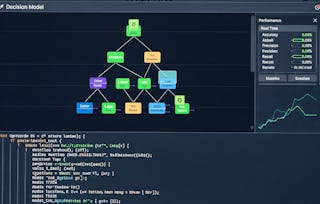
You've built machine learning models from fundamental linear regression and classification algorithms. These algorithms can get you pretty far in many scenarios, but they are not the only algorithms that can meet your needs. In this module, you'll build machine learning models from decision trees and random forests, two alternative approaches to solving regression and classification problems.
What's included
16 videos5 readings1 assignment1 discussion prompt2 ungraded labs
16 videos•Total 64 minutes
- Build Decision Trees, SVMs, and Artificial Neural Networks Course Introduction•3 minutes
- CAIP Specialization Introduction•4 minutes
- Build Decision Trees and Random Forests Module Introduction•1 minute
- Decision Tree•3 minutes
- Classification and Regression Tree (CART)•3 minutes
- Gini Index Example•8 minutes
- CART Hyperparameters•8 minutes
- Pruning•4 minutes
- C4.5•5 minutes
- Bin Determination•3 minutes
- One-Hot Encoding•3 minutes
- Decision Trees Compared to Other Algorithms•2 minutes
- Ensemble Learning•3 minutes
- Random Forest•7 minutes
- Random Forest Hyperparameters•3 minutes
- Feature Selection Benefits•3 minutes
5 readings•Total 20 minutes
- Overview•2 minutes
- Get help and meet other learners. Join your Community!•5 minutes
- Decision Tree Algorithm Comparison•3 minutes
- Guidelines for Building a Decision Tree Model•5 minutes
- Guidelines for Building a Random Forest Model•5 minutes
1 assignment•Total 30 minutes
- Building Decision Trees and Random Forests•30 minutes
1 discussion prompt•Total 5 minutes
- Reflect on What You've Learned•5 minutes
2 ungraded labs•Total 180 minutes
- Building a Decision Tree Model•90 minutes
- Building a Random Forest Model•90 minutes
Another alternative approach to regression and classification comes in the form of support-vector machines (SVMs). In this module, you'll build SVMs that can do a good job of handling outliers and tackling high-dimensional data in an efficient manner.
What's included
8 videos3 readings1 assignment1 discussion prompt2 ungraded labs
8 videos•Total 35 minutes
- Build Support-Vector Machines (SVM) Module Introduction•1 minute
- Support-Vector Machines (SVMs)•2 minutes
- SVMs for Linear Classification•3 minutes
- Hard-Margin and Soft-Margin Classification•4 minutes
- SVMs for Non-Linear Classification•1 minute
- Kernel Trick•14 minutes
- Kernel Methods•8 minutes
- SVMs for Regression•2 minutes
3 readings•Total 12 minutes
- Overview•2 minutes
- Guidelines for Building SVM Models for Classification•5 minutes
- Guidelines for Building SVM Models for Regression•5 minutes
1 assignment•Total 30 minutes
- Building SVMs•30 minutes
1 discussion prompt•Total 5 minutes
- Reflect on What You've Learned•5 minutes
2 ungraded labs•Total 105 minutes
- Building an SVM Model for Classification•60 minutes
- Building an SVM Model for Regression•45 minutes
All of the algorithms discussed thus far fall under the general umbrella of machine learning. While they are powerful and complex in their own right, the algorithms that make up the subdomain of deep learning—called artificial neural networks (ANNs)—are even more so. In this module, you'll build a fundamental version of an ANN called a multi-layer perceptron (MLP) that can tackle the same basic types of tasks (regression, classification, etc.), while being better suited to solving more complicated and data-rich problems.
What's included
8 videos2 readings1 assignment1 discussion prompt1 ungraded lab
8 videos•Total 29 minutes
- Build Multi-Layer Perceptrons (MLP) Module Introduction•1 minute
- Artificial Neural Network (ANN)•2 minutes
- Perceptron•6 minutes
- Perceptron Training•7 minutes
- Multi-Layer Perceptron (MLP)•4 minutes
- ANN Layers•2 minutes
- Backpropagation•3 minutes
- Activation Functions•5 minutes
2 readings•Total 7 minutes
- Overview•2 minutes
- Guidelines for Building MLPs•5 minutes
1 assignment•Total 30 minutes
- Building MLPs•30 minutes
1 discussion prompt•Total 5 minutes
- Reflect on What You've Learned•5 minutes
1 ungraded lab•Total 90 minutes
- Building an MLP•90 minutes
Now that you've built MLP neural networks, you can incorporate them into two wider architectures: convolutional neural networks (CNNs), which excel at solving computer vision problems; and recurrent neural networks (RNNs), which are most often used to process natural languages.
What's included
11 videos3 readings1 assignment1 discussion prompt2 ungraded labs
11 videos•Total 66 minutes
- Build Convolutional and Recurrent Neural Networks (CNN/RNN) Module Introduction•2 minutes
- Convolutional Neural Network (CNN)•4 minutes
- CNN Filters•7 minutes
- Padding and Stride•3 minutes
- CNN Architecture•10 minutes
- Generative Adversarial Network (GAN)•6 minutes
- Recurrent Neural Network (RNN)•6 minutes
- Memory Cell•2 minutes
- RNN Training•4 minutes
- Long Short-Term Memory (LSTM) Cell•13 minutes
- Embedding•8 minutes
3 readings•Total 17 minutes
- Overview•2 minutes
- Guidelines for Building CNNs•10 minutes
- Guidelines for Building RNNs•5 minutes
1 assignment•Total 30 minutes
- Building CNNs and RNNs•30 minutes
1 discussion prompt•Total 5 minutes
- Reflect on What You've Learned•5 minutes
2 ungraded labs•Total 240 minutes
- Building a CNN•120 minutes
- Building an RNN•120 minutes
You'll work on a project in which you'll apply your knowledge of the material in this course to a practical scenario.
What's included
1 peer review1 ungraded lab
1 peer review•Total 300 minutes
- Building a CNN to Classify Handwritten Characters•300 minutes
1 ungraded lab•Total 10 minutes
- Course 4 Project•10 minutes
Earn a career certificate
Add this credential to your LinkedIn profile, resume, or CV. Share it on social media and in your performance review.
Instructor

Explore more from Machine Learning
- Status: Free Trial
Course
- Status: Free Trial
Course
- Status: Free Trial
Course
- Status: Preview


Why people choose Coursera for their career


Learner reviews
- 5 stars
92.85%
- 4 stars
7.14%
- 3 stars
0%
- 2 stars
0%
- 1 star
0%
Showing 3 of 14
Reviewed on Feb 11, 2023
This was a very intense course. I am glad I was able to see it through to the end




Frequently asked questions
To access the course materials, assignments and to earn a Certificate, you will need to purchase the Certificate experience when you enroll in a course. You can try a Free Trial instead, or apply for Financial Aid. The course may offer 'Full Course, No Certificate' instead. This option lets you see all course materials, submit required assessments, and get a final grade. This also means that you will not be able to purchase a Certificate experience.
When you enroll in the course, you get access to all of the courses in the Certificate, and you earn a certificate when you complete the work. Your electronic Certificate will be added to your Accomplishments page - from there, you can print your Certificate or add it to your LinkedIn profile.
More questions
Financial aid available,
¹ Some assignments in this course are AI-graded. For these assignments, your data will be used in accordance with Coursera's Privacy Notice.