

Cervical Thoracic Junction Mechanics
Keep adding new skills with 10,000+ programs for $239 (usually $399). Save now.

Cervical Thoracic Junction Mechanics
This course is part of Upper Body Specialist: Advanced Assessments and Treatments Specialization

Instructor: Niel Asher Education
Included with
Recommended experience
Recommended experience
What you'll learn
How to evaluate and restore mobility in the cervical-thoracic region
How to apply manual therapy and exercise techniques to reduce pain and tension
How to identify and improve restrictions where the neck meets the upper back to support better posture, shoulder movement, comfort, and performance.
Skills you'll gain
Details to know

January 2026
3 assignments
See how employees at top companies are mastering in-demand skills

Build your subject-matter expertise
- Learn new concepts from industry experts
- Gain a foundational understanding of a subject or tool
- Develop job-relevant skills with hands-on projects
- Earn a shareable career certificate

There are 4 modules in this course
Neck tension, upper back stiffness, poor posture, shoulder restriction, and recurring headaches often have one thing in common: the area where the neck meets the upper back is not moving or functioning as well as it should. By the end of this course, learners will understand how the cervical-thoracic junction influences posture, shoulder motion, breathing mechanics, mobility, pain, and athletic performance.
Taught by Sue Falsone, PT, ATC, this course focuses on one of the body’s most important transition zones. When this region is stiff, poorly controlled, or overloaded, it can contribute to discomfort, compensation, and inefficient movement throughout the upper body. Through clear explanation and practical demonstrations, learners explore relevant anatomy, movement assessment, joint mobility, soft tissue techniques, postural correction, and corrective exercise concepts. Healthcare and fitness professionals will gain practical tools for assessment and intervention, while non-clinical learners will gain a clearer understanding of why this region matters. This course offers a structured way to think about the neck-upper back connection and how improving it can support comfort, mobility, and performance.
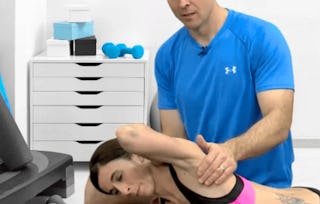
In this first module, Dr. Sue Falsone explores the anatomy and biomechanics of the cervical thoracic junction (CTJ), emphasizing why this region is both functionally significant and clinically complex. The lesson begins with a deep dive into the anatomy of the lower cervical and upper thoracic vertebrae (C7–T4), highlighting the structural transition from cervical mobility to thoracic stability. Learners are guided to appreciate how this area connects the neck, shoulders, and upper back — and why dysfunction here often leads to widespread pain, tension, and movement restrictions. Through anatomical reasoning and live demonstration, Sue illustrates how to observe and palpate CTJ motion during head and arm movement, recognize compensatory patterns, and understand when manual or medical referral is appropriate. The module lays the foundation for understanding how mobility, stability, and tension interact within this crucial transitional zone.
What's included
6 videos3 readings1 assignment1 discussion prompt
6 videos•Total 35 minutes
- Introduction to the Cervical Thoracic Junction•6 minutes
- Osteokinematics and Arthrokinematics•9 minutes
- Breathing and Respiration •7 minutes
- Breathing and Mobility•3 minutes
- Posture•5 minutes
- Common Compensatory Patterns•5 minutes
3 readings•Total 30 minutes
- Syllabus•10 minutes
- New Reading•10 minutes
- Student Notes•10 minutes
1 assignment•Total 15 minutes
- Practice Assignment•15 minutes
1 discussion prompt•Total 10 minutes
- Introduction•10 minutes
This second module transitions from theory into applied clinical strategies for improving function and reducing tension in the cervical thoracic junction. Dr. Falsone demonstrates practical observation and activation drills designed to restore postural balance, optimize scapular control, and retrain breathing patterns that directly affect the CTJ. Using live models, she guides learners through exercises such as scapular depression, wall-based postural realignment, and deep neck flexor activation to enhance stability while reducing overactivity in the upper trapezius and levator scapulae. The module also covers breathing as both an assessment and therapeutic tool, explaining how apical, diaphragmatic, and lateral breathing patterns impact tension and mobility. By integrating movement, breathwork, and neuromuscular re-education, therapists learn to support lasting changes in tension management and postural control across the neck–shoulder–thoracic complex.
What's included
3 videos1 reading
3 videos•Total 16 minutes
- Corrective Exercises - Part 1•7 minutes
- Corrective Exercise - Part 3•4 minutes
- Corrective Exercise - Part 4•5 minutes
1 reading•Total 10 minutes
- Student Notes•10 minutes
This module provides an opportunity to consolidate and apply what you’ve learned throughout the course. You will review key concepts, reflect on clinical relevance, and complete a short practice assignment and/or course reflection quiz. The goal is to reinforce understanding and strengthen your ability to integrate these skills into real-world client care.
What's included
1 assignment1 discussion prompt
1 assignment•Total 15 minutes
- Practice Assignment•15 minutes
1 discussion prompt•Total 10 minutes
- Summary•10 minutes
This final exam is designed to assess your understanding of the key concepts presented throughout the course. Please review all video lessons and written materials before beginning. A passing score of 70% or higher is required to successfully complete the course and earn your CE certificate. You may reference your notes during the exam. Once you pass, your certificate will be available for immediate download.
What's included
1 assignment
1 assignment•Total 60 minutes
- Course Exam•60 minutes
Earn a career certificate
Add this credential to your LinkedIn profile, resume, or CV. Share it on social media and in your performance review.
Instructor
Offered by

Explore more from Patient Care
- Status: Free TrialN
Niel Asher Education
Course
- Status: PreviewN
Niel Asher Education
Course
- Status: Free TrialN
Niel Asher Education
Course
- Status: Free TrialN
Niel Asher Education
Specialization



Why people choose Coursera for their career






Frequently asked questions
To access the course materials, assignments and to earn a Certificate, you will need to purchase the Certificate experience when you enroll in a course. You can try a Free Trial instead, or apply for Financial Aid. The course may offer 'Full Course, No Certificate' instead. This option lets you see all course materials, submit required assessments, and get a final grade. This also means that you will not be able to purchase a Certificate experience.
When you enroll in the course, you get access to all of the courses in the Specialization, and you earn a certificate when you complete the work. Your electronic Certificate will be added to your Accomplishments page - from there, you can print your Certificate or add it to your LinkedIn profile.
Yes. In select learning programs, you can apply for financial aid or a scholarship if you can’t afford the enrollment fee. If fin aid or scholarship is available for your learning program selection, you’ll find a link to apply on the description page.
More questions
Financial aid available,