

Digital Manufacturing: Introduction and Smart Design
Keep adding new skills with 10,000+ programs for $239 (usually $399). Save now.

Digital Manufacturing: Introduction and Smart Design
This course is part of Digital Technology in Manufacturing Specialization

Instructor: Subject Matter Expert
3,780 already enrolled
Included with
Ask Coursera
16 reviews
Recommended experience
16 reviews
Recommended experience
Skills you'll gain
Details to know

See how employees at top companies are mastering in-demand skills

Build your subject-matter expertise
- Learn new concepts from industry experts
- Gain a foundational understanding of a subject or tool
- Develop job-relevant skills with hands-on projects
- Earn a shareable career certificate

There are 3 modules in this course
This course has been created for Mechanical, Manufacturing, and Mechatronics Engineers. The "Digital Manufacturing and Industry 4.0" course is intended for those who want to comprehend and navigate the transformative concepts and technologies that shape modern Industry. Throughout this course, participants will learn about the fundamental principles of digital manufacturing, the path to Industry 4.0, and the emerging technology that drives smart design and production processes through three modules.
In the first module, "Introduction to Digital Manufacturing," students will conduct a thorough examination of the drivers driving digital transformation in manufacturing. Learners will recognize the importance of efficiency, agility, and competitiveness in driving the industry into a new era. Key concepts such as the Digital Thread, Value Chain, and Smart Factory will be investigated to demonstrate how they are transforming traditional manufacturing processes. Participants will learn about key concepts such as Digital Thread and Digital Twin, as well as their roles in enabling continuous information flow and virtual representations for analysis and optimization. The importance of a strong digital infrastructure, which includes networked systems, cybersecurity measures, and data analytics capabilities, will be highlighted. The second module, "Evolution of Industry 4.0," builds on the knowledge learned in the first module. Participants will learn about the history and progress of Industry 4.0, from the fourth industrial revolution to the present era of intelligent, networked systems. Key components such as cyber-physical systems, the Internet of Things (IoT), cloud computing, and artificial intelligence will be emphasized, demonstrating how they work together to create adaptable production environments. The six Industry 4.0 design ideas will be discussed, providing students with a foundation for seamless integrating digital technologies. In the last module of the course, students will learn about the latest innovations that shape smart design and production processes. Learners will look into Computer-Aided Design and Computer-Aided Manufacturing (CAD/CAM), recognizing its importance as the foundation for effective digital design and manufacturing instruction translation. Other technologies, such as Geometric Dimensioning and Tolerancing (GD&T), Computer-Aided Fixture Design, and automation adaptation, will also be discussed, with a focus on their contributions to precision, repeatability, and efficiency in manufacturing operations, which align with the larger goals of smart design and manufacturing.
Digital Manufacturing revolutionizes industry with streamlined processes driven by digital transformation, emphasizing efficiency and innovation. Key dimensions include the Digital Thread for lifecycle connectivity, a reinvented value chain, and Smart Factory integration of IoT, AI, and analytics. This transformation demands a robust digital infrastructure to overcome challenges like data interoperability and upskilling, promising enhanced efficiency, quality, and competitiveness.
What's included
19 videos1 assignment
19 videos•Total 136 minutes
- About the Specialization•2 minutes
- About the Course•2 minutes
- Evolution of Conventional to Digital Manufacturing (DM) Part 1•9 minutes
- Evolution of Conventional to Digital Manufacturing (DM) Part 2•9 minutes
- Introduction to Digital transformation Part 1•11 minutes
- Introduction to Digital transformation Part 2•7 minutes
- Drivers for Digital transformation in Manufacturing Part 1•8 minutes
- Drivers for Digital transformation in Manufacturing Part 2•8 minutes
- Three dimension of Digital Manufacturing Part 1•5 minutes
- Three dimension of Digital Manufacturing Part 2•9 minutes
- Cyber Physical systems•10 minutes
- Industrial Internet of things•10 minutes
- Digital thread and Digital Twin in Manufacturing Part 1•10 minutes
- Digital thread and Digital Twin in Manufacturing Part 2•5 minutes
- Need of Digital Infrastructure in Digital Manufacturing Part 1•3 minutes
- Need of Digital Infrastructure in Digital Manufacturing Part 2•7 minutes
- Challenges in Digital transformation in Manufacturing•10 minutes
- Outcomes of Digital transformation for Industrial Enterprise Part 1•3 minutes
- Outcomes of Digital transformation for Industrial Enterprise Part 2•8 minutes
1 assignment•Total 30 minutes
- Assessment on Introduction to Digital Manufacturing•30 minutes
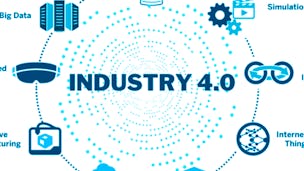
"Industry 4.0 revolutionizes manufacturing through digital integration, marking the fourth industrial revolution with smart, interconnected systems. Key components include cyber-physical systems, IoT, and AI, fostering adaptable production environments. With real-time connectivity and digital twins, Industry 4.0 ensures efficient, validated processes, advancing towards intelligent, flexible manufacturing systems."
What's included
18 videos1 assignment
18 videos•Total 124 minutes
- Origin and development of Industry 4.0 Part-1•5 minutes
- Origin and development of Industry 4.0 Part-2•6 minutes
- Key components of Industry 4.0•6 minutes
- Connectivity of components across the Industry 4.0 Part-1•7 minutes
- Connectivity of components across the Industry 4.0 Part-2•7 minutes
- Industry 4.0 Adoption in India•8 minutes
- Six design Principles in Industry 4.0•9 minutes
- Architecture model in Industry 4.0 Part-1•6 minutes
- Architecture model in Industry 4.0 Part-2•9 minutes
- Comparison of Models and adaptability in Digital Manufacturing•10 minutes
- Digital Resource Modelling and Simulation - Factory Model Part-1•5 minutes
- Digital Resource Modelling and Simulation - Factory Model Part-2•11 minutes
- Digital Manufacturing Planning process- ERP and Value Chain Management Part-1•4 minutes
- Digital Manufacturing Planning process- ERP and Value Chain Management Part-2•5 minutes
- Digital Manufacturing Planning process- ERP and Value Chain Management Part-3•6 minutes
- Validation & Virtual Commissioning Part-1•5 minutes
- Validation & Virtual Commissioning Part-2•7 minutes
- Validation & Virtual Commissioning Part-3•6 minutes
1 assignment•Total 30 minutes
- Assessment on Evolution of Industry 4.0•30 minutes
"Smart Design and Manufacturing Technology revolutionize Digital Manufacturing, integrating CAD/CAM for efficient design-to-production processes. Computer-Aided Geometric Modelling Systems enable intricate shapes, while simulation tools like Finite Element Analysis ensure performance and safety standards. Automation enhances efficiency and accuracy, shaping a connected, precise future in manufacturing."
What's included
17 videos1 assignment
17 videos•Total 137 minutes
- Introduction to CAD/CAM Part-1•6 minutes
- Introduction to CAD/CAM Part-2•8 minutes
- Geometric Modelling and Kernals•12 minutes
- Computer Aided Geometric Modelling System•11 minutes
- Component Assembly design Part-1•9 minutes
- Component Assembly design Part-2•8 minutes
- Simulated motion analysis of Machine component Part-1•6 minutes
- Simulated motion analysis of Machine component Part-2•7 minutes
- Finite Element Analysis and Modelling Procedure Part-1•7 minutes
- Finite Element Analysis and Modelling Procedure Part-2•8 minutes
- CAE - Implementation Part-1•7 minutes
- CAE - Implementation Part-2•6 minutes
- Adaptation of Automation in Digital Manufacturing Part-1•9 minutes
- Adaptation of Automation in Digital Manufacturing Part-2•6 minutes
- Geometric Dimensioning and Tolerancing (GD&T)•12 minutes
- Computer Aided Fixture Design Part-1•10 minutes
- Computer Aided Fixture Design Part-2•5 minutes
1 assignment•Total 30 minutes
- Assessment on Technology for Smart Design and Manufacturing •30 minutes
Earn a career certificate
Add this credential to your LinkedIn profile, resume, or CV. Share it on social media and in your performance review.
Instructor
Offered by

Explore more from Mechanical Engineering
Course
- L
L&T EduTech
Course
Why people choose Coursera for their career






Frequently asked questions
To access the course materials, assignments and to earn a Certificate, you will need to purchase the Certificate experience when you enroll in a course. You can try a Free Trial instead, or apply for Financial Aid. The course may offer 'Full Course, No Certificate' instead. This option lets you see all course materials, submit required assessments, and get a final grade. This also means that you will not be able to purchase a Certificate experience.
When you enroll in the course, you get access to all of the courses in the Specialization, and you earn a certificate when you complete the work. Your electronic Certificate will be added to your Accomplishments page - from there, you can print your Certificate or add it to your LinkedIn profile.
Yes. In select learning programs, you can apply for financial aid or a scholarship if you can’t afford the enrollment fee. If fin aid or scholarship is available for your learning program selection, you’ll find a link to apply on the description page.
More questions
Financial aid available,