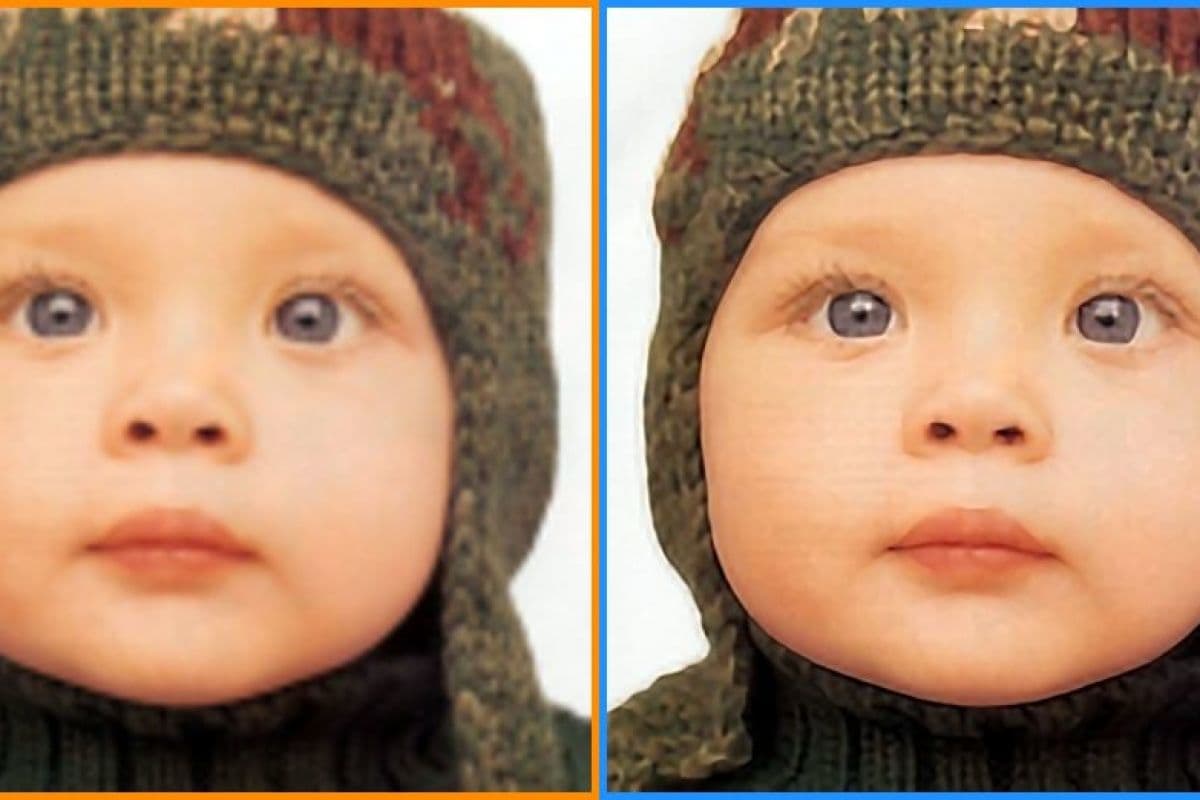
A Complete Guide to Image Super-Resolution in Deep Learning and AI
Updated on August 6, 2025
Image Super-Resolution (ISR) is the process of improving the quality and resolution of a low-resolution (LR) image to a high-resolution (HR) version. This technique enhances finer details, sharpness, and clarity, making it highly valuable in various fields. ISR is widely used in medical imaging to improve the accuracy of diagnoses, in satellite imaging to extract finer geographical details, and in security applications for enhancing surveillance footage. It also plays a crucial role in digital media, helping upscale old or low-quality images and videos while maintaining visual fidelity. With advancements in deep learning and neural networks, modern ISR methods, such as convolutional neural networks (CNNs) and generative adversarial networks (GANs), have significantly improved the effectiveness of this technology, making it indispensable in both academic research and industrial applications. Here are a few of the use cases of ISR discussed in detail:
- Surveillance: To detect, identify, and perform facial recognition on low-resolution images obtained from security cameras.
- Medical: Capturing high-resolution MRI images can be tricky due to scan time, spatial coverage, and signal-to-noise ratio (SNR). Super-resolution helps resolve this by generating high-resolution MRI from low-resolution MRI images.
- Media: Super-resolution can help reduce server costs by allowing media to be transmitted at a lower resolution and upscaled in real time. Deep learning techniques have proven effective in addressing the challenges of image and video super-resolution. This article will explore the underlying theory, various techniques utilized, loss functions, metrics, and the relevant datasets involved.
👁 image
(Image Source)
Key takeaways:
- Image super-resolution is the task of producing a high-resolution image from a low-resolution input, and deep learning has transformed this field by training models that can infer and generate plausible high-frequency details, rather than just smoothing or interpolating the image as traditional methods do.
- Early deep learning models for super-resolution (such as the SRCNN) showed that a simple convolutional neural network could already outperform classic upscaling techniques, and newer architectures—including GAN-based approaches like SRGAN/ESRGAN and even transformer-based models—have further improved results by generating sharper, more realistic details.
- Super-resolution has many practical applications—from enhancing medical and satellite images, to sharpening security camera footage and old photographs, to upscaling video content for higher-quality streaming—making it a valuable tool whenever there’s a need to improve image detail and clarity.
Thanks for learning with the DigitalOcean Community. Check out our offerings for compute, storage, networking, and managed databases.
Learn more about our products
About the author
With a strong background in data science and over six years of experience, I am passionate about creating in-depth content on technologies. Currently focused on AI, machine learning, and GPU computing, working on topics ranging from deep learning frameworks to optimizing GPU-based workloads.
Still looking for an answer?
Was this helpful?
This textbox defaults to using Markdown to format your answer.
You can type !ref in this text area to quickly search our full set of tutorials, documentation & marketplace offerings and insert the link!
👁 Creative CommonsThis work is licensed under a Creative Commons Attribution-NonCommercial- ShareAlike 4.0 International License. Become a contributor for community
Get paid to write technical tutorials and select a tech-focused charity to receive a matching donation.
DigitalOcean Documentation
Full documentation for every DigitalOcean product.
Resources for startups and AI-native businesses
The Wave has everything you need to know about building a business, from raising funding to marketing your product.
Dark mode is coming soon.