VOOZH about

URL: https://www.digitalocean.com/community/tutorials/two-dimensional-array-in-c-plus-plus?comment=178127

โ‡ฑ 2D Arrays in C++: Declare, Initialize & Operations | DigitalOcean


2D Arrays in C++: Declare, Initialize & Operations

Updated on June 16, 2026
๐Ÿ‘ 2D Arrays in C++: Declare, Initialize & Operations

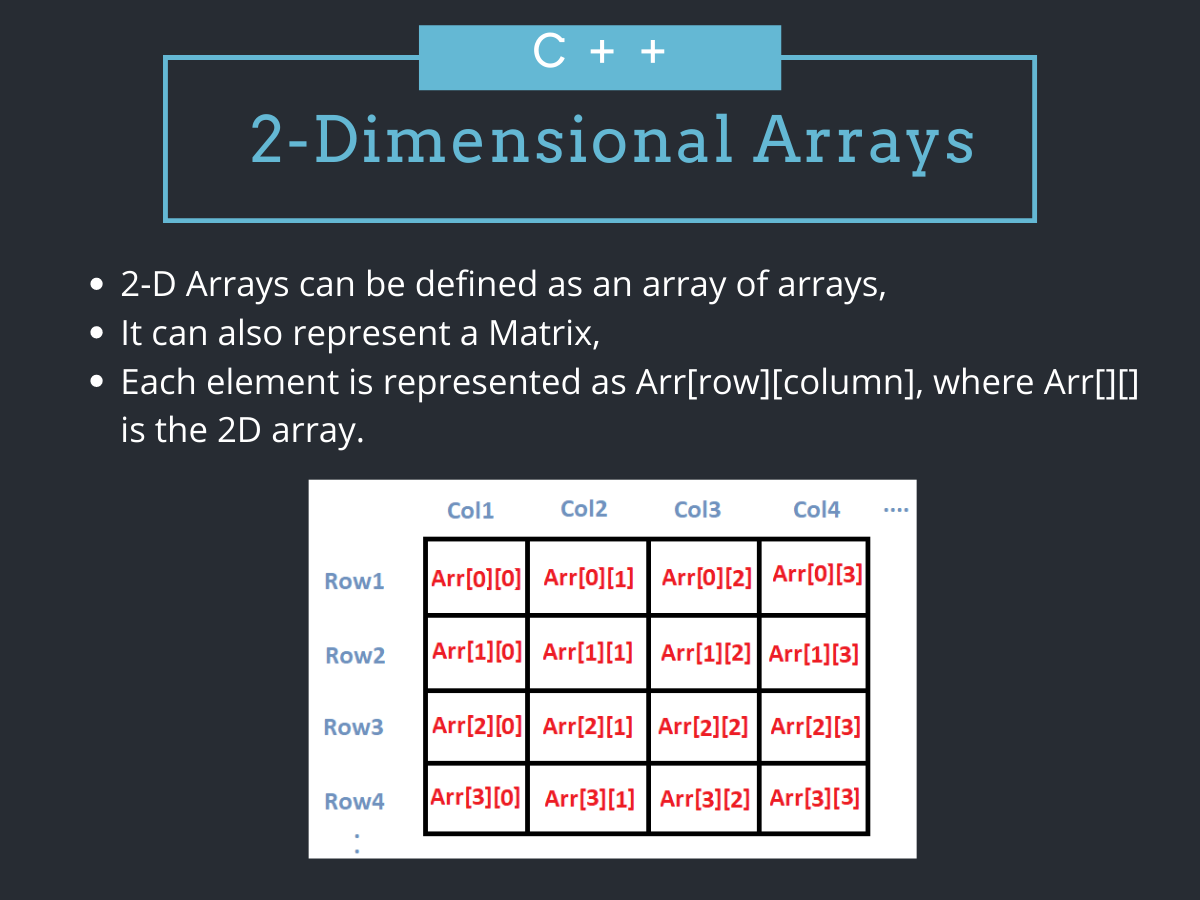
A two-dimensional array in C++ provides a powerful way to organize data into a grid-like table of rows and columns. This article will walk you through the fundamentals of declaring and initializing 2D arrays, including operations like handling user input and performing matrix addition. We will also dive into advanced topics such as dynamic arrays, pointers, the modern std::vector approach, performance optimization, and avoiding common errors. By the end, you will know how to choose between static arrays, pointer-based dynamic arrays, and vectors, and you will get a preview of std::mdspan, the C++23 way to work with multidimensional data. Letโ€™s jump in!

Key takeaways:

  • A 2D array organizes data in a grid-like structure, which you typically process using nested for loops for rows and columns.
  • When passing a static 2D array to a function, you must always specify the arrayโ€™s column size in the functionโ€™s parameters.
  • Static arrays have dimensions fixed at compile time, while dynamic arrays are created at runtime using new[] for variable sizing.
  • You must manually deallocate dynamic arrays to prevent memory leaks by deleting each row and then the main pointer.
  • For modern C++, std::vector<std::vector<int>> is the recommended alternative because it automatically manages memory and is safer to use.
  • C++ stores 2D arrays in row-major order, so processing data row-by-row makes the best use of the CPU cache and runs faster on large datasets.
  • A comparison of static arrays, pointer-based arrays, and vectors helps you pick the right structure for compile-time versus runtime sizing.
  • std::vector supports range-based for loops, resizing, and jagged (uneven) rows, which raw arrays cannot do.
  • std::mdspan, introduced in C++23, gives you a lightweight, multidimensional view over an existing contiguous buffer.

Thanks for learning with the DigitalOcean Community. Check out our offerings for compute, storage, networking, and managed databases.

Learn more about our products

About the author(s)

๐Ÿ‘ Sneh
Sneh
Author
๐Ÿ‘ Manikandan Kurup
Manikandan Kurup
Editor
Senior Technical Content Engineer I
See author profile

With over 6 years of experience in tech publishing, Mani has edited and published more than 75 books covering a wide range of data science topics. Known for his strong attention to detail and technical knowledge, Mani specializes in creating clear, concise, and easy-to-understand content tailored for developers.

Category:
Tags:
While we believe that this content benefits our community, we have not yet thoroughly reviewed it. If you have any suggestions for improvements, please let us know by clicking the โ€œreport an issueโ€œ button at the bottom of the tutorial.

Still looking for an answer?

Was this helpful?

Write a C++ programme and initialize a 2d array of size [4][4] and display it. please solve it!!!

- unzillah

I did not understand the concept properly plz do say in simple way to understand for the students

- Reya

MASHALLAH! Very helpful for computer science studnets

- Khalil Ullah

write c++ program that will ask the user to enter the array size, desired elements and output the total sum of elements stored in array ANYONE CAN ANSWER THIS PLEASE, asap. THANKYOU IN ADVANCE

- TAKOOOOHAKI

๐Ÿ‘ Creative Commons
This work is licensed under a Creative Commons Attribution-NonCommercial- ShareAlike 4.0 International License.
  • Deploy on DigitalOcean

    Click below to sign up for DigitalOcean's virtual machines, Databases, and AIML products.

Become a contributor for community

Get paid to write technical tutorials and select a tech-focused charity to receive a matching donation.

DigitalOcean Documentation

Full documentation for every DigitalOcean product.

Resources for startups and AI-native businesses

The Wave has everything you need to know about building a business, from raising funding to marketing your product.

Get our newsletter

Stay up to date by signing up for DigitalOceanโ€™s Infrastructure as a Newsletter.

New accounts only. By submitting your email you agree to our Privacy Policy

The developer cloud

Scale up as you grow โ€” whether you're running one virtual machine or ten thousand.

Start building today

From GPU-powered inference and Kubernetes to managed databases and storage, get everything you need to build, scale, and deploy intelligent applications.

ยฉ 2026 DigitalOcean, LLC.Sitemap.
Dark mode is coming soon.