|
VOOZH | about |
|
VOOZH | about |
Load balancing is a key component of highly-available infrastructures commonly used to improve the performance and reliability of web sites, applications, databases and other services by distributing the workload across multiple servers.
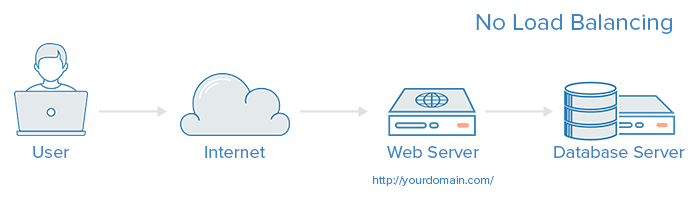
A web infrastructure with no load balancing might look something like the following:
In this example, the user connects directly to the web server, at yourdomain.com. If this single web server goes down, the user will no longer be able to access the website. In addition, if many users try to access the server simultaneously and it is unable to handle the load, they may experience slow load times or may be unable to connect at all.
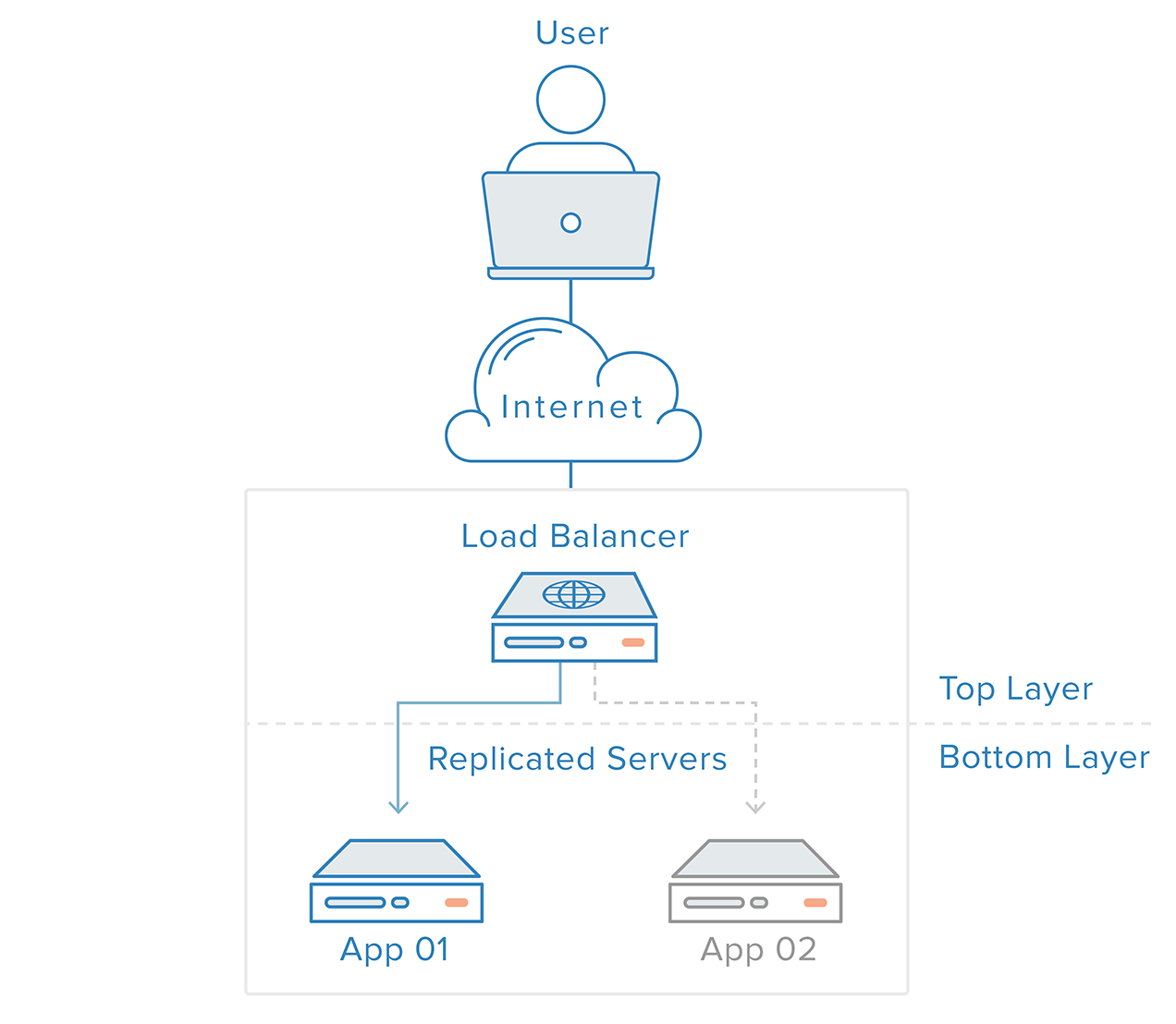
This single point of failure can be mitigated by introducing a load balancer and at least one additional web server on the backend. Typically, all of the backend servers will supply identical content so that users receive consistent content regardless of which server responds.
👁 Diagram 01: Load Balancers / Top-to-bottom
In the example illustrated above, the user accesses the load balancer, which forwards the user’s request to a backend server, which then responds directly to the user’s request. In this scenario, the single point of failure is now the load balancer itself. This can be mitigated by introducing a second load balancer, but before we discuss that, let’s explore how load balancers work.
Thanks for learning with the DigitalOcean Community. Check out our offerings for compute, storage, networking, and managed databases.
This textbox defaults to using Markdown to format your answer.
You can type !ref in this text area to quickly search our full set of tutorials, documentation & marketplace offerings and insert the link!
thanks for the tutorial
Melissa, Very clear article with great diagrams… Do I take it that the DigitalOcean solution is based on your own implementation of HAProxy? If so is it possible to customise the configuration file directly? Or would you have to set up your own HAProxy as discussed in your other blog? https://www.digitalocean.com/community/tutorials/how-to-set-up-highly-available-haproxy-servers-with-keepalived-and-floating-ips-on-ubuntu-14-04 I was wondering if you could change the configuration to help prevent DDOS attacks? https://www.loadbalancer.org/blog/simple-denial-of-service-dos-attack-mitigation-using-haproxy-2 Even the simple addition of: timeout http-request 5s Would help stop slow HTTP attacks.
Hi Melissa - great article. Could you let me know what software you used for those animated diagrams? (Not sure if I am the 1000th person to ask this question)
One of the cleanest and simplest descriptions I’ve read about load balancers and what they do. Thanks, and I might borrow a few bits to put on the Loadbalancer.org blog :-).
It’s a shame that Google picks up all the naff glossary pages from vendors such as Kemp and F5 when you look for more information on load balancers.
Full documentation for every DigitalOcean product.
The Wave has everything you need to know about building a business, from raising funding to marketing your product.