What AI handles customer questions for an ecommerce brand (and what it doesn't)


Last edited June 10, 2026

Table of Contents
- What customers actually ask an ecommerce brand
- What AI handles well: the ~80%
- What AI still struggles with: the ~20%
- Why accuracy depends on what you connect
- When AI hands off to a human
- The tools that actually answer ecommerce questions
- Quick comparison
- eesel - best if you're already on a helpdesk
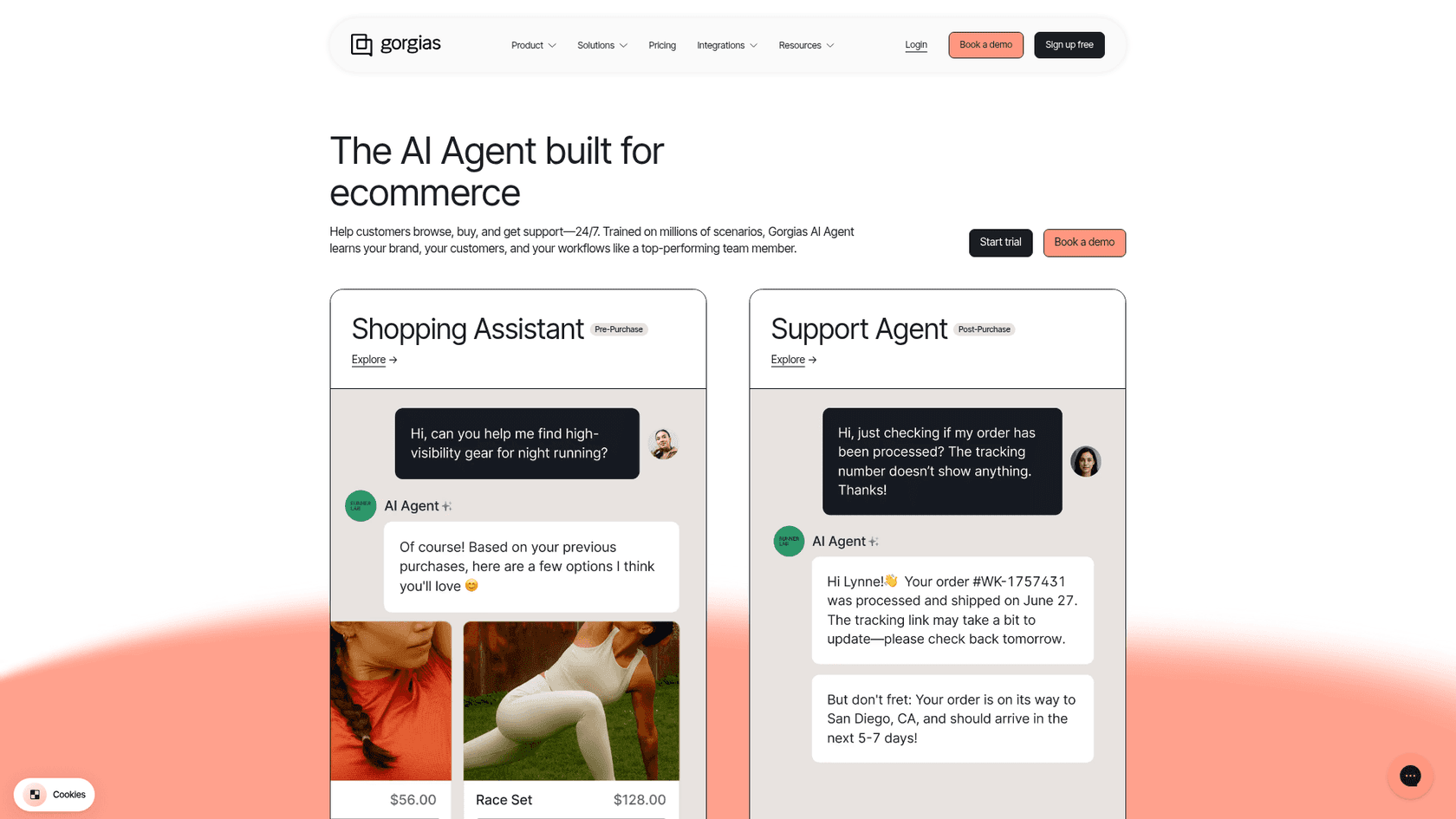
- Gorgias - best for Shopify-native brands
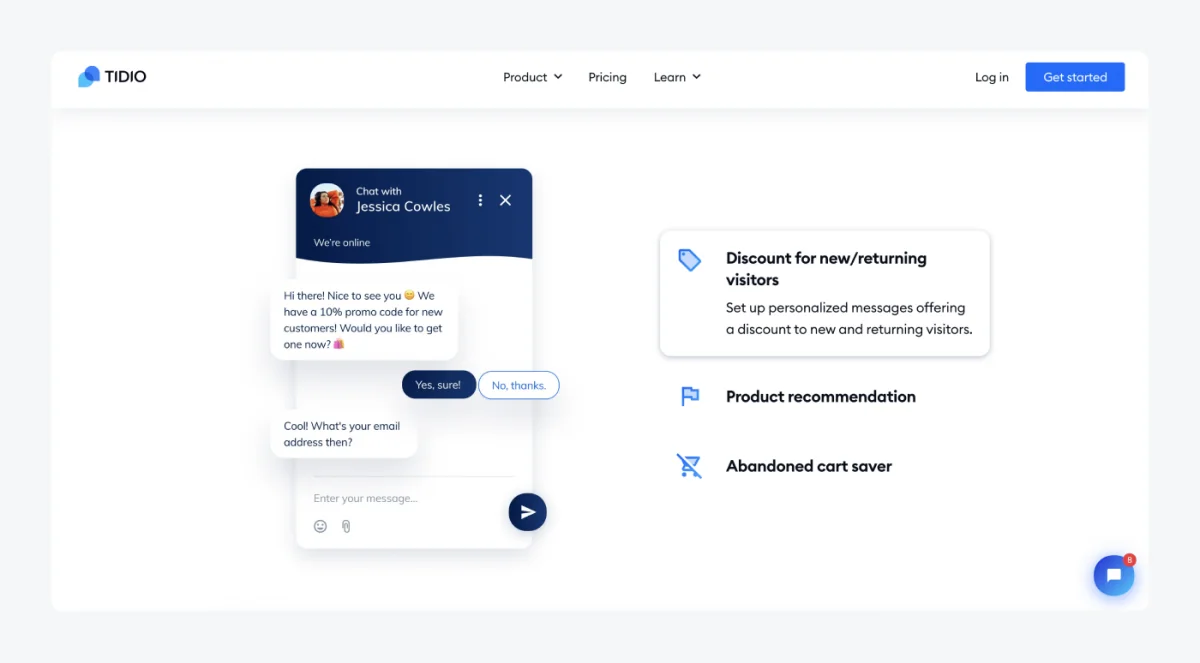
- Tidio - best for SMBs wanting a standalone chatbot
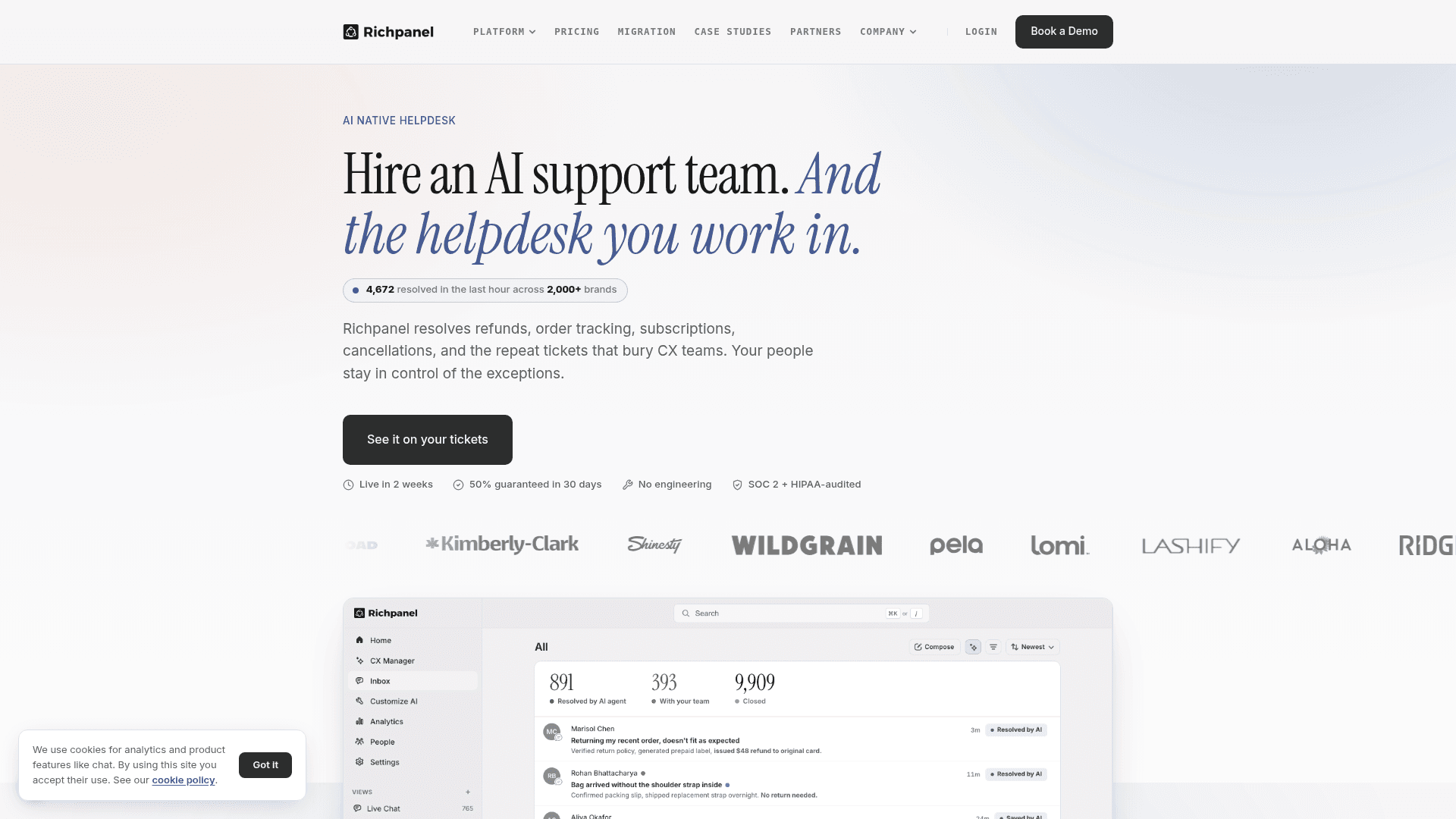
- Richpanel - best for brands wanting full AI-native helpdesk replacement
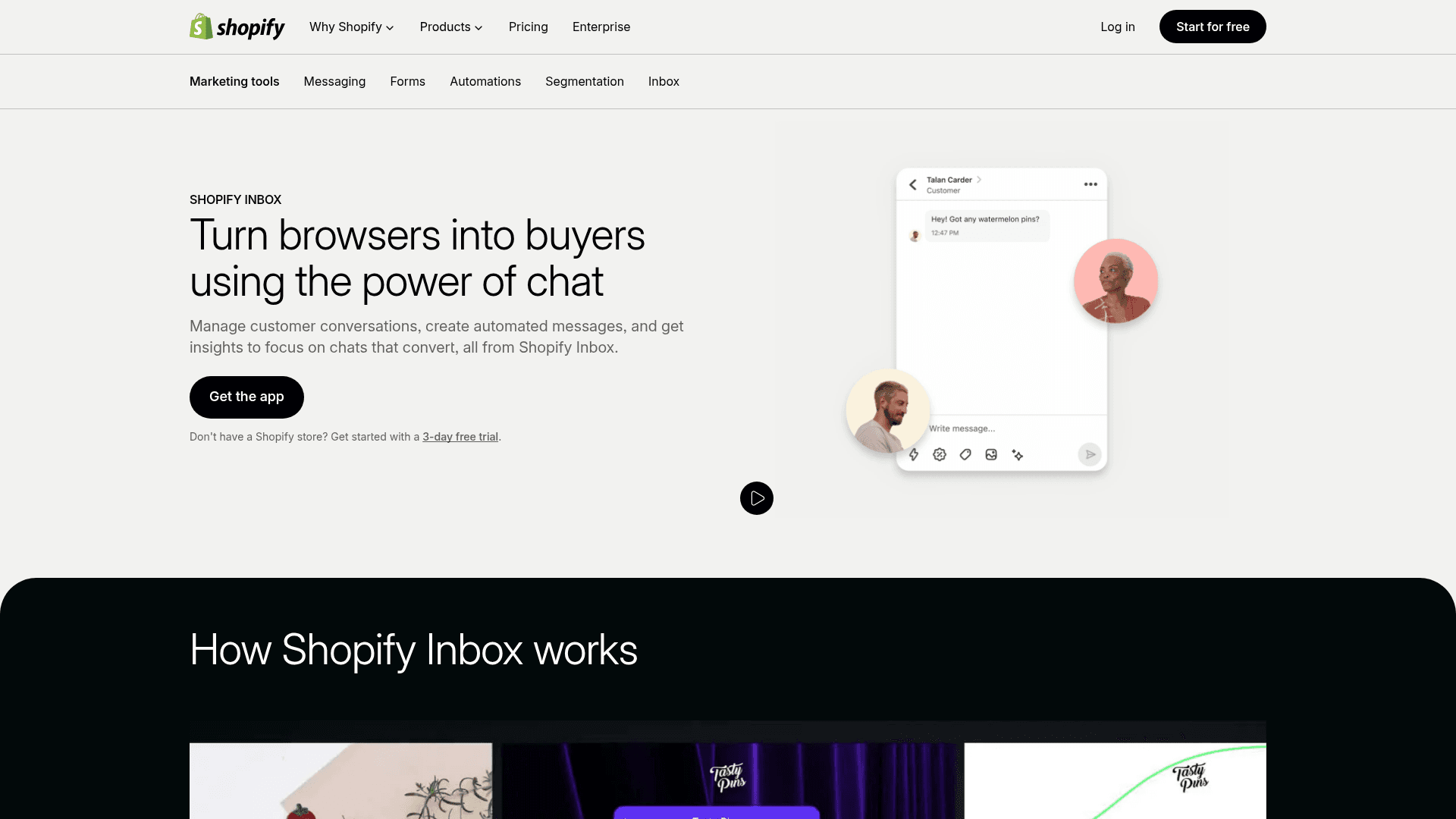
- Shopify Inbox - the free starting point
- Re:amaze - good SMB multi-channel option
- How to actually get AI answering your questions well
- Try eesel
What customers actually ask an ecommerce brand
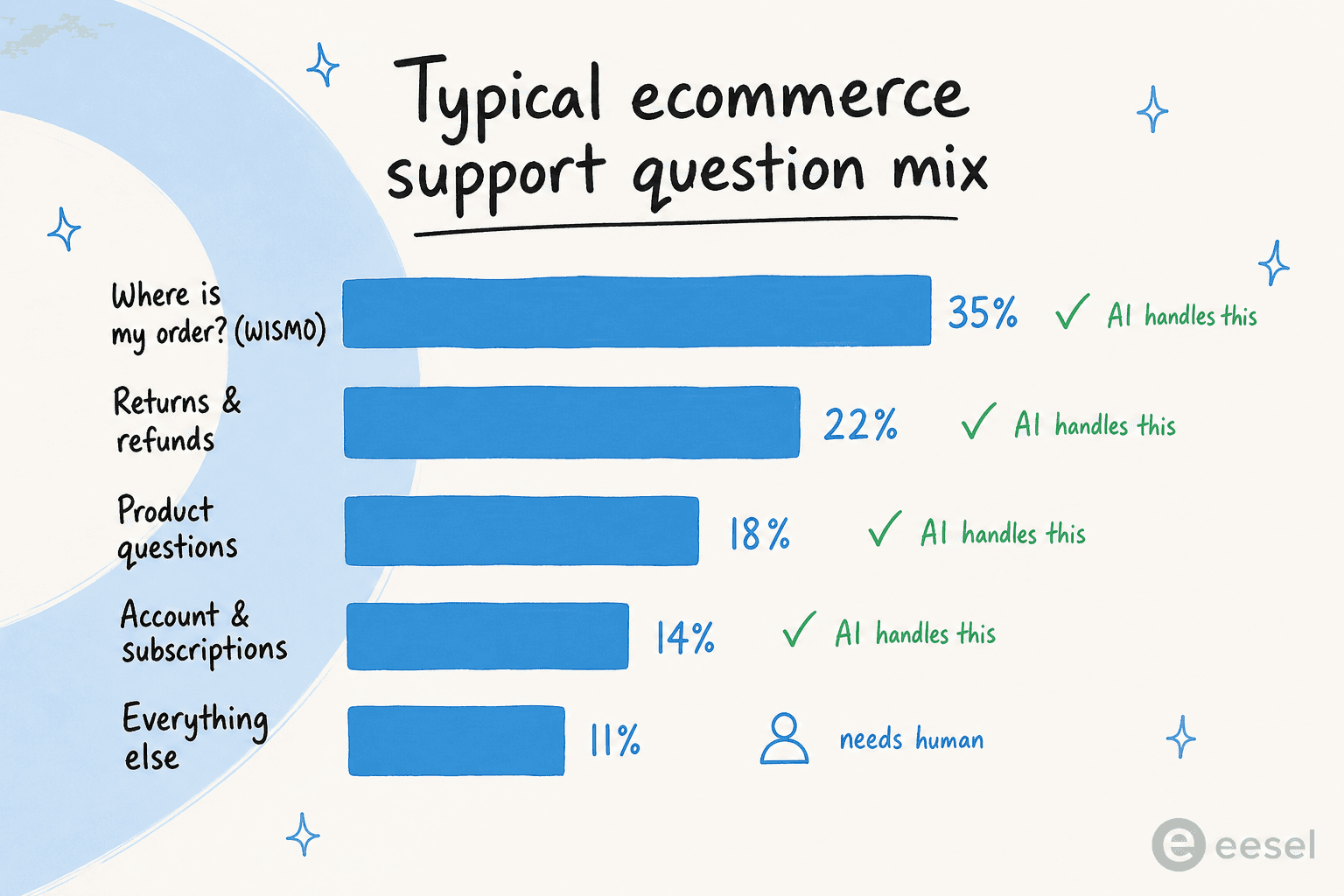
The mix is more predictable than most people expect. Across ecommerce support, roughly 89% of questions fall into four categories:
| Question type | Share of tickets | AI handle rate |
|---|---|---|
| "Where is my order?" (WISMO) | ~35% | Near 100% with Shopify data |
| Returns and refunds | ~22% | 70-90% (straightforward cases) |
| Product questions | ~18% | High (product catalog dependent) |
| Account and subscription changes | ~14% | High (with helpdesk actions enabled) |
| Everything else | ~11% | Varies |
The four main categories are all structured lookups: they require pulling data from Shopify (order status, return eligibility, product specs, subscription records) and returning a clear answer. That's exactly what AI is good at - fast, accurate, repeatable, at 3am.
The "everything else" bucket (about 11%) is where it gets messier: unique complaints, goodwill requests, fraud flags, situations where the customer's account history and their claim don't match. Those still need human judgment.
What AI handles well: the ~80%
Order tracking and WISMO
This is the clearest win and the highest-volume category. "Where is my order?" is a structured lookup: match the customer's email to an order record, pull the current shipping status, and return it. Any AI connected to Shopify can do this accurately in under 2 seconds, at any hour, without a ticket ever hitting your queue.
WISMO queries alone typically make up 30-35% of ecommerce support volume. Deflecting that category entirely usually cuts total ticket volume by a third before you've done anything else.
Returns and refunds
Return eligibility is a policy lookup: is the order within the return window? Is the SKU eligible? Does the customer's account show previous return patterns? AI can check all of these against your configured rules and either initiate the return label directly or give the customer the right answer about why a return isn't eligible.
The cases that still route to humans: items outside the return window where the customer has a legitimate reason, suspected return fraud, and situations where your policy has an exception the AI wasn't trained on. Richpanel's Frontline AI, for instance, handles returns and refunds end-to-end and only escalates when confidence is low - their guaranteed 50% resolution in 30 days is driven largely by this category.
Product questions
"Is this available in a size 8?" "Does this work with the 2024 MacBook Pro?" "What's the material?" These are product catalog lookups. AI answers them accurately when it has access to your product data - description pages, spec sheets, inventory levels.
The failure mode here isn't AI capability; it's knowledge gaps. If your product descriptions are sparse or out of date, the AI's answers will be too. Clean product data leads directly to accurate product answers.
Account and subscription changes
Update a shipping address, cancel a subscription, apply a discount code, change a billing date - all of these are structured actions that Shopify and your helpdesk can execute. Good AI tools don't just answer questions about these things; they do them. eesel, for example, can take actions inside your existing helpdesk (Zendesk, Gorgias, Freshdesk) rather than just drafting a reply for a human to approve - which is what makes the difference between a chatbot and an actual resolution.
"Finally, AI software that suits our needs. Easy to connect to Shopify, easy to prompt, and it learns from our articles. We're using it as a copilot for our Zendesk agents, with AI live chat next."
Mateusz Golda, Director, Tulipy (multi-brand gardening e-commerce, G2 review)

What AI still struggles with: the ~20%
Fraud and account security
Anything touching payment details, suspected stolen accounts, or return fraud patterns should route directly to a human - not because AI can't detect the signals, but because the risk of a false positive (blocking a legitimate customer) or false negative (approving a fraudulent one) is too high to automate without human review. This isn't a capability gap; it's a risk management choice.
Emotionally charged situations
A customer who received the wrong item for a wedding gift. Someone who's been waiting six weeks for an order that got lost. These situations need empathy that goes beyond a lookup, and the right response often requires bending a policy rather than applying it. AI can acknowledge the issue and hand off cleanly - and a good handoff is better than a bad human response - but closing the situation well takes a person.
Complex disputes and edge cases
Multi-item partial refunds. Orders where the address was correct in the system but the carrier delivered to the wrong door. Situations where the customer's account history contradicts their claim but there's a plausible innocent explanation. These require judgment, not data lookups. One DTC supplements CX lead put it well:
"The AI will never be able to answer 100% of the questions... I need an AI who is only handling the tickets that it's confident to handle and all the other ones, leave them alone."
a DTC supplements CX lead, via eesel AI customer research
That's the right mental model. Confidence-based routing - where the AI only auto-resolves when it's certain, and escalates everything else - is what separates tools that actually reduce support load from ones that create more work through mis-answers.
Why accuracy depends on what you connect
Here's what most chatbot marketing glosses over: AI accuracy for ecommerce questions is almost entirely determined by the data connections you set up, not the AI model itself. The questions are structured, the answers are in your systems - Shopify, your helpdesk, your product catalog. An AI that can't reach those systems can only answer from generic training data, which means it guesses on anything specific to your store.
This is why AI chat for ecommerce has historically had such a bad reputation. Early deployments were FAQ bots trained on static documents. They worked fine for "What's your return policy?" and failed on "Where is order #47291?" The gap wasn't intelligence - it was data access.
Modern AI tools fix this by connecting directly to Shopify's order API, reading your help center articles, and learning from your past ticket history. The result is an AI that actually knows your store, not just the general shape of ecommerce support.
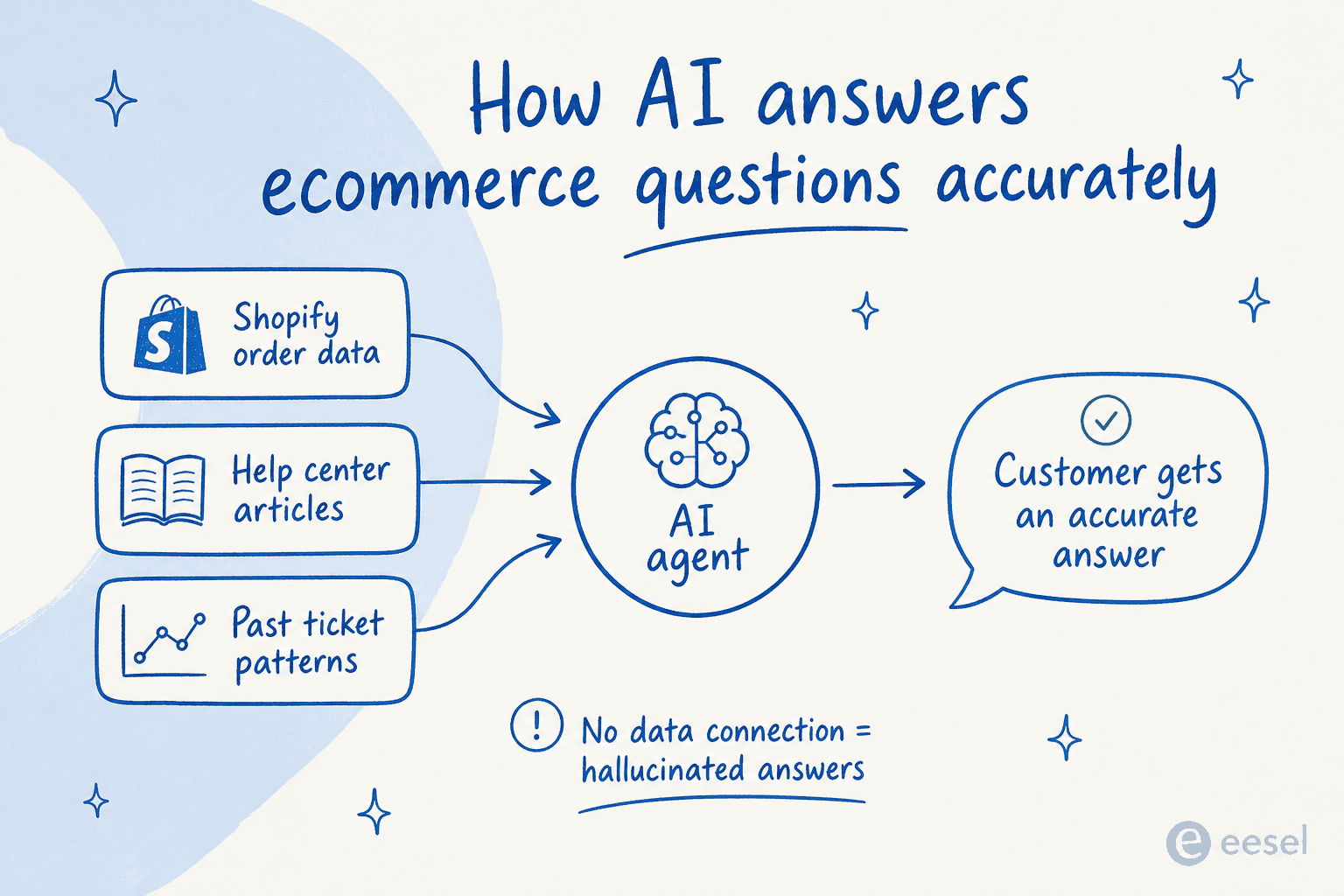
A real example: a German online jewelry retailer running ~1,000 tickets/month on Zendesk + Shopify trialled eesel on real traffic. Results: 93% triage accuracy, 100% spam detection with zero false positives, and perfect accuracy on product inquiries and refund status questions. The accuracy came from the Shopify + Zendesk data connections, not from anything exotic about the AI setup.
When AI hands off to a human
The escalation logic matters as much as the deflection logic. An AI that never escalates isn't safer - it's just covering up misses with confident-sounding wrong answers.
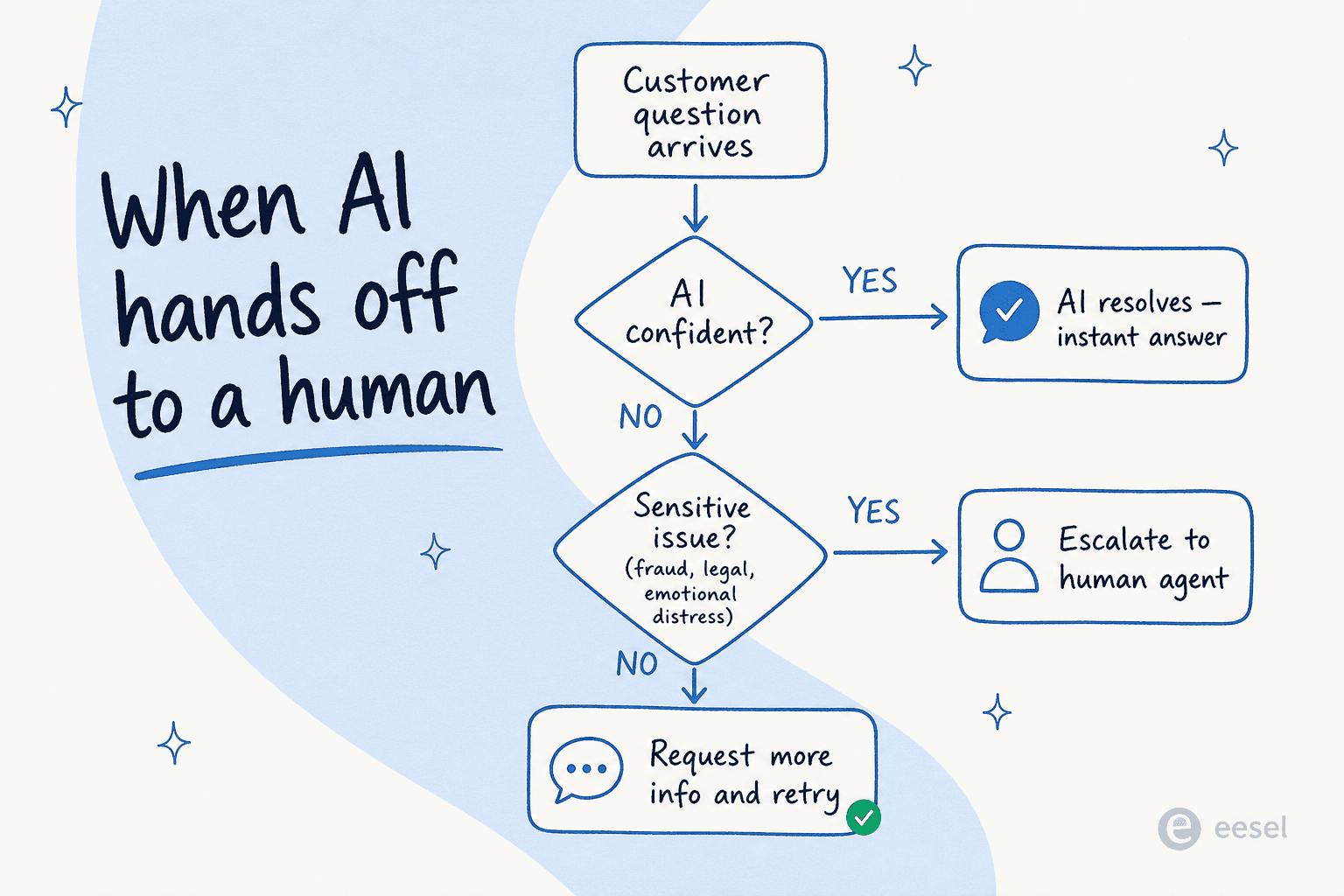
Triggers that should always route to a human:
- Low confidence - the AI doesn't have a high-certainty answer from its sources
- Fraud signals - payment disputes, multiple return requests, mismatched account details
- Emotional distress markers - language indicating high frustration, threats, or explicit escalation requests
- Policy exceptions - the customer is asking for something outside your defined rules
- Explicit human request - the customer asks to speak to a person
Good tools let you configure these thresholds. eesel's AI chat escalation settings let you specify which ticket types, confidence levels, and customer signals trigger a handover - and where that handover goes (a Zendesk ticket, a Gorgias conversation, a Slack notification to your team).
The tools that actually answer ecommerce questions
There are many ways to add AI to ecommerce support. Here's an honest breakdown of the main options - what each is best for and where each falls short.
Quick comparison
| Tool | Best for | Starting price | AI resolution rate | Works with existing helpdesk? |
|---|---|---|---|---|
| eesel | Teams already on Zendesk, Gorgias, or Freshdesk | $0.40/ticket, no platform fee | 73%+ (Gridwise, month 1) | Yes - runs inside your existing stack |
| Gorgias | Shopify-native brands starting fresh | $10/mo + $0.90/AI conversation | 56-60% reported | Gorgias is the helpdesk |
| Tidio | SMBs wanting a standalone chatbot with built-in AI | Free; from $24.17/mo | 67% claimed | Standalone or alongside |
| Richpanel | Brands wanting a full AI-native helpdesk replacement | $500/mo + $0.25/convo | 50% guaranteed (30 days) | Richpanel replaces your helpdesk |
| Shopify Inbox | Merchants wanting free, native Shopify chat | Free | Basic AI-suggested replies | Native Shopify only |
| Re:amaze | SMBs wanting multi-channel support + AI at a per-seat price | $29/seat/mo | 10-20 AI resolutions/user/mo | Re:amaze is the helpdesk |
eesel - best if you're already on a helpdesk
eesel is an AI agent layer that runs inside your existing helpdesk rather than replacing it. If you're on Zendesk, Gorgias, or Freshdesk, you add eesel on top and it starts handling tickets, drafting replies, triaging, and routing - without changing your existing workflow.
Pricing is clean: $0.40 per ticket, no platform fee, no per-seat charges. A store with 500 tickets a month pays $200. Agents pause at your configured spend cap. The free trial gives you $50 in credit to test on real traffic - no card required.
Kim Simpson at Gridwise (a gig-economy driver analytics app on Zendesk) saw 73% of tier-1 requests resolved in the first month with results working within a 7-day trial. The Shopify connection means product and order questions get live answers, not guesses.
Best for: Teams that want AI on top of a helpdesk they already use and like. If you're happy with Zendesk or Gorgias's ticketing but want AI handling the routine queue, eesel fits cleanly without a migration.
Watch out for: eesel isn't a standalone chat widget - it's an AI layer for existing helpdesk workflows. If you don't have a helpdesk yet, you'd set one up first.

Gorgias - best for Shopify-native brands
Gorgias is the most Shopify-native helpdesk on the market - used by 40% of the top 1,500 Shopify brands and Shopify's only Premier Partner for CX. Every ticket and chat conversation surfaces live order data, customer history, and product context from Shopify without any tab-switching.
The AI Agent add-on ($0.90-$1.00 per fully resolved conversation) handles returns, refunds, order edits, subscription changes, and discount code generation directly - not just answering questions, but taking actions in Shopify. Orthofeet achieved 56% automation in under 2 months after deploying the AI Agent. bareMinerals reported 8.83x ROI on their implementation.
Gorgias pricing starts at $10/month for 50 tickets, scaling to $360/month for 2,000 tickets, with the AI add-on priced per resolved conversation on top.
Best for: Shopify brands that want a single platform for helpdesk plus AI, especially starting fresh or willing to migrate their support stack.
Watch out for: Gorgias is expensive relative to ticket volume - roughly 3x the cost of general-purpose helpdesks at the same scale. Community rule of thumb: worth it if 40%+ of your tickets require direct Shopify actions.
Tidio - best for SMBs wanting a standalone chatbot
Tidio combines live chat, a helpdesk, and an AI agent (Lyro) in a single product. Lyro is powered by Anthropic's Claude and claims a 67% average resolution rate - which Tidio positions as the highest in the customer support AI market. Over 300,000 businesses use it, including The Body Shop, Stanley, and Dermalogica.
Bella Sante, a spa chain, generated $66K+ in revenue attributed to Lyro conversations. Suitor, a menswear brand, saw a 97% decrease in response time after deploying Lyro. There's a money-back guarantee if resolution rate stays below 50%.
Pricing starts free (50 Lyro conversations lifetime), with paid plans from $24.17/month. The Growth plan at $49.17/month includes Shopify actions and advanced analytics. Lyro as a standalone starts at $32.50/month for teams with an existing helpdesk.
Best for: SMBs that want an all-in-one chat plus AI product without managing multiple tools.
Watch out for: At scale (10K+ conversations), per-conversation pricing adds up quickly. The Plus plan starts at $749/month.
Richpanel - best for brands wanting full AI-native helpdesk replacement
Richpanel replaces your helpdesk entirely with an AI-native alternative built for ecommerce. It ships four AI roles out of the box: Frontline AI (customer-facing resolution), Copilot AI (human agent assist), QA AI (reviews every reply before it sends), and CX Manager AI (orchestrates the others and builds SOPs). Used by 2,000+ brands including Jones Road Beauty, The Ridge, and Pela.
The QA AI layer is the standout feature for anyone worried about hallucination: it grades every response before it goes out and flags uncertainty before it reaches a customer. Jones Road Beauty went from 18 to 10 agents while revenue grew, with CSAT climbing from 88% to 96%. Richpanel guarantees 50% autonomous resolution in 30 days or a full refund.
Pricing starts at $500/month base plus $0.25/AI conversation. A sample bill: 2 AI agents plus 3 human seats = $800/month.
Best for: Ecommerce brands ready to replace their helpdesk entirely with an AI-first system, especially Shopify brands with high BFCM volumes.
Watch out for: The $500/month minimum is hard to justify for lower-volume stores. ROI breakeven is roughly 2,000 conversations/month.
Shopify Inbox - the free starting point
Shopify Inbox is the native chat tool that ships with every Shopify subscription. It's free, installs in minutes, and surfaces cart contents and order history inside every conversation. 70% of Shopify Inbox conversations involve customers in active purchasing decisions, making it as much a sales tool as a support channel.
The AI features are lightweight: Shopify Magic suggests FAQ answers based on your store content, and AI-suggested replies help agents respond faster. It's not an autonomous AI agent - it still needs a human to review and send every message.
Best for: Merchants just starting with AI-assisted chat, or stores where a human is always available to respond. Zero cost makes it a sensible first step before investing in a dedicated tool.
Watch out for: If you want AI to actually resolve tickets without human involvement, Shopify Inbox isn't there yet. It's an AI assist tool, not an autonomous agent.
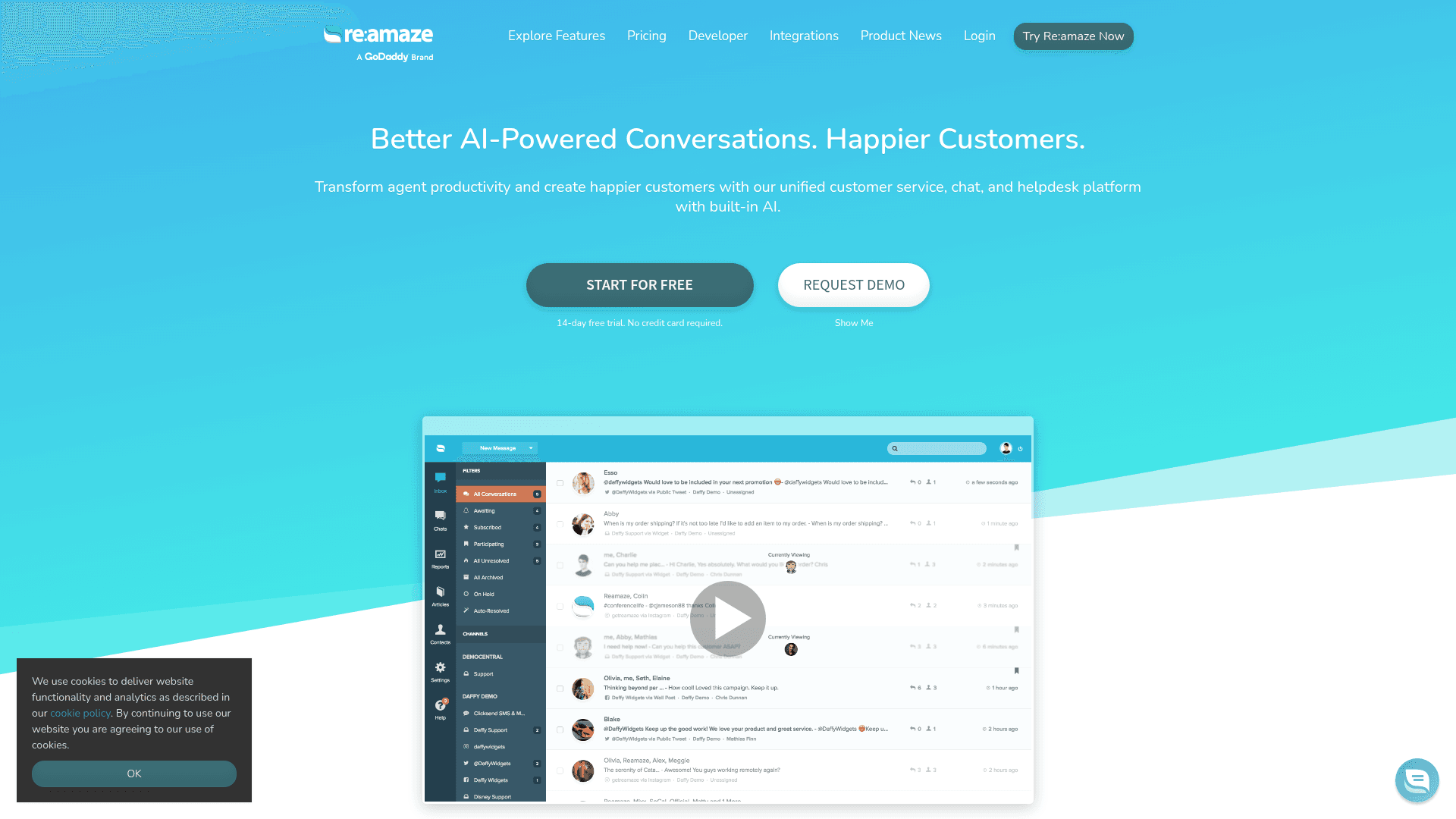
Re:amaze - good SMB multi-channel option
Re:amaze (owned by GoDaddy since 2021) bundles email, live chat, social media, SMS, and push notifications into a single inbox with an AI Agent in beta. It's priced per seat - $29-$69/month depending on the plan - with AI resolutions capped per user per month (5 on Basic, 10 on Pro, 20 on Plus).
The AI resolution cap model is worth understanding before you commit: at $0.85/overage resolution, heavy AI volumes get expensive. For stores doing 1,000+ AI-resolved tickets a month with a small team, the economics shift quickly. For teams wanting multi-channel support at a predictable per-seat cost, Re:amaze is worth evaluating.
Best for: Small ecommerce teams wanting multi-channel support in one place at a known monthly cost.
Watch out for: AI resolution caps per seat limit scalability for high-volume stores.
How to actually get AI answering your questions well
Two things matter more than tool choice:
1. Connect your order data first. Every tool above has a Shopify integration - use it before anything else. Without live order data, WISMO questions get generic answers, and WISMO is your biggest category. This single connection typically deflects 30% of your queue on its own. Our guide on how to connect Shopify order data to your AI chatbot walks through the exact setup.
2. Train on your policies, not just your products. Most AI setups fail because teams train the AI on product descriptions and forget to give it the actual return policy, the exceptions to that policy, and the escalation paths for edge cases. The AI then either over-applies rules ("return window closed, can't help") or gives vague non-answers ("please contact support") - both of which defeat the purpose.
Beyond those two: start with your highest-volume question type (almost always WISMO), get that working well, then expand. Trying to automate everything at once leads to sprawling prompts and declining accuracy. AI customer service workflow automation works best built category by category.
If you're on a platform other than Shopify, the same principles apply - we've covered the specifics for WooCommerce, BigCommerce, and ecommerce helpdesks separately.
It's also worth checking how much AI can save in customer support before you pick a tool - the cost-per-ticket math changes significantly depending on whether you're adding an AI layer to an existing stack or replacing your helpdesk entirely.
Try eesel
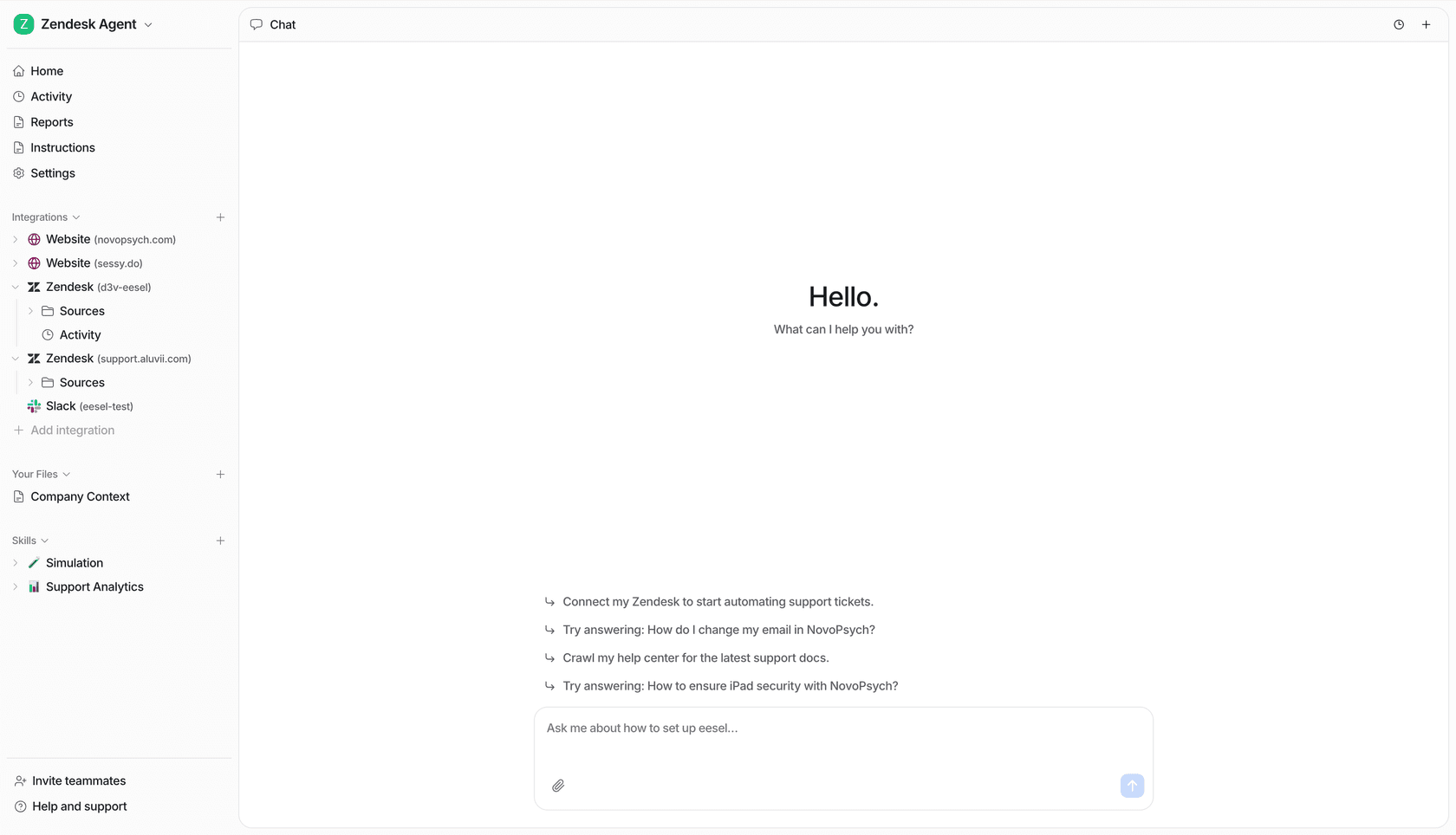
eesel is an AI agent that sits inside your existing helpdesk - Zendesk, Gorgias, Freshdesk, or any of 100+ supported platforms - and handles your support queue without a migration or workflow change. Connect it to Shopify and your help center, brief it like a new team member, and it starts resolving tickets: order status, returns, product questions, account changes.
Pricing is $0.40 per ticket, no platform fee, no seat charges. The free trial gives you $50 in credit to test on real traffic - no card required.
"In the first month, eesel is resolving 73% of our tier 1 requests. Our team achieved results quickly during our 7-day trial."
Kim Simpson, Gridwise (G2 review)
The best AI for Shopify customer support depends on your stack - but if you're already on a helpdesk and want AI on top of it rather than a full replacement, eesel is where we'd start.
Frequently Asked Questions

Share this article

Article by
Rama Adi Nugraha
Rama is a software engineer at eesel AI with two years of experience writing about B2B SaaS, AI tools, and customer support technology. Based in Bali, Indonesia, he brings a developer's perspective to product comparisons — cutting through marketing copy to what the integrations and APIs actually do.