The 6 best ChatGPT AI tools that will actually improve your business in 2025

Last edited January 9, 2026

ChatGPT is an incredibly versatile tool. It can compose poetry, explain complex topics, and even provide a recipe for banana bread. However, for specialized business tasks, it can sometimes require significant effort to craft the perfect prompt for consistent results.
Many "AI tools" have emerged, with some offering a new interface for the same underlying technology. It can be challenging to identify which tools provide genuine workflow enhancements.
To help, we've evaluated numerous tools to identify those that offer significant value. These are the tools that integrate into your workflows, understand your business context, and deliver results that go beyond a simple copy-paste from a chatbot.i tried jasper but chatgpt covers most of the same tasks if you prompt it right. the main difference with other tools is when they add seo checks or structure drafts so they’re ready to post.

Here’s our list of the 6 best ChatGPT AI tools for 2025 that can help make your business more productive.
What exactly are ChatGPT AI tools?
"ChatGPT AI tools" are specialized apps built on the powerful technology that powers ChatGPT, like OpenAI's GPT models. They aren’t entirely new, separate AIs; think of them as tailored interfaces designed to perform specific jobs effectively.
This is why they are important. They save you from needing to become a "prompt engineering" expert for every task and help create a repeatable, reliable system around AI. For instance, instead of manually feeding customer questions into a chatbot, a workflow tool like eesel AI can be hired as an AI teammate that learns from your past support tickets and begins handling customer conversations autonomously, directly within your help desk. That’s when AI transitions from a demonstration to a real business asset.Yeah, totally agree - most wrappers are just UX layers over ChatGPT.
How we picked the best ChatGPT AI tools
- Value Beyond ChatGPT: Does it offer a capability you can't easily replicate by writing a good prompt in the standard ChatGPT application? The tool must provide a unique advantage.
- Workflow Integration: How smoothly does it fit into your existing work processes? The best tools feel like a natural part of your help desk, code editor, or CRM, not an extra browser tab.
- Ease of Use: Is it intuitive? Can your team start using it and see results quickly without extensive training?
- Specialization: Is it highly proficient in one area? We looked for tools that are exceptional at a specific business function, whether it’s marketing, support, sales, or development.
- Transparent Pricing: Is the cost structure clear? We prioritized tools with fair pricing that aligns with the value they provide.
Quick comparison of the top ChatGPT AI tools
Here's a quick side-by-side look at our top picks to help you find the right fit at a glance.
| Tool | Best For | Key Feature | Starting Price |
|---|---|---|---|
| eesel AI Blog Writer | SEO Content Creation | Generates complete, AEO-optimized articles with assets | Free to try, then $99/mo for 50 blogs |
| Zapier | Workflow Automation | Connecting ChatGPT to 8,000+ other apps | Free plan available, paid from $19.99/mo (billed annually) |
| GitHub Copilot | Software Development | Real-time code suggestions and automated fixes | Pro plan starts at $10/mo |
| Grammarly AI | Writing & Editing | AI writing assistance and agents across 1M+ sites | Free plan available, Pro from $12/mo (billed annually) |
| Perplexity AI | Research & Fact-Finding | Conversational search with real-time, cited sources | Free plan available, Pro for $17/mo (billed annually) |
| CustomGPT | Personalized Chatbots | Creating a custom, secure chatbot trained on your data | Standard plan starts at $99/mo |
Our top 6 ChatGPT AI tools for 2025
Let's get into the details. Here’s a closer look at what makes each of these tools a valuable addition to your business.
1. eesel AI Blog Writer
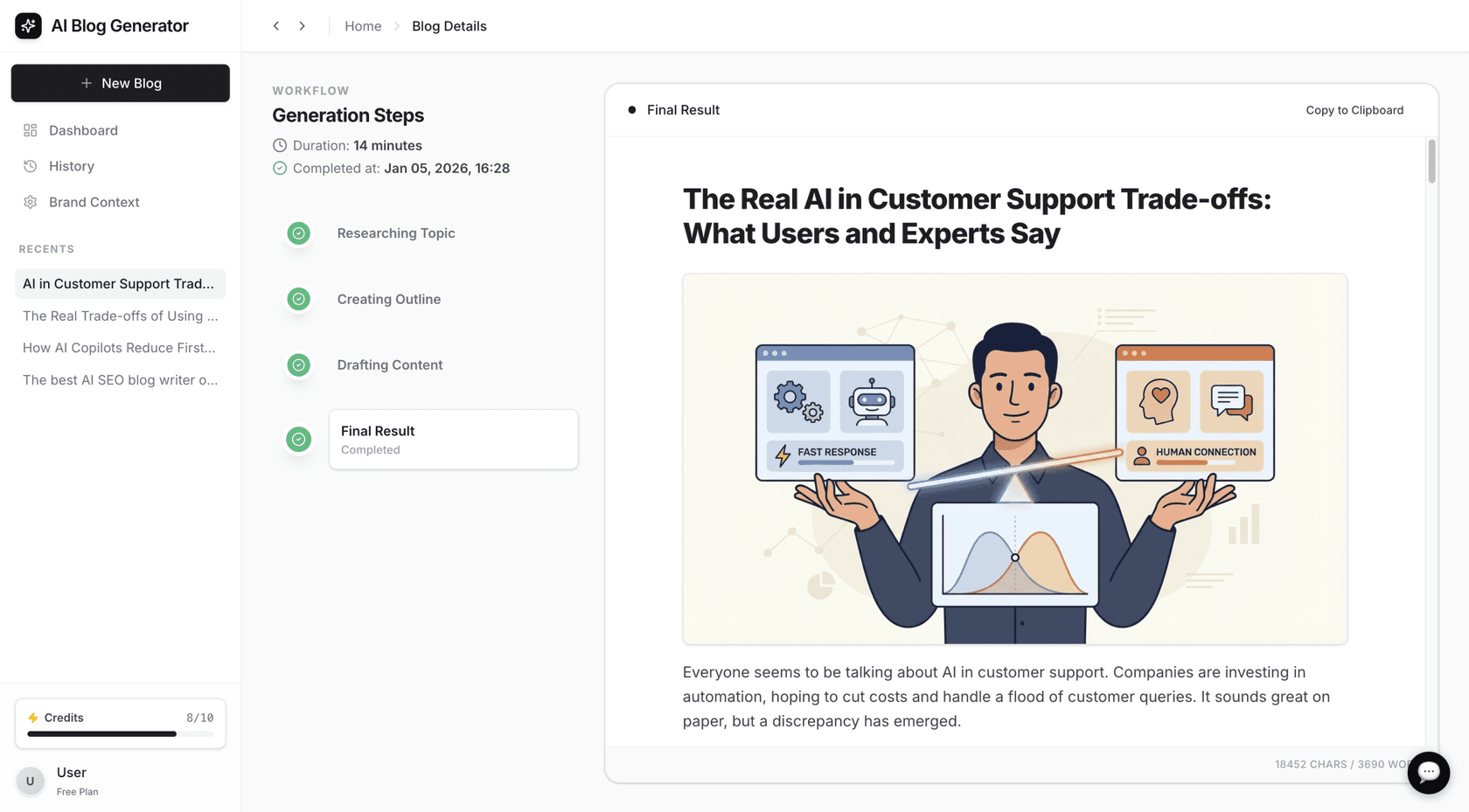
- Pros: Its main strength is its focus on creating content designed to rank. It's optimized for both traditional SEO and AEO (Answer Engine Optimization), which is important for visibility in features like Google's AI Overviews. You provide your website URL, and it automatically learns your brand context, weaving in product mentions that sound natural.
- Cons: It's designed specifically for creating high-quality, discoverable content at scale. If you're looking to write a novel or a highly creative, narrative-driven piece, this is not the tool for that purpose.
- Pricing:
- You can try it completely free and generate your first full article to see the quality for yourself.
- The Early Bird plan starts at $99 per month for 50 blog generations.
2. Zapier
- Pros: Its library of over 8,000 integrations is its primary strength. It transforms ChatGPT from a standalone tool into an integrated component that can power a vast number of workflows, from updating your CRM to scheduling social media posts.
- Cons: For more complex, multi-step Zaps, there can be a learning curve. Additionally, costs can increase if you're running a high volume of tasks each month.
- Pricing:
- A free plan is available to get started with a limited number of tasks.
- Paid plans start at $19.99 per month when billed annually.
3. GitHub Copilot
if you’re already in VS Code, GitHub Copilot is hands down the best option right now. it can autocomplete, refactor, and explain code in real time.
- Pros: The integration is seamless. It offers contextual suggestions much like a pair programmer. It’s effective for writing tests, filling out boilerplate code, and translating code between languages. At companies like Duolingo, it has been shown to boost developer speed by 25%.
- Cons: The suggested code is not always perfect and requires human review, especially for complex or security-critical parts of an application. There's also a risk that junior developers might rely on it too heavily instead of building foundational skills.
- Pricing:
- A limited free plan is available.
- The Pro plan for individuals starts at $10 per month.
4. Grammarly AI
- Pros: Its primary advantage is its ubiquity; it is available where you write. The tone adjustment feature is particularly useful for ensuring messages land correctly. Agents like the Citation Finder are helpful for anyone writing research-based content.
- Cons: The free version is limited. The more powerful AI features require a Pro subscription. The AI suggestions can sometimes be overly assertive and may not capture the nuance in very creative or technical writing.
- Pricing:
- The free plan covers basic grammar and spelling.
- The Pro plan starts at $12 per member per month with annual billing.
5. Perplexity AI
Perplexity AI describes itself as a "conversational answer engine." When you ask it a question, it doesn't just retrieve an answer from its training data. It searches the web in real-time and provides a concise summary with citations and links to the sources it used, making it a reliable tool for business research.
- Pros: The inclusion of citations is a key feature. In a business context where accuracy is critical, this is a significant advantage. It addresses the issue of "hallucinations" where other AIs may generate incorrect information. Their Enterprise plan also focuses on security, stating it will never train its models on customer data.
- Cons: It is primarily a research tool. It does not have the same creative writing capabilities as other tools and is not designed for integration into other automated workflows.
- Pricing:
- A capable free version is available.
- Perplexity Pro is $17 per month (billed annually), and Enterprise Pro starts at $40 per user per month.
6. CustomGPT
- Pros: It's an effective way to create a secure AI assistant that is aligned with your brand. Because it's trained only on your information, the answers are highly relevant and accurate, and it's built on an anti-hallucination architecture. It is also SOC 2 Type II compliant, which is important for businesses handling sensitive data.
- Cons: The chatbot's effectiveness depends on the quality of the information you provide. Upfront effort is required to gather and organize your knowledge base for the best results.
- Pricing:
- The Standard plan starts at $99 per month ($89/mo if you pay annually).
- A 7-day free trial is available to test it out.
How to choose the right ChatGPT AI tools for your team
Choosing the right tool can seem challenging. Here’s a simple way to approach it.
- Start with the problem, not the tool. Identify the biggest bottleneck in your business. Is it writing blog posts? Answering repetitive customer questions? Fixing bugs in your code? Once you know the problem, you can find a specialized tool that solves it. For example, if your team is handling a high volume of repetitive support tickets, a generic chatbot may not be sufficient. You might need an AI teammate like eesel AI that integrates with your help desk and resolves issues.
- Prioritize workflow integration. The best tools don't feel like another app to manage. They fit into your existing software. Look for tools that connect with your help desk, CRM, code editor, or wherever your team spends their time.
- Test before you invest. Almost every tool on this list has a free trial or a free version. Use it to see how it performs on your real-world tasks before committing to a subscription.
- Don't pay for duplication. Consider if a tool's main feature offers value beyond what can be achieved with a well-crafted prompt in ChatGPT. Look for unique value, whether it’s deep integrations, specialized data, or a user experience built for a specific job.
For a visual walkthrough of some of the best AI tools available and how they can boost productivity, check out the video below. It provides a great overview of what's possible when you go beyond a basic chatbot.
Go beyond the chatbox with ChatGPT AI tools
While ChatGPT introduced a new era of AI, tangible business results often come from specialized tools that apply the technology to specific problems. The tools on this list represent the next step, moving AI from a simple chat window to a fully integrated, workflow-native teammate.
Whether you're looking to automate your content pipeline, accelerate your development cycles, or connect your entire ecosystem of apps, there's a tool that can help you get it done faster and smarter.
If creating high-quality, SEO-optimized content is your biggest challenge right now, see what a specialized AI can do. Try the eesel AI Blog Writer for free and generate a complete, ready-to-publish article from a keyword in minutes.
Frequently Asked Questions

Share this article

Article by
Stevia Putri
Stevia Putri is a marketing generalist at eesel AI, where she helps turn powerful AI tools into stories that resonate. She’s driven by curiosity, clarity, and the human side of technology.