7 best ChatGPT alternatives in 2026 (I tested them all)


Last edited June 12, 2026

Table of Contents
- Why people leave ChatGPT
- The 7 best ChatGPT alternatives in 2026
- 1. Claude - best for writing and coding
- 2. Gemini - best for Google ecosystem users
- 3. Perplexity - best for real-time research
- 4. Microsoft Copilot - best for Microsoft 365 teams
- 5. Grok - best for real-time news and X data
- 6. DeepSeek - best for free and open-source access
- 7. eesel - best for teams who need AI on their own knowledge
- How to pick the right ChatGPT alternative
- Try eesel
Why people leave ChatGPT
ChatGPT is the product that proved conversational AI works at scale. It earned that reputation. But a few friction points keep driving people to look elsewhere.
Cost. The ChatGPT Plus plan costs $20/month, and the Pro plan - which unlocks the full power of GPT-5.5 Pro and 400K context - runs $100/month. For heavy users, that's $1,200/year for a single AI subscription. Most alternatives match the $20 mark, and at least one (DeepSeek) is free entirely.
Rate limits. Even Plus users hit "reasonable use" throttling on longer sessions. The free tier is especially limited - only access to GPT-5.5 Instant, a 27K context window, and per-day message caps. Pro isn't "unlimited" either; it comes with "abuse guardrails."
No real-time web, by default. Standard ChatGPT conversation doesn't pull from the live web unless you're using a plan that includes Deep Research or web search. Perplexity, Gemini, and Grok are built around live retrieval from the start.
Privacy concerns. OpenAI's default setting allows your chats to be used for model training. You can opt out, but it's not opt-in. For enterprise teams handling sensitive data, this creates friction that competing tools (some with stronger default privacy postures) don't.
No company-specific knowledge. This is the big one for teams. ChatGPT knows the public internet, but it doesn't know your support ticket history, your product documentation, or the decisions buried in your Slack threads. None of the general-purpose tools solve this - it takes a purpose-built product.
The 7 best ChatGPT alternatives in 2026
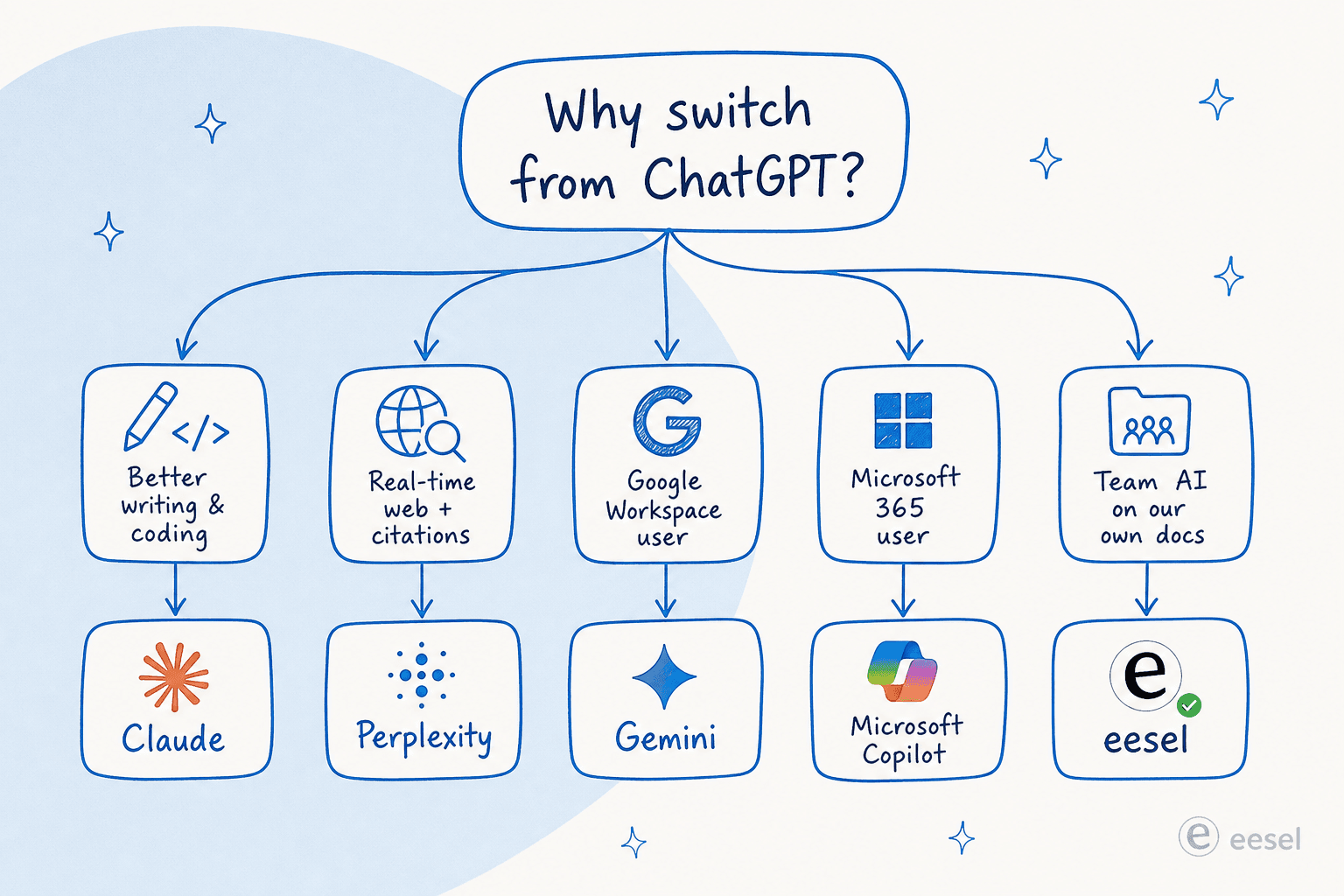
Here's where each tool lands before we go into the detail:
| Tool | Best for | Free tier | Paid from |
|---|---|---|---|
| Claude | Writing, coding, long docs | Yes | $17/mo |
| Gemini | Google ecosystem, research | Yes | $7.99/mo |
| Perplexity | Cited web research | Yes | $17/mo |
| Microsoft Copilot | Microsoft 365 teams | Yes | $18/user/mo |
| Grok | Real-time news, X/Twitter | Yes | ~$30/mo |
| DeepSeek | Free use, technical tasks | Yes | API only |
| eesel | Teams needing company knowledge AI | Trial | $0.40/task |
1. Claude - best for writing and coding
Claude is Anthropic's AI assistant, and it holds the strongest position of any ChatGPT alternative for two specific tasks: writing and coding. The gap is real enough that it shows up consistently in community data - 78% of developers prefer Claude over ChatGPT for code tasks, citing multi-file project handling, more readable output, and a habit of actually flagging uncertainty rather than confidently producing broken logic.
For writing, Claude's output is consistently described as less "AI-smelly" - fewer sycophantic openers, fewer reflexive bullet points, better voice matching. That's a real differentiator for content teams and anyone drafting longer-form work.
Pricing
| Plan | Price | What you get |
|---|---|---|
| Free | $0 | Chat, web search, code execution, memory, file creation |
| Pro | $17/mo (annual) / $20/mo (monthly) | Everything free + Claude Code, Cowork, more models, Microsoft 365 |
| Max | From $100/mo | 5x or 20x more usage than Pro, priority access |
| Team Standard | $20/seat/mo (annual) | All Pro features, SSO, admin controls, no model training on content |
| Team Premium | $100/seat/mo (annual) | 5x more usage than standard seats |
The Claude Pro plan at $17/month annually is a straightforward trade if you write or code daily. The 200K-token context window (roughly 150,000 words) lets you drop entire codebases or long documents into a single conversation - something ChatGPT Plus at $20/month doesn't match at its 54K ceiling.
What's worth knowing
Claude's context window and instruction-following are consistently praised. On coding specifically: it maintains style rules throughout a long response, doesn't "forget" constraints mid-session, and handles multi-file refactoring more reliably than ChatGPT.
The honest caveat is that the user community has documented a rough few months of quality regression. Opus 4.7 was widely called a step backward (nicknamed "Gaslightus-4.7" in some threads), uptime dipped in early 2026, and Anthropic was slow to acknowledge some of the issues. Opus 4.8 has partially recovered trust, but power users report the rate limits on a $20/month Pro account still bite hard.
"One complex prompt to Claude and by the end you've burned 50-70% of your 5-hour limit."
Developer survey: Claude Code vs Codex, 500+ devs, 388 upvotes
Verdict: Claude is the best single ChatGPT alternative for writing and coding - but go in with eyes open about rate limits on lower plans. Coders doing heavy sessions may find themselves needing the $100/month Max tier to avoid interruptions.
2. Gemini - best for Google ecosystem users
Gemini is Google's AI assistant and the most practically integrated option for anyone whose work runs through Google Workspace. If you draft in Google Docs, analyze data in Sheets, or manage your day in Gmail and Calendar, Gemini works directly inside those surfaces - not as a separate tab you switch to.
The model lineup after 2025's quality leap is genuinely competitive. Gemini 3.5 Flash handles agentic coding tasks and scored 76.2% on Terminal-bench 2.1. The flagship models have a 1M-token context window - 5x larger than Claude Pro's 200K and 18x larger than ChatGPT Plus's 54K.
Pricing
| Plan | Price | What you get |
|---|---|---|
| Free | $0 | Gemini 3.5 Flash, limited 3.1 Pro access, 15 GB storage |
| AI Plus | $7.99/mo | Gemini 3.1 Pro, 2x limits, 200 GB storage |
| AI Pro | $19.99/mo | 4x limits, 5 TB storage, Jules coding agent, YouTube Premium Lite |
| AI Ultra | $99.99/mo | Deep Think, 20-30 TB storage, up to 25,000 Flow credits |
Gemini pricing at the AI Plus tier is the best deal in the lineup at $7.99/month - for light to moderate use, it gives you access to 3.1 Pro at less than half the price of Claude Pro or ChatGPT Plus. For a full Gemini vs ChatGPT comparison, we have a dedicated post.
What's worth knowing
Gemini's real-time grounding via Google Search is seamlessly integrated - you get up-to-date answers without needing to switch modes or enable a special feature. That alone makes it genuinely better than ChatGPT for anything time-sensitive. The math and technical precision community users praise is measurable: Gemini 3.1 Deep Think is specifically tuned for science and reasoning.
The community friction mainly runs around subscription value: paying Gemini subscribers have reported getting worse model access than free users in some rollouts - a pattern that mirrors Google's broader AI product launches. For a Gemini vs Perplexity breakdown, we cover that directly too.
Verdict: Gemini is the obvious call if your workflow lives in Google Workspace. For anyone else, Claude and Perplexity will likely edge it out for specific tasks. The AI Plus plan at $7.99/month is an unusually good value.
3. Perplexity - best for real-time research
Perplexity does one thing differently from every other tool on this list: every answer it gives you shows exactly where the information came from, inline, with clickable citations. That sounds like a small detail until you realize how often you spend time fact-checking AI responses that cite nothing.
The positioning is "AI for the curious" - which means researchers, analysts, journalists, and anyone who needs to verify claims before acting on them. Its backing by real-time web indexing means there's no knowledge cutoff. You get current information the same day, not whenever the model was last trained.
Pricing
| Plan | Price | What you get |
|---|---|---|
| Free | $0 | ~5 Pro searches/day, unlimited standard searches |
| Pro | $17/mo (annual) / $20/mo (monthly) | 300+ searches/day, GPT-5.4 + Claude Sonnet 4.6 + Gemini 3.1 Pro access |
| Education Pro | $5/mo | Full Pro features with .edu email |
| Max | $167/mo (annual) / $200/mo (monthly) | Unlimited deep research, 10k monthly + 35k bonus Computer credits |
| Enterprise Pro | $40/seat/mo | SOC 2 compliance, team Spaces, admin controls |
The Perplexity Pro plan is often cited as the best value consolidation in AI tools: for $20/month you get access to ChatGPT's GPT-5.4, Claude Sonnet 4.6, and Gemini 3.1 Pro from a single interface - tools that would cost $60/month to subscribe to individually.
What's worth knowing
Perplexity also has Perplexity Computer, an agentic task execution layer available on Pro and Max that handles multi-step browser automation, data extraction, and integrations with Gmail, Slack, Notion, Linear, and 100+ tools. It's a meaningful upgrade over basic chat.
The one honest caveat from 2026 community threads: a vocal segment reports undisclosed throttling on deep research (roughly 10 deep research prompts per week rather than the advertised unlimited), and some inconsistency in model routing. G2 reviewers still rate it 4.5/5, and high-volume users find the value holds - but it's worth knowing the friction exists.
Also worth noting: for a Claude vs Perplexity breakdown if you're deciding between the two, we have that covered separately.
Verdict: Perplexity is the best ChatGPT alternative for anyone who needs real-time, cited research. The free tier is more functional than most, and Pro's multi-model bundling makes the math work in its favor versus subscribing to tools separately.
4. Microsoft Copilot - best for Microsoft 365 teams
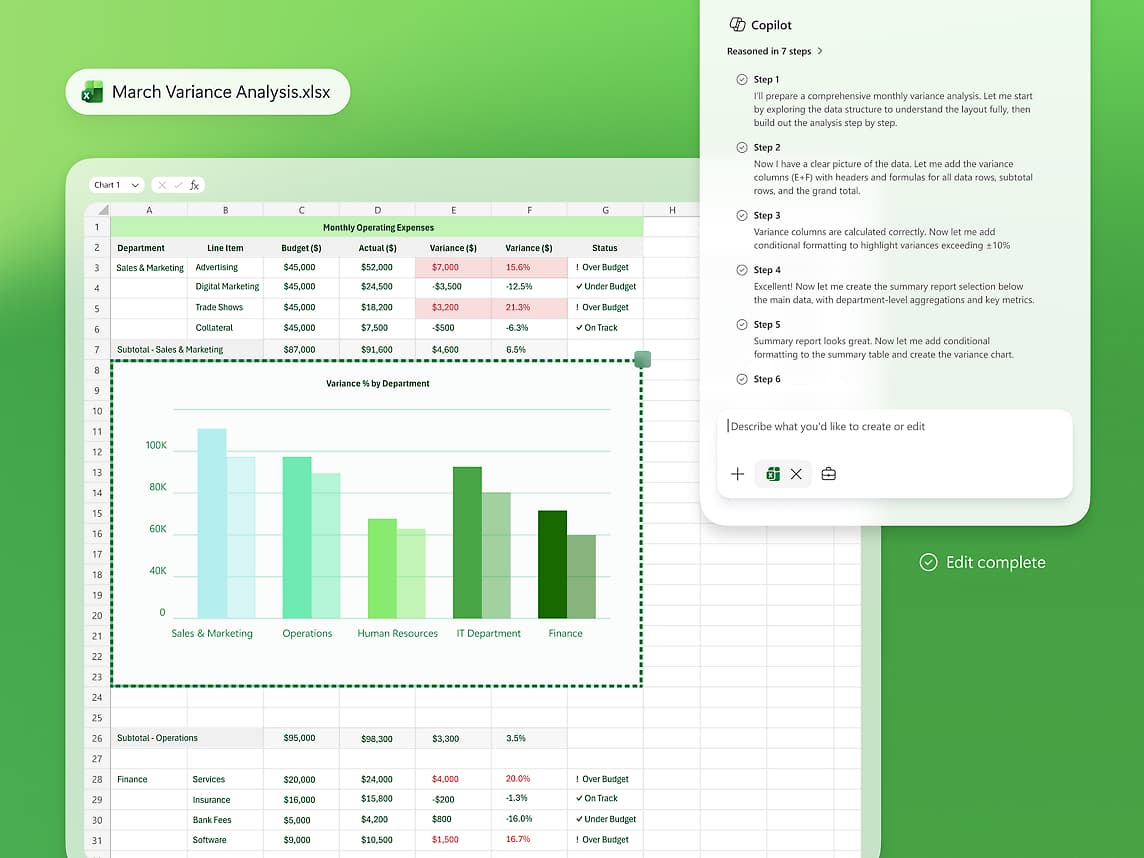
Microsoft Copilot is the ChatGPT alternative you already have budget for - if your organization pays for Microsoft 365. The free consumer version works on the web and mobile. The paid business tiers plug directly into Word, Excel, PowerPoint, Teams, and Outlook, turning the tools your team uses every day into AI-augmented surfaces.
The argument for Copilot is almost entirely about integration depth. You're not adding a new tool - you're getting AI inside the tools your team already runs. Meeting summaries in Teams, formula generation in Excel, email drafting in Outlook. It runs on the same security and compliance policies your IT team already manages.
Pricing
| Plan | Price | What you get |
|---|---|---|
| Copilot (Free) | $0 | Web chat, image generation, no app integrations |
| Business | $18/user/mo (annual) | Copilot in Teams, Outlook, Word, Excel, PowerPoint; custom agents |
| Enterprise | $30/user/mo (annual) | Everything Business + OneNote, no metered agent costs, voice |
Note: Business and Enterprise plans require a separate qualifying Microsoft 365 license on top of the Copilot fee.
What's worth knowing
Microsoft's own 2026 Work Trend Index projects 116% ROI for large enterprise users, based on 8+ hours saved per user per month. That math only works if adoption follows - and Whatfix research found only 35.8% of eligible users actually use Copilot after deployment. The tool shines for heavy Word and Excel users; it's less compelling if you're mostly in chat.
Claude vs Copilot is a useful comparison if you're deciding between embedding AI into Microsoft workflows versus choosing a standalone assistant with broader capability.
Verdict: Microsoft Copilot is the clearest call for Microsoft 365 teams - not because it's the best AI, but because the integration advantage is real and it inherits your organization's security posture automatically. For teams outside the Microsoft ecosystem, the other options here will likely serve you better.
5. Grok - best for real-time news and X data
Grok is xAI's flagship AI assistant and the only tool on this list with native, built-in access to live X (formerly Twitter) posts. If you need to track what's happening in real time - breaking news, market sentiment, community reactions - Grok's x_search tool pulls from the live X stream in a way no other model can match.
The model is grok-4.3, with a 1M-token context window and API prices that are among the most competitive on the market at $1.25/1M input tokens. xAI's Colossus supercluster sits behind the inference, and the company has been moving fast: Grok Build 0.1 for agentic coding launched May 2026, and Grok Voice was named the top speech reasoning model by Artificial Analysis in February 2026.
Pricing
| Plan | Price | What you get |
|---|---|---|
| Free | $0 | Grok chat with limited daily usage, all modalities |
| SuperGrok | ~$30/mo | Higher limits, priority access, multi-agent mode, Grok Build beta |
For a full Grok review with real usage testing, we've covered that separately.
What's worth knowing
Grok's real differentiator - the X/Twitter real-time data access - is also a niche one. If you don't follow X closely or don't have workflows built around social signal, that advantage is theoretical rather than practical. The community candor from r/grok is that the model itself is strong ("the goods are really good") but production reliability is inconsistent: random spikes in reasoning token usage, tool-calling failures in certain IDEs, and an aggressive model retirement schedule (8 models retired in a single day in May 2026) frustrated developers who'd built integrations.
Verdict: Grok is the right choice if you specifically need real-time X/social data access, or if the API price matters and you're building something. For general conversational AI, Claude or Gemini edges it out.
6. DeepSeek - best for free and open-source access
DeepSeek is the most disruptive entrant on this list. The web chat is completely free with no paywall, no daily limit, and access to the full DeepSeek-V4 model. A Reddit post titled "ChatGPT Plus is dead" received 4,000 upvotes in a single day when DeepSeek launched, capturing user sentiment: why pay $20/month when DeepSeek reasons comparably for free?
The technical performance is real. DeepSeek R1's reasoning is described as "neck-and-neck with OpenAI's O3 on LiveCodeBench", and a Frontiers in Artificial Intelligence analysis of 46,649 Reddit posts found approximately 90.9% positive sentiment when comparing DeepSeek directly to ChatGPT. The models are also published open-source with full weights - meaning technically capable teams can self-host.
Pricing
| Access | Price | Notes |
|---|---|---|
| Web chat | Free, unlimited | chat.deepseek.com |
| API - V4-Flash (cache hit) | ¥0.02/M tokens | ~$0.003/M tokens at current rates |
| API - V4-Pro (cache miss) | ¥3/M tokens | ~$0.41/M tokens |
The API pricing is denominated in Chinese yuan and requires a Chinese payment method for direct access - most non-China developers access it via third-party gateways.
What's worth knowing
The privacy concerns are substantial and documented. All data is stored on servers in China. Cybersecurity researchers found hidden code capable of transmitting user data to CMPassport.com, a state-controlled telecom registry, collecting chat history, device info, and IP addresses. The response was institutional: Italy banned DeepSeek within 72 hours, 13 EU jurisdictions launched probes, and the US Navy, NASA, and several government agencies blocked access.
There are also documented content restrictions: systematic filtering of sensitive topics related to Chinese geopolitical positions, with inconsistent enforcement that can sometimes be bypassed.
For individual use on non-sensitive technical tasks, DeepSeek may be fine. For anything business-critical or privacy-sensitive, use Claude, Gemini, or Perplexity.
Verdict: DeepSeek offers the best performance-per-dollar of any option on this list - because the dollar cost is zero. But the hidden cost is data sovereignty, and that's a real consideration before routing sensitive work through it.
7. eesel - best for teams who need AI on their own knowledge
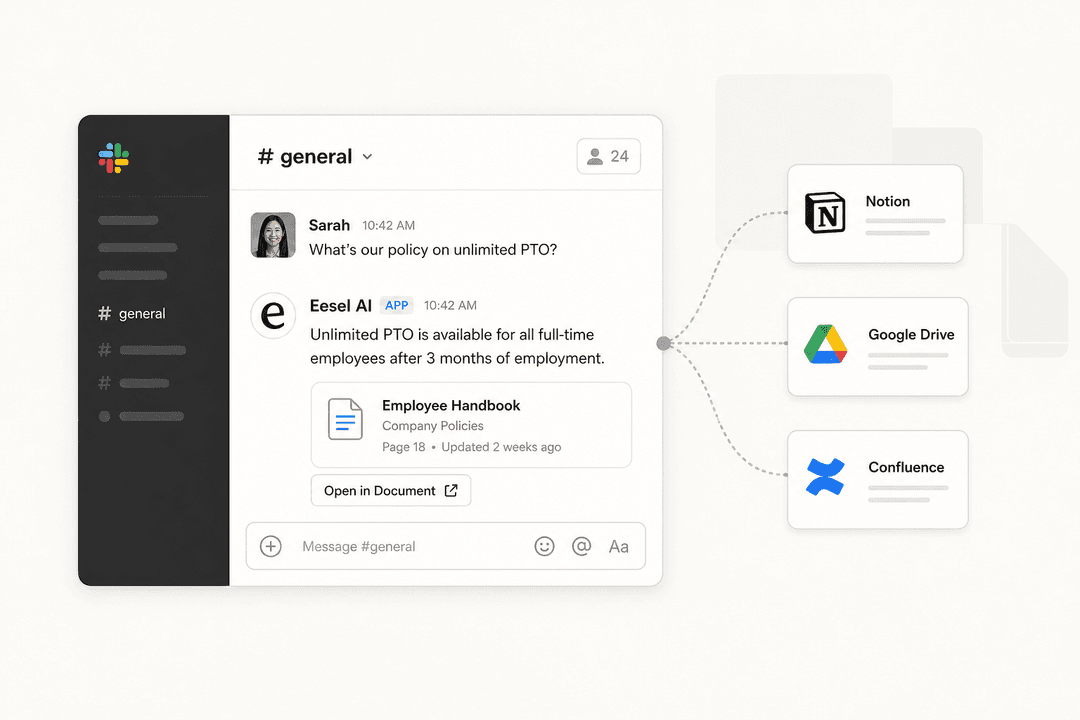
The tools above are all variations on the same idea: a general-purpose AI assistant that knows the public internet well and your organization not at all. eesel solves the problem none of the others touch - deploying an AI teammate that actually knows your company's specific knowledge.
The pitch is direct: rather than copying and pasting context from Slack, Confluence, or Zendesk into a chat window and hoping the AI figures it out, eesel agents are trained on your existing knowledge base and act as autonomous workers inside the tools you already use. An eesel helpdesk agent reads your ticket, drafts a reply using your actual product documentation, escalates based on your stated rules, and logs the resolution - without a human having to feed it the context every time.
It runs directly inside 100+ integrations - Zendesk, Slack, Freshdesk, email, Shopify, and more. There's no new interface to onboard to, and the briefing model is intentionally close to onboarding a new employee: plain-language instructions, no prompt engineering required.
Pricing
| Plan | Price | What you get |
|---|---|---|
| Free trial | $50 credit, no card required | Full feature access to test |
| Regular task | $0.40 each | Ticket handling, chat responses |
| Heavy task | $4.00 each | Blog posts and long-form content |
| Annual commit (≥$300/mo) | 25% discount | |
| Enterprise | $1,000/mo + usage | Dedicated onboarding, SLA, custom setup |
There are no seat fees and no monthly minimums on self-serve. The pricing scales with what you actually use rather than charging per user regardless of usage volume.
What's worth knowing
eesel's model is clearly different from a general AI assistant - it's purpose-built for autonomous workflows on company-specific knowledge, not for one-off chat. Teams running high volumes of repetitive support or content tasks (100,000+ tickets/month is cited as current customer scale) see the most clear return. For an individual who wants a better ChatGPT for personal use, the other options on this list are the right fit.
The ChatGPT plugin marketplace alternatives post explores a related angle if you're specifically looking for tool-connected AI workflows.
Verdict: eesel is for teams who've tried the general-purpose alternatives and hit a ceiling around "it doesn't know our actual product." It's the right call when AI-on-your-data is the specific requirement, not a nice-to-have.
How to pick the right ChatGPT alternative
The decision tree is simpler than it might look:
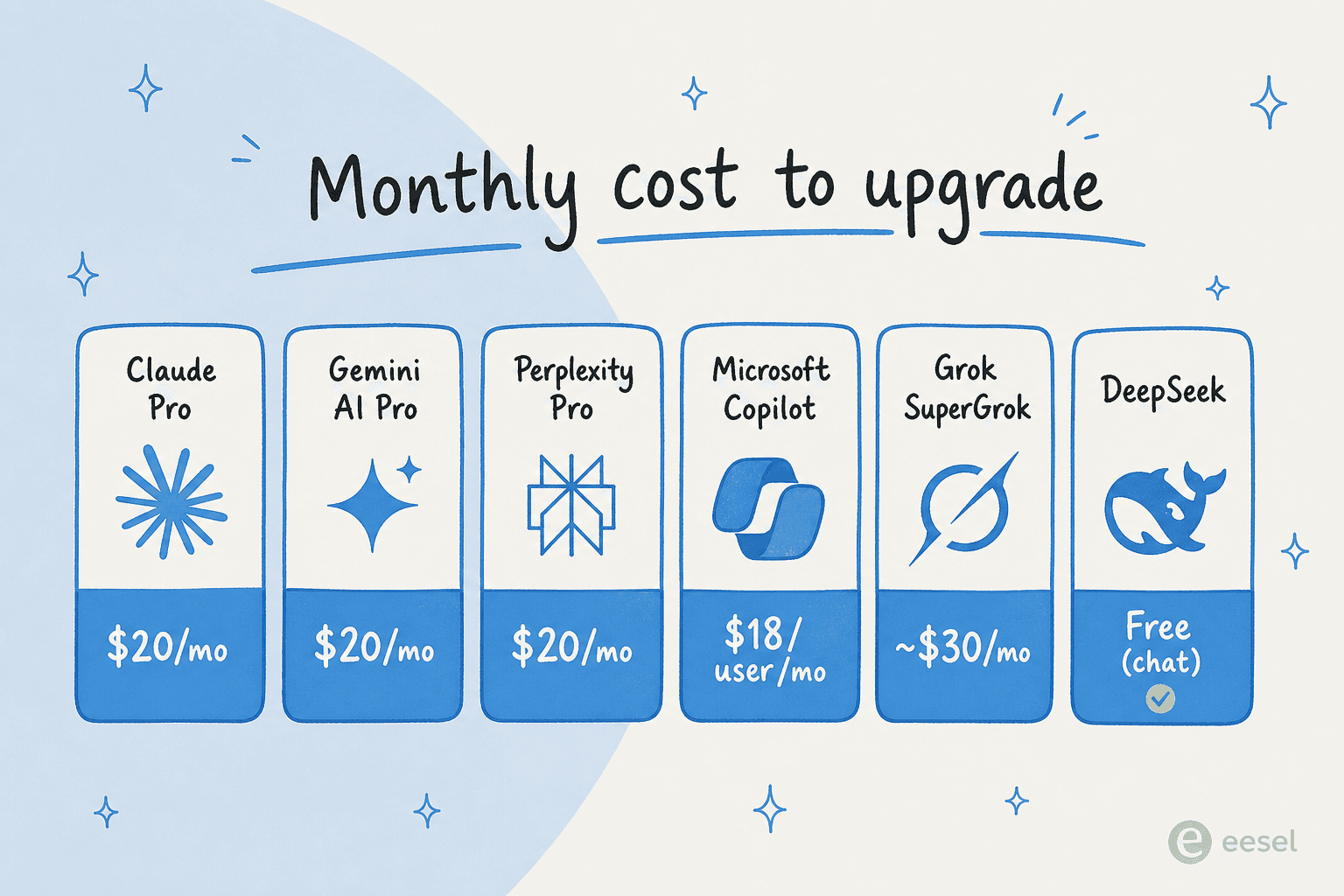
Go with Claude if you write or code daily and want the most reliable output quality, with enough context to handle large projects. The $17/month annual Pro tier is the best value for individual heavy users.
Go with Gemini if your work lives in Google Docs, Sheets, or Gmail - the integration is native rather than bolted on. The $7.99 AI Plus tier is the cheapest paid entry on this list for meaningful capability.
Go with Perplexity if you need real-time research with verifiable sources. The bundled model access at $20/month is genuinely good value for anyone who'd otherwise subscribe to multiple tools.
Go with Microsoft Copilot if your org already pays for Microsoft 365 and you want AI embedded in Teams, Outlook, and Office. Justify the $18/user/month by calculating the hours saved on meeting summaries and email drafting.
Go with Grok if you need live X/Twitter signal, or if you're building on the API and care about per-token pricing.
Go with DeepSeek if the use case is non-sensitive technical work and the data-privacy tradeoffs are acceptable for your context.
Go with eesel if your team needs an AI that actually knows your company's knowledge - not just the public web - and you want it to act as an autonomous worker rather than a chat assistant.
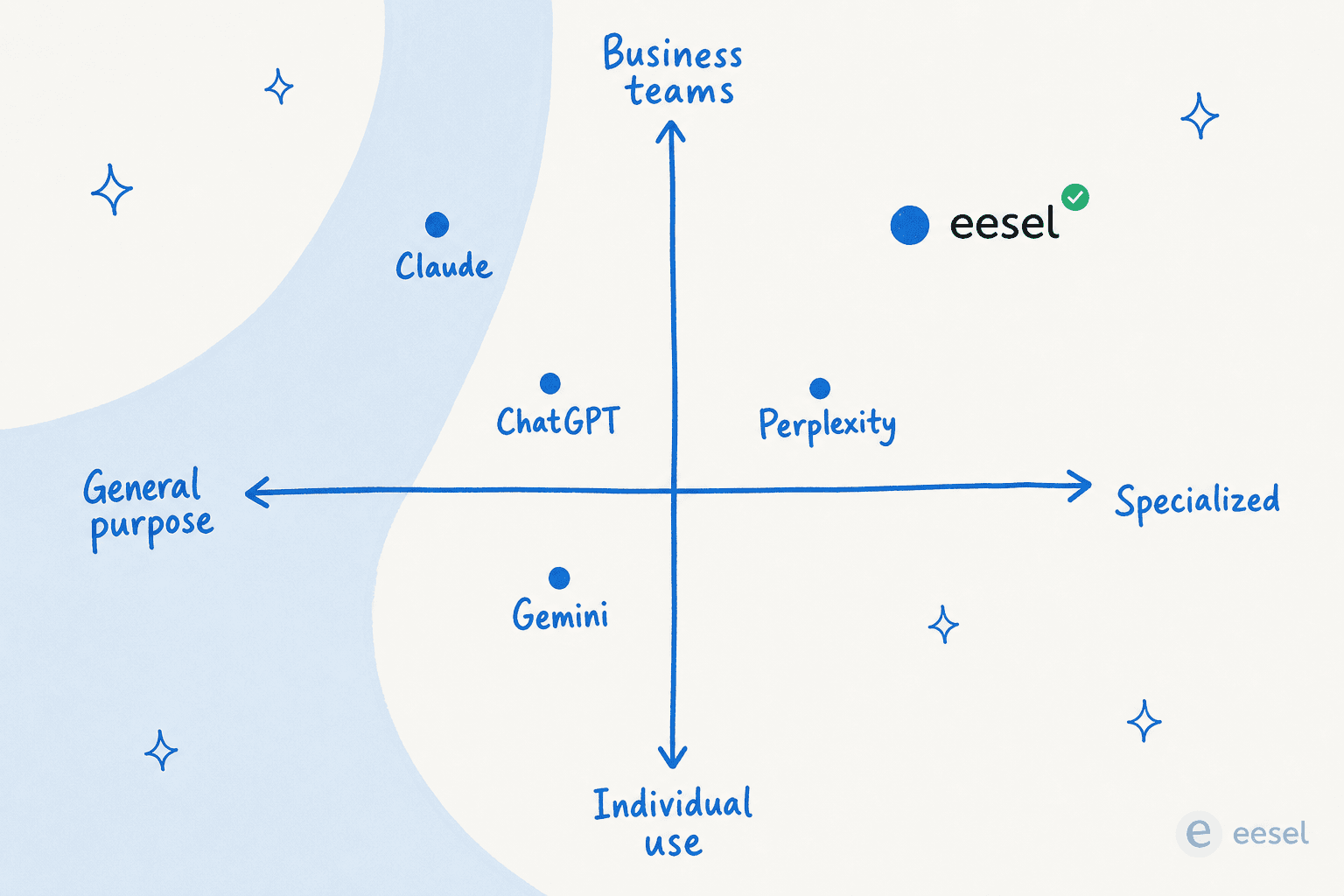
One thing worth noting: most people eventually land on using two or three of these in combination. Perplexity for research, Claude for drafting, Copilot for the Microsoft surfaces. The AI landscape in 2026 rewards composition more than commitment to a single tool.
Try eesel
If you've hit the wall where ChatGPT or Claude is genuinely useful but just doesn't know your company's specifics - the product edge cases, the support history, the internal processes your team runs on - eesel is built for exactly that gap.
You can give an eesel agent your Zendesk history, your Confluence docs, your Slack threads, and plain-language instructions for how you want it to behave. It deploys into the tools your team already uses (Zendesk, Slack, Freshdesk, email, and 100+ others) and starts working without a new interface to adopt or prompt engineering to learn.
The free trial gives you $50 in credit with no card required - enough to see it handling real tickets before you commit to anything.
Try eesel - no card required.
Frequently Asked Questions

Share this article

Article by
Riellvriany Indriawan
Riell is a designer and writer at eesel AI with about two years of experience researching CX platforms, AI chatbots, and helpdesk software. She combines her design background with a sharp eye for how these tools actually look and feel in practice — making her comparisons unusually visual and user-focused.