Claude vs Copilot in 2026: which AI coding assistant should you actually pick?


Last edited June 9, 2026

Table of Contents
- The short answer, with the receipts
- What Claude actually is
- What GitHub Copilot actually is
- Autopilot vs copilot: the framing that actually matters
- Pricing compared, end to end
- What $20 a month actually gets you
- Models, IDEs, and integrations
- What developers actually say
- Who should pick what
- Where neither tool is the right answer
- Try eesel for non-code work
The short answer, with the receipts
If you only read one section, read this one.
Claude Code crossed $2.5B in annualised revenue by February 2026 and 130,000+ GitHub stars on its public repo - six months after general availability. Anthropic engineers internally average five merged PRs a day, with PR throughput up 67% in the year they adopted the product. That's not marketing - that's "antfooding," in Anthropic's own term.
GitHub Copilot, the older incumbent, has 60 million Copilot code reviews under its belt and customer claims of up to 55% productivity gains. Customers featured at the top of the homepage: Coyote Logistics, Duolingo, General Motors, Mercado Libre, Shopify, Stripe, and Coca-Cola. Grupo Boticário is the standout case study - a 94% productivity claim.
So both are real. The question is what each does well, and that's where developers actually disagree.
"The general consensus is GitHub Copilot is worse than Claude Code or Codex. It's true to me. GC is best in term of value though."

That comment captures the whole debate in two sentences. Read the rest of this post for the why.
What Claude actually is
Claude is Anthropic's AI assistant - three models (Haiku 4.5, Sonnet 4.6, and Opus 4.8) across web, desktop, mobile, and an API. When developers say "Claude" in a coding context, they almost always mean Claude Code - Anthropic's agentic coding tool that you describe a task to, and watch it write the code, run the tests, and open the PR.
Claude Code runs across Terminal CLI, VS Code, JetBrains IDEs, a standalone desktop app, the web, iOS, and Slack, and it's included in the Pro, Max, Team, and Enterprise subscriptions - not sold separately. The same engine shoots across every surface, which means a CLAUDE.md file or MCP server works the same whether you started in the terminal or the IDE.
The two features that actually distinguish Claude Code from the rest of the field:
- Subagent orchestration. A lead agent can coordinate tens to hundreds of subagents simultaneously, each with its own scoped tool permissions. Dynamic Workflows (launched in v2.1.154) made this the default mode for any non-trivial task.
- The hooks system. 28+ lifecycle events you can wire to shell commands, HTTP endpoints, or MCP tool calls -
PreToolUse,PostToolUse,SessionStart,Stop. This is the closest thing to a "Git hooks for agents" framework in any AI coding tool, and it's what makes Claude Code workable inside disciplined engineering teams. Our walkthrough is in our Claude Code hooks guide.
The vibe in practice, in the words of one r/ClaudeCode user:
"Gemini CLI is impressive, but Claude Code is acting like the senior engineer who already read your whole codebase twice."
There's a reputational tax, too. The Claude Pro plan at $20/month has 5-hour usage windows that power users burn through in minutes. The widely-cited Reddit complaint is the 388-upvote: "One complex prompt to Claude and by the end you've burned 50-70% of your 5-hour limit." We'll come back to pricing.
What GitHub Copilot actually is
GitHub Copilot is the older incumbent - born as a clever autocomplete in 2021, now stretched into a full-stack AI developer platform that spans the IDE, GitHub.com, the terminal, and chat surfaces. The current homepage tagline is "Command your craft," with the subhead "Your AI accelerator for every workflow, from the editor to the enterprise."
GitHub splits Copilot's surface area into three buckets (per the features overview):
- Assistive features. Inline suggestions, Copilot Chat, PR summaries, commit messages in GitHub Desktop.
- Agentic features. Cloud agent, agent mode in IDEs, Copilot CLI, and code review.
- Customization. Copilot Spaces, custom instructions, Copilot Memory, MCP servers, and agent skills.
The thing that genuinely changed in 2026: Copilot stopped being only GitHub's models. The model picker now includes Claude Opus 4.8, Sonnet 4.6, Haiku 4.5, GPT-5.4 and 5.5, Gemini 3.1 Pro and 3.5 Flash, and Microsoft's own MAI-Code-1-Flash. On Pro+ and above, you can even assign GitHub issues to Claude or Codex as third-party agents right next to Copilot's own cloud agent.
That's the structural twist this post is built around. The Copilot of 2024 was "GitHub's model." The Copilot of 2026 is "the GitHub-native shell around whichever model you want, including Claude."
Autopilot vs copilot: the framing that actually matters
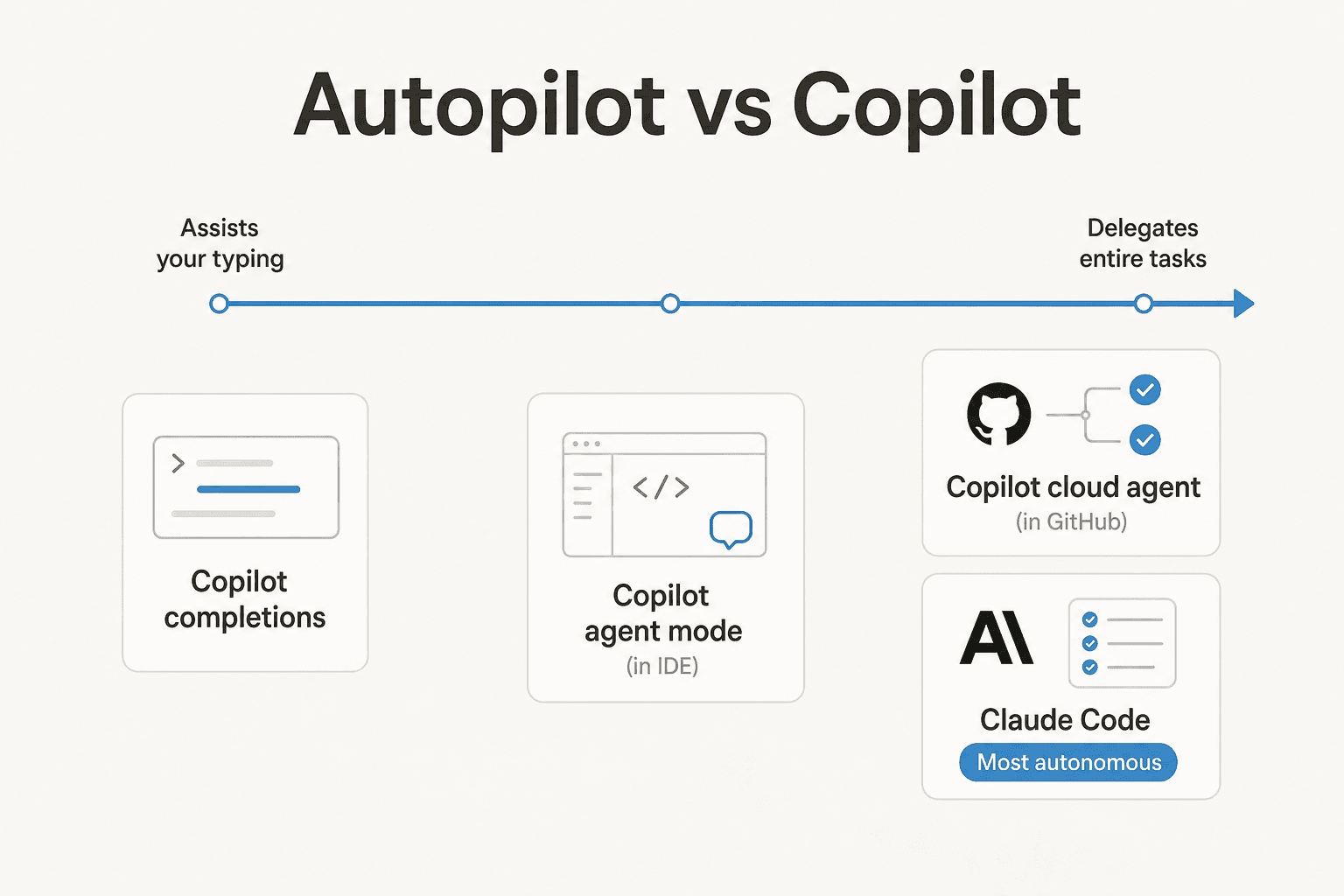
The dominant framing on X and Reddit, repeated almost word-for-word across threads, is "autopilot vs copilot." Practitioners use Cursor and Copilot for assisted typing - "like having an extremely fast colleague pair with me" - and Claude Code for delegation - "like sending a task to a junior engineer overnight." The same person often uses both, in different modes, on different tasks.
"The real difference is Claude Code works across the whole repo autonomously, while Copilot still needs you to direct it file by file."
The framing matters because it changes the comparison. If you treat Claude Code and Copilot completions as the same product category, Claude looks better at almost everything and Copilot looks like an expensive autocomplete. If you treat them as different categories - delegation vs assistance - both make sense in the same week, on the same machine, by the same engineer.
Copilot has tried to climb out of the autocomplete bucket with cloud agent and agent mode in the IDE. It's a real product - but it has hard limits Claude Code doesn't:
- One repo per session. "Copilot cannot make changes across multiple repositories in one run." (docs)
- One branch, one PR per task. (docs)
- 59-minute hard cap per session. "This is a hard limit that cannot be extended or bypassed." (docs)
Claude Code has none of those guardrails. That's a feature if you trust the agent and a footgun if you don't.
Pricing compared, end to end
Pricing is where most claude vs copilot posts lie a little - by quoting $20 vs $10 and stopping there. Here's the full picture, with every plan you can actually buy, as of June 2026.
| Plan | Claude (Anthropic) | GitHub Copilot |
|---|---|---|
| Free | $0 - chat, code gen, no Claude Code | $0 - 2,000 completions/month, limited CLI + agent mode |
| Individual entry | Pro: $17/mo annual ($20 monthly) - includes Claude Code | Pro: $10/mo - unlimited completions, $15/mo AI credits |
| Individual mid | Max 5x: $100/mo - 5x Pro usage | Pro+: $39/mo - Opus, audit logs, $70/mo credits |
| Individual top | Max 20x: ~$200/mo - 20x Pro usage | Max: $100/mo - priority models, $200/mo credits |
| Team standard | $20/seat annual ($25 monthly) | Copilot Business - from the org pricing page |
| Team premium | $100/seat annual ($125 monthly) - 5x usage | Copilot Enterprise - custom features, fine-tuned models |
| Enterprise | Custom | Custom |
| API token rates | Opus 4.8 $5/$25 per Mtok · Sonnet 4.6 $3/$15 · Haiku 4.5 $1/$5 | Bundled with plan; overflow billed as AI credits at $0.01 per credit |
| Free promo | $1,000 in Claude Code + Cowork credits per seat activated by July 2 | Business / Enterprise promo through August 2026 |
| Models included | Claude only | Claude (Haiku/Sonnet/Opus) + GPT-5 family + Gemini 3.x + MAI-Code-1-Flash |
| Free-tier training opt-out | n/a | As of April 24, 2026, default opt-in for Free/Pro/Pro+ - must opt out manually |
| Sign-up freeze (June 2026) | None | New Pro/Pro+/Max sign-ups paused on the consumer side |
The two real gotchas:
- Copilot's "usage-based billing" change. Starting June 1, 2026, code review consumes Actions minutes, and license-less reviewer AI credits are billed to the org. The old fixed-quota world is over.
- Claude's silent tokenizer change. The Opus 4.7 tokenizer effectively bumped usage costs by 20-30% without a price change. Combined with the 5-hour Pro limits, this is the loudest community complaint of 2026.
What $20 a month actually gets you
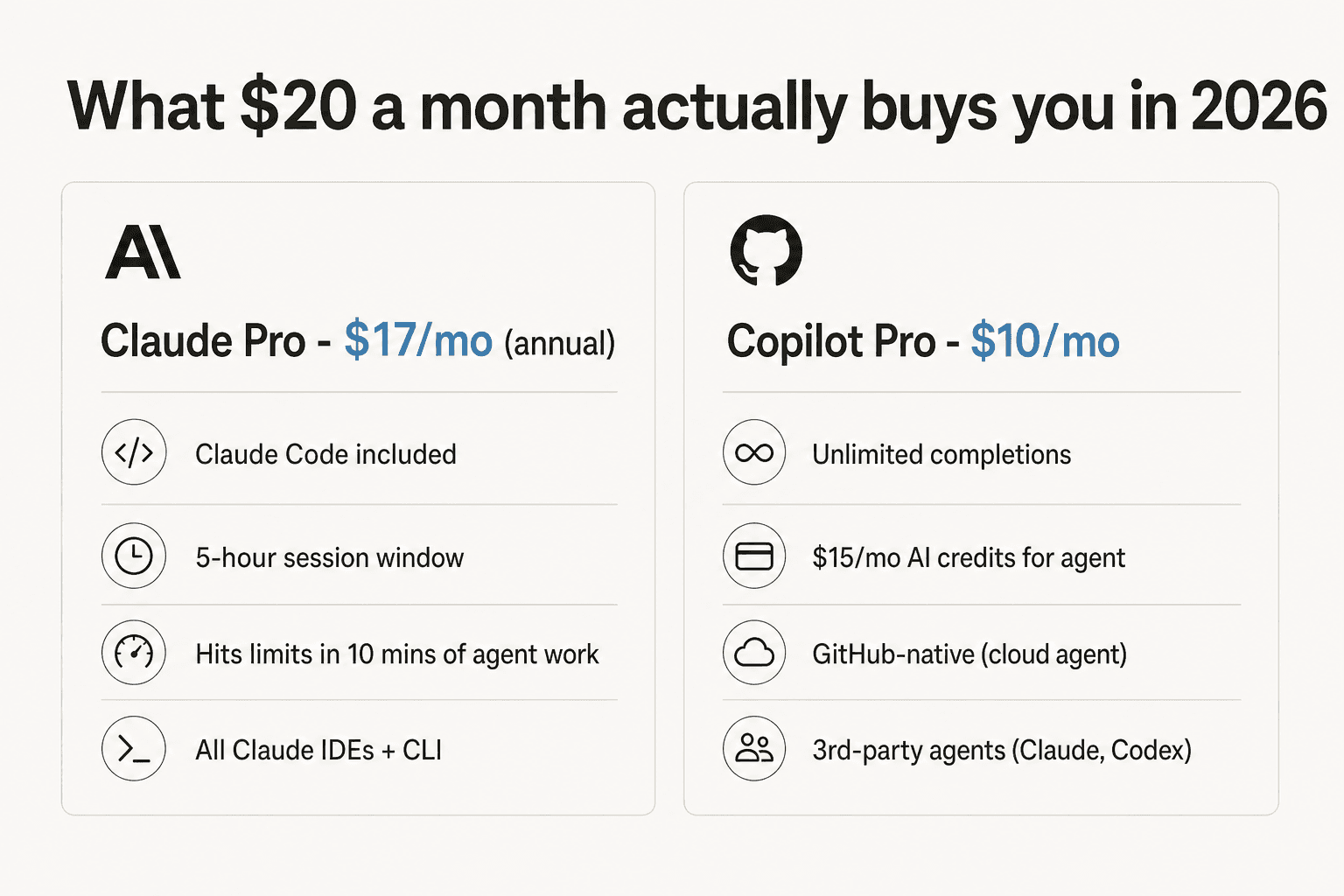
This is the section the pricing table can't deliver on its own.
At $17/month on Claude Pro (annual), you get Claude Code across every Anthropic surface, but you bump into the 5-hour usage window fast. Power users on r/ClaudeCode are almost unanimous: the $100/month Max plan is the price of admission for sustained agentic work. One developer summed it up bluntly:
"I used it 8 hours a day. Kept hitting usage limits so I bought two $200/month accounts. Canceled both immediately."
Copilot Pro at $10/month is the value pick of the AI coding world. Unlimited inline completions and next-edit suggestions never consume AI credits, the $15/month base credits cover light agent + chat usage, and you can model-switch on the fly to Claude or GPT-5.5 if Copilot's defaults aren't pulling their weight on a given task.
The catch on Copilot's side: the agent and code review features eat AI credits, and as the r/GithubCopilot reaction to the June 1 change showed, people are nervous about predictability. "Messing up the previous fixed quotas - more and more," one commenter put it.
The honest read: if you only ever type code and want completions plus the occasional agent task, Copilot Pro is hard to beat at $10. If you actually want to delegate work - the way Anthropic's engineers do - you're spending $100/month somewhere, regardless of which side you pick.
Models, IDEs, and integrations
Most posts skim this section. We won't - because it's where the strongest practical differences live.
Models
| Model family | Claude Code | GitHub Copilot |
|---|---|---|
| Claude Opus 4.8 | Native | (GA, VS Code 1.118+) |
| Claude Sonnet 4.6 | Native | GA |
| Claude Haiku 4.5 | Native | GA |
| GPT-5.5 / 5.4 / 5.4 mini | Not available | GA |
| GPT-5.3-Codex | Not available | GA |
| Gemini 3.x family | Not available | 3.5 Flash GA, 3.1 Pro preview |
| MAI-Code-1-Flash | Not available | GA (Microsoft-fine-tuned) |
| Context window | 200K | 128K typical; 1M on select Claude + GPT models in VS Code |
If you want to only ever run Claude, Claude Code is the cleaner home - the harness was built for it. If you want a single tool that can fall back to GPT-5.5 or Gemini 3.1 Pro for tasks where they outperform (and they do, on specific benchmarks), Copilot is the better bet. As one r/GithubCopilot user put it:
"Claude seems to handle context better than Copilot. Additionally, it has features like subagents so you can have multiple agents doing things in [parallel]."
IDE support
Claude Code:
- Official VS Code extension with inline diffs, @-mentions, plan review, and session history
- JetBrains plugin (beta, IntelliJ/PyCharm/WebStorm)
- Terminal CLI - Unix-pipe composable
- Desktop app, web, iOS, Slack
- Auto mode safety classifier for long agentic runs (Max only)
GitHub Copilot:
- VS Code, Visual Studio, JetBrains, Xcode, Eclipse, Neovim, Raycast, Zed, SQL Server Management Studio
- GitHub.com, GitHub Mobile, GitHub CLI
- Windows Terminal
The Copilot reach is broader. It's the only AI assistant most Xcode and Eclipse developers can use without leaving their IDE. Claude Code is deeper where it does run - the VS Code extension, in particular, ships features faster than the upstream - but you'll find no Eclipse plugin and no native Xcode support today.
Agentic workflow: where the real gap lives
GitHub's cloud agent is the most coherent product for GitHub-native teams. You assign an issue, the agent works in a GitHub Actions sandbox, opens a PR with the diff, and everything is reviewable in the same UI your team already lives in. As GitHub frames it:
"Working on GitHub adds transparency, with every step happening in a commit and being viewable in logs, and opens up collaboration opportunities for the entire team."
Claude Code's subagent orchestration is the most powerful product for engineers who want to push the envelope. A lead Claude session can spawn background agents, each with scoped permissions, and coordinate them on a single task graph. It runs on your machine, not in a Microsoft-controlled sandbox, so the answer to "can it do X" is almost always yes.
These are different products. Cloud agent is governable, observable, and rate-limited by Actions minutes and AI credits. Claude Code is open-ended, fast, and rate-limited by Anthropic's 5-hour Pro window or your Max plan ceiling.
What developers actually say
A claude vs copilot section without verbatim quotes is incomplete. Here are the receipts.
"Claude Code just feels different. It's the only setup where the best coding model and the product are tightly integrated. 'Taste' is thrown around a lot these days, but the UX here genuinely earns it."
"Maybe it's just me, but I'm under the impression that Copilot works better for me with no issues at all now. Maybe the people complaining..."
"I really like Claude Code. It is extremely good, but... in Cursor, I can simply select the code and press Cmd+L and it automatically opens the chat with the context of that exact snippet. That makes the iteration loop much smoother."
"Copilot has 128k context window. Claude is 200k. So if you have a big project I would suggest you use it in VS Code or any client with semantic [search]."
The pattern: senior engineers tend to land on Claude Code for hard work and Copilot for easy work, and a growing number simply pay for both. The "underrated Copilot" thread on r/GithubCopilot - 130+ comments - is mostly developers conceding that Copilot's value proposition at $10 is honest, and that the noise around Claude Code obscures it.
There's a real critical view too. Anthropic's March 2026 reliability dip (uptime from 99.50% to 98.93%) and the Opus 4.7 "regression" debate gave Copilot's marketing team an opening, and many Claude alternatives posts started ranking for the first time. The Claude experience in 2026 is less smooth than it was in 2025.
Who should pick what
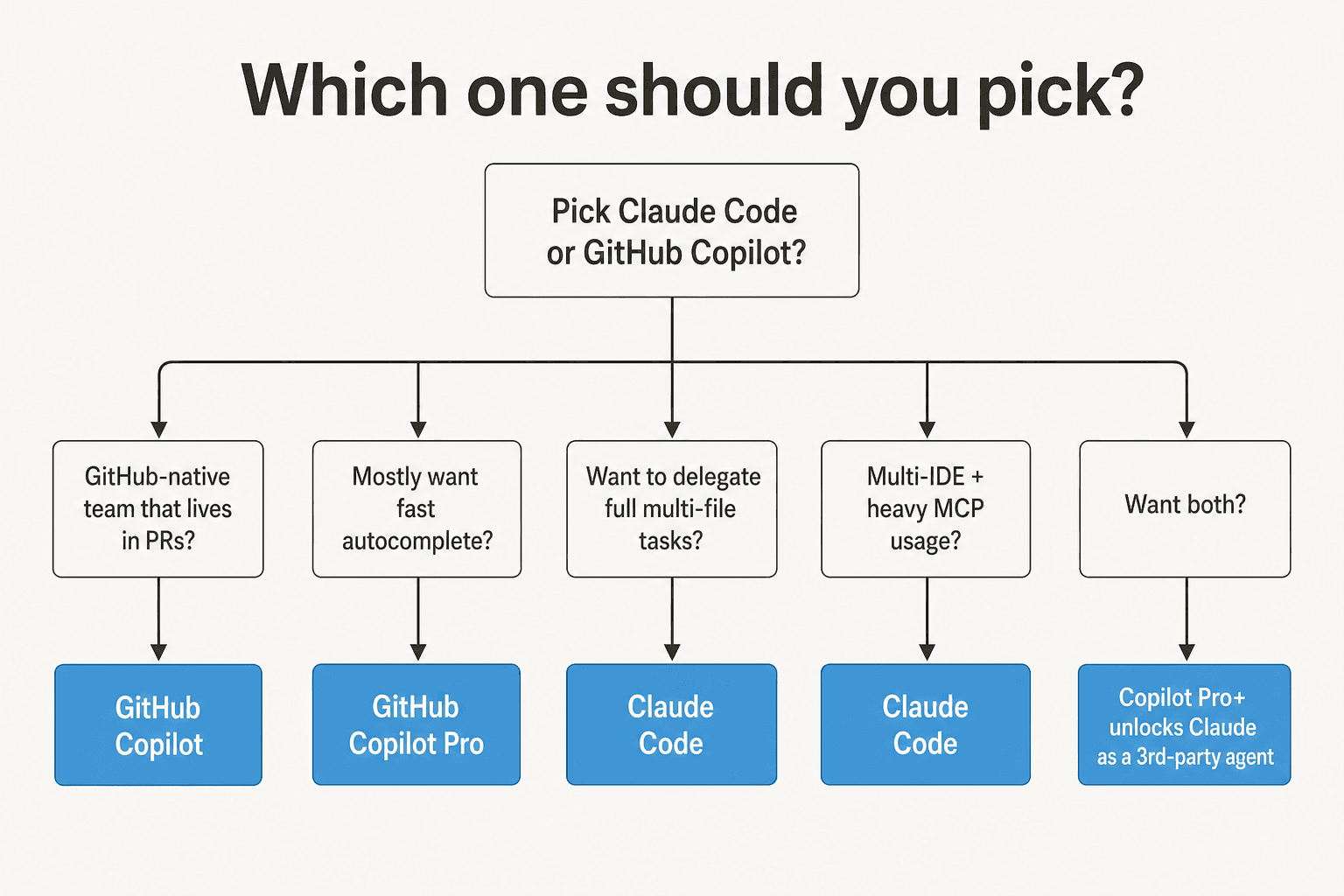
The decision tree, written out:
- Solo dev who lives in VS Code and mostly wants smart autocomplete? Copilot Pro at $10/month. Don't overthink it.
- Solo dev who wants to delegate end-to-end features to an agent? Claude Code via Claude Pro at $17-20/month, expecting to upgrade to Max 5x ($100) within a month if you're heavy.
- GitHub-native team that lives in PRs and code review? Copilot Business or Enterprise - cloud agent and code review both work where your reviewers already are. Our Copilot pricing breakdown covers the org tiers.
- Multi-IDE team with heavy MCP / tooling investment? Claude Code is the deeper harness for now. The hooks system alone is a meaningful gap.
- Wants the best of both? Copilot Pro+ at $39/month unlocks Claude as a third-party agent and gives you the GitHub-native UX with Claude's brain on the hard tasks. This is the underrated 2026 setup.
- Enterprise with strict data-training opt-outs? Copilot Business / Enterprise data is explicitly excluded from model training; Claude's Team and Enterprise plans match that posture. For Free/Pro/Pro+ users, Copilot's April 24, 2026 default opt-in is the thing to know.
If you've read this far and you still want a single answer: Claude Code if you can afford to delegate, Copilot if you want unbeatable value, both if you can swing $50-60/month total. Most senior engineers we've read end up on the third option.
Where neither tool is the right answer
A fair claude vs copilot post owes you the case where the answer is "neither."
If your work is non-code - answering customer questions, sorting tickets, writing internal docs, replying on Slack - these tools weren't built for you. They're coding agents. Claude Code is for engineers; Copilot is for engineers; the closest non-code thing in either ecosystem is Claude Cowork, and even that is general-purpose rather than function-specific.
The shape of an AI tool that actually fits a customer-support, sales, or operations team looks different: it lives inside the helpdesk (Zendesk, Freshdesk, Gorgias) or the inbox (Gmail, Slack), it reads tickets in your team's voice, it escalates on policy, and it learns from existing replies. That's a different category of product - AI teammates, not AI coding assistants - and it's the one we've built eesel against.
Try eesel for non-code work

If the work you want to delegate isn't code, eesel is the AI-teammate platform built for the rest of your team. Eesel agents live inside Zendesk, Freshdesk, Slack, Gmail, Shopify, and 100+ other tools - reading tickets, composing replies, taking actions, and escalating on policy without a new interface to adopt. The pitch is simple: briefing an eesel agent feels like onboarding a new employee, in plain language, in minutes. Pricing is $0.40 per resolved ticket and $4 per blog post, with no seat fees and a $50 free trial.
Bring Claude Code or Copilot to your engineers; bring eesel to everyone else.
Frequently Asked Questions

Share this article

Article by
Rama Adi Nugraha
Rama is a software engineer at eesel AI with two years of experience writing about B2B SaaS, AI tools, and customer support technology. Based in Bali, Indonesia, he brings a developer's perspective to product comparisons — cutting through marketing copy to what the integrations and APIs actually do.