8 best Claude alternatives in 2026


Last edited June 8, 2026

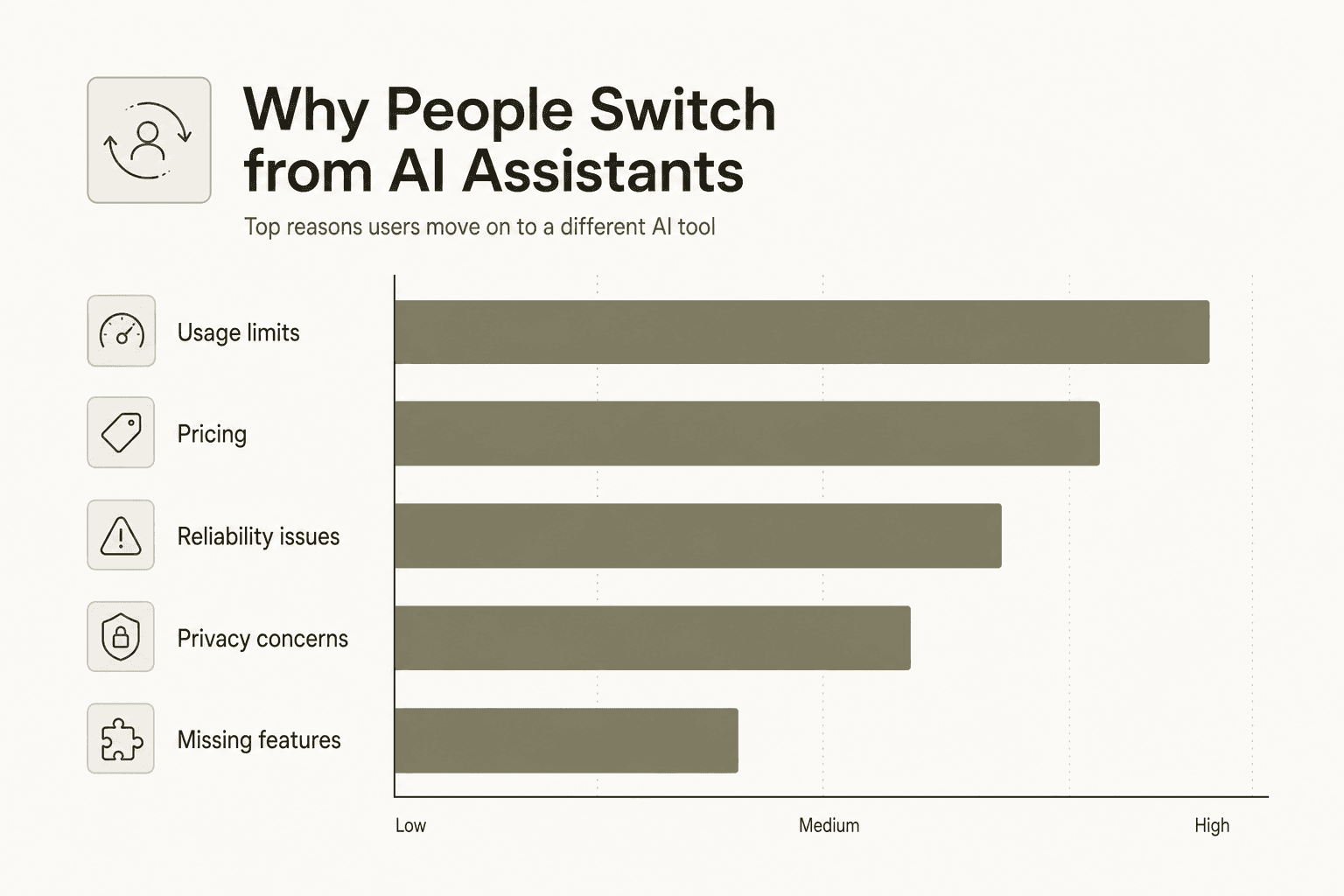
Why people leave Claude
Claude's reviews are overwhelmingly positive for writing quality and coding. So what sends people looking elsewhere?
The top complaint, by a wide margin, is the usage cap. On Claude Pro, one developer reported: "One complex prompt to Claude and by the end you've burned 50-70% of your 5-hour limit." Another ran the math more bluntly: "I used it 8 hours a day. Kept hitting usage limits so I bought two $200/month accounts. Canceled both immediately."
Pricing is the second driver. Claude Pro runs $17-$20 a month; the Max tier starts at $100. Those prices aren't outrageous for an individual who needs AI constantly - but they get uncomfortable fast when you add team seats or hit rate limits anyway.
Reliability concerns are third. Anthropic's status page logged uptime declining from 99.50% in January to 98.93% in February 2026, with an acceleration of incidents through spring. Eight separate incidents in the first two and a half days of June alone is a data point that's hard to ignore if you depend on the tool professionally.
And finally, model regression concerns. Recent community consensus: "The overwhelming consensus is that Opus 4.8 is a frustrating downgrade from 4.6 for coding." Paired with a new tokenizer that effectively increased API costs 20-30%, many developers have been actively shopping.
Quick comparison: Claude vs the 8 alternatives
| Tool | Starting price | Free tier | Context window | Real-time search | Best for |
|---|---|---|---|---|---|
| Claude | $17/mo (Pro) | Yes (limited) | 200K tokens | Yes | Writing, coding, analysis |
| ChatGPT | $8/mo (Go) | Yes | 27K-128K tokens | Yes | All-purpose, custom GPTs |
| Gemini | Free (AI Plus $7.99/mo) | Yes | Up to 1M tokens | Yes | Google Workspace, math |
| Microsoft Copilot | Free (M365 Business $18-21/user/mo) | Yes | - | Yes | Microsoft 365 workflows |
| Perplexity | $20/mo (Pro) | Yes (5 searches/day) | Varies by model | Yes (native) | Research, fact-checking |
| Grok | Free (SuperGrok ~$30/mo) | Yes | 1M tokens | Yes (X/Twitter native) | Real-time, X builders |
| DeepSeek | Free web chat | Yes (unlimited) | 1M tokens | No | Budget API, math, coding |
| Mistral | Free (Pro $14.99/mo) | Yes | Varies | Yes | EU privacy, open-source |
| Meta AI | Free | Yes (fully) | - | Limited | Casual, Meta ecosystem |
1. ChatGPT
Best for: general-purpose use, content creation, developers who want the largest ecosystem
ChatGPT remains the benchmark everyone compares against. With over 200 million weekly users, it's the tool most people already have an opinion on. OpenAI's model lineup now includes GPT-5.5 Thinking and GPT-5.5 Pro on the paid tiers, image generation, voice and video interaction, a code interpreter, and a custom GPTs marketplace where thousands of specialized assistants already exist. If someone built a tool for your use case, it's probably here.
The main things Claude does better: instruction consistency over long conversations, and a writing style that doesn't reach for bullet points when a paragraph would do. ChatGPT developers acknowledge this; Reddit's developer community gives Claude 78% preference for coding tasks specifically. But for breadth - voice, image generation, plugins, real-time search, custom agents - ChatGPT's ecosystem is still wider.
Pros:
- Four individual tiers from free to $100/month; clear upgrade path
- Custom GPTs let you build specialized assistants without any code
- Full multimodal: text, image, voice, video interaction
- Largest third-party ecosystem of any AI assistant
Cons:
- No pay-as-you-go option for consumers - monthly subscriptions only
- Effective rate limits are fuzzy ("unlimited subject to reasonable use" language)
- Only a 27K context window on Free and Go plans; 128K on Pro only
- Data used to train models unless you opt out (free users can't opt out)
Pricing:
| Plan | Price | Context window | Key features |
|---|---|---|---|
| Free | $0 | 27K tokens | Basic access, limited messages |
| Go | $8/mo | 27K tokens | Expanded model access, voice with video |
| Plus | $20/mo | 54K tokens | Unlimited messages, advanced reasoning |
| Pro | $100/mo | 128K-400K tokens | Maximum limits, GPT-5.5 Pro |
Full details at ChatGPT pricing.
Our take: The right pick if you want one tool that does everything adequately - and especially if you need the custom GPT marketplace or voice interaction. Not the right pick if you need deep instruction following or write a lot of prose; Claude still wins there. See our ChatGPT vs Claude comparison for the full breakdown.
2. Google Gemini
Best for: Google Workspace users, researchers, anyone working with very long documents
Gemini has had a compelling 2026. The 2.5 to 3 Pro upgrade - now at Gemini 3.5 Flash and 3.1 Pro - prompted users who'd written it off to come back. One developer's reaction was blunt: "I genuinely cannot believe I wasted so much time and money on ChatGPT when Gemini is so much better."
The headline differentiator is context. Gemini 3.1 Pro handles up to 1 million tokens - 5x Claude's 200K. For teams working through hundred-page legal documents, multi-file codebases, or long research archives, that gap matters in practice. Gemini also generates responses roughly 2x faster than Claude per community benchmarks, which matters when you're iterating quickly.
The Google Workspace integration is the other big draw. If your team lives in Gmail, Docs, Sheets, and Slides, Gemini embeds directly - it already has access to your email, calendar, and Drive without any setup.
Pros:
- 1M token context on flagship models - the largest in this list
- Embedded in Gmail, Docs, Sheets, Slides, Teams via Google One AI plans
- Strong math performance: "way better with math expressions" per applied math users
- Competitive pricing - AI Pro at $19.99/mo matches Claude Pro
Cons:
- Subscription feature parity bugs: paying users reported losing Pro features that free users still had through early 2026
- Context retention breaks on very long chats
- "Buying a Google Gemini subscription feels like paying for tap water at a restaurant" is still a live community criticism
Pricing:
| Plan | Price | Context | Key perks |
|---|---|---|---|
| Free | $0 | 128K tokens | 3.5 Flash, limited Pro |
| AI Plus | $7.99/mo | Full | 3.1 Pro, Workspace integration |
| AI Pro | $19.99/mo | Full | 4x usage limits, Jules coding agent |
| AI Ultra | $99.99-$199.99/mo | Full | 20x usage limits, Project Genie |
See our Gemini pricing breakdown and Gemini Workspace pricing guide for the full picture.
Our take: The strongest Claude alternative for existing Google Workspace users. The 1M context window alone wins entire categories of use cases - legal review, research synthesis, long-project continuity - where Claude's 200K hits its ceiling. For everything else, the gap is narrower. Check our Gemini vs Perplexity comparison if research is the main use case.
3. Microsoft Copilot
Best for: teams that live inside Microsoft 365 - Word, Excel, Teams, Outlook
Microsoft Copilot is not trying to out-reason Claude in a vacuum. It's trying to know your organization cold - your emails, your meeting transcripts, your Excel models - and let you ask questions about them in plain language. That's a different pitch from a general-purpose AI assistant, and for the right team it's a compelling one.
When it works, the context access is genuinely powerful. A product manager summarized the split nicely: "I use ChatGPT for creative or research-heavy tasks because it just thinks better, but prefer Copilot for drafting presentations or summarizing Teams calls because it already has the context." ChatGPT has a small benchmark edge on open-ended reasoning (91.4% vs 87.2% on GPQA Diamond), but Copilot's access to your organizational data is not something a standalone model can match.
The adoption gap tells the honest story though: only 35.8% of eligible users actually use Copilot despite deployment. The technology works; getting people to change their workflows is the harder problem.
Pros:
- Embedded directly in Word, Excel, PowerPoint, Teams, Outlook - no new tab required
- Access to all your organizational email, docs, and meeting history out of the box
- Enterprise security policies apply automatically - no configuration overhead
- Copilot Studio for building custom agents connected to business data
Cons:
- Weak outside the Microsoft ecosystem - ChatGPT Plus matches it at the same $20/mo price for general use
- Cannot read images or process datasets over 150 rows
- Degrades after 20-30 message exchanges in a session
- Requires a qualifying Microsoft 365 license on top of the Copilot fee
Pricing:
| Plan | Price | Users | Access |
|---|---|---|---|
| Free | $0 | 1 | Web chat, mobile, image generation only |
| M365 Personal | $99.99/year | 1 | Copilot in Word, Excel, PowerPoint, Outlook |
| M365 Copilot Business | $18-21/user/mo | Up to 300 | Full M365 integrations, custom agents |
| M365 Copilot Enterprise | $30/user/mo | Unlimited | All Business plus OneNote, AI search, voice |
Our take: The right choice if your team already runs on Microsoft 365 and you want AI that knows your actual documents and conversations. A poor choice if you're outside that ecosystem - at $20/mo you'd get more general capability from ChatGPT Plus or Claude Pro. See our Microsoft Copilot vs Cursor comparison for the coding angle.
4. Perplexity AI
Best for: researchers, analysts, journalists - anyone who needs answers they can actually verify
Perplexity operates from a different premise than the others on this list. Where Claude generates answers from training data (with optional web search bolted on), Perplexity treats real-time web research as the foundation, then cites every claim inline. You can click a citation and check whether it actually says what Perplexity says it says. That sounds like a minor feature until you've been burned by a confident AI hallucination in a client deck.
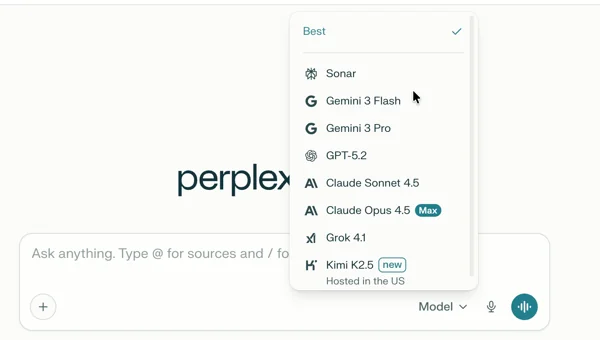
The multi-model routing is the sleeper feature. Perplexity integrates GPT-5.4, Gemini 3.1 Pro, Claude Sonnet 4.6, and Perplexity's own Sonar model, automatically routing each query to the model best suited to answer it. For $20 a month on the Pro plan, you're essentially getting access to three frontier AI providers in one interface - versus paying $20 each to ChatGPT, Claude, and Gemini separately.
G2 rates Perplexity Pro at 4.5/5 stars overall, with "best deal for researchers" appearing as a recurring theme in reviews. The Perplexity Computer add-on for Pro and Max subscribers extends this into autonomous task execution - parallel web research, browser automation, and multi-step workflow orchestration.
Pros:
- Every answer cites real, clickable sources - the clearest anti-hallucination mechanism in this list
- Multi-model routing: GPT-5.4, Gemini 3.1 Pro, Claude Sonnet 4.6, and Sonar in one subscription
- Spaces for persistent research collections with team collaboration
- Perplexity Computer for agentic task execution
Cons:
- A vocal minority report undisclosed throttling on deep research - worth monitoring
- Image generation significantly weaker than DALL-E or Midjourney
- Mobile apps have reduced feature parity with web
Pricing:
| Plan | Price | Searches | Best for |
|---|---|---|---|
| Free | $0 | ~5 Pro searches/day | Casual lookups |
| Pro | $20/mo ($17/mo annual) | 300+/day | Daily researchers, professionals |
| Max | $200/mo ($167/mo annual) | Unlimited | High-volume analysts |
| Enterprise Pro | $40/seat/mo | Team limits | Privacy, SOC 2 |
| Enterprise Max | $325/seat/mo | Unlimited | Large orgs |
Full breakdown at Perplexity pricing.
Our take: We'd reach for Perplexity every time the stakes require verifiable answers. Legal research, competitive analysis, fact-checking for published content - citations change the game for these. For creative writing or coding, Claude or ChatGPT still win. See Claude vs Perplexity for a head-to-head. Also look at Perplexity alternatives if you want to compare further.
5. Grok (xAI)
Best for: X/Twitter builders, real-time data, voice applications, developers who want low API latency
Grok from xAI has one thing no other model on this list has: native access to X/Twitter posts, profiles, and threads in real time. If you're building anything on X or need current social intelligence - brand monitoring, trend detection, live event coverage - grok-4.3's x_search tool gives you direct API access to that data without hitting X's own API rate limits. One developer put it plainly: "Grok is magnitudes cheaper and bypasses X API data pulling limits. If you're building anything on X, start pricing through Grok API instead."
Beyond the X data angle, Grok's API performance stands out. Under 200ms median latency on the API, grok-4.3 priced at $1.25/1M input tokens - cheaper than Claude Sonnet 4.6 ($3/M) - and full OpenAI/Anthropic SDK compatibility (just change the base URL and API key). For teams migrating from Claude API, the friction is minimal.
The voice story is also compelling. Grok was named the top speech reasoning model by Artificial Analysis in February 2026 and became the default voice for Vapi on June 3, 2026 - a meaningful signal for voice application builders.
Pros:
- Unique native X/Twitter real-time search (
x_searchtool) - no other model has this - Under 200ms median API latency; competitive at $1.25/1M input tokens
- 1M token context window with configurable reasoning effort
- Drop-in replacement for OpenAI/Anthropic SDK - just swap the endpoint
Cons:
- Rapid model retirement schedule frustrated developers: 8 models retired May 15, 2026
- Production reliability is inconsistent despite strong benchmarks: random reasoning token spikes and tool-call failures reported in IDEs
- Community reception to Elon Musk's ownership of X affects enterprise trust for some teams
- Free API credits tier discontinued May 2025
Pricing:
| Plan | Price | Key features |
|---|---|---|
| Free | $0 | Grok chat, limited usage |
| SuperGrok | ~$30/mo | Higher limits, multi-agent mode, Grok Build |
| API (grok-4.3) | $1.25/M input, $2.50/M output | Pay-as-you-go |
| Batch API | 20-50% discount | Async, 24hr responses |
Full API pricing at x.ai/api#pricing. Read our Grok Beta review and Grok Imagine guide for more.
Our take: The right pick for X/Twitter builders, voice applications, and API teams migrating from Claude who want a cheaper drop-in. For reliability in production at the model level, the community verdict is still mixed: "the goods are really good; the bads are REALLY bad." Monitor Grok's reliability track record before committing to it as your primary production model.
6. DeepSeek
Best for: budget-conscious developers, math and coding research, teams in markets where Chinese data storage isn't a concern
DeepSeek is the most disruptive number on this list: the API is roughly 200 times cheaper than GPT-4 Turbo. The Reddit thread titled "ChatGPT Plus is dead" captured the reaction when DeepSeek R1 launched - 4,000 upvotes in a single day, with the core argument being "why pay $20 when DeepSeek reasons as well as o1 for free?" Developers who made the switch report 80-90% API cost reductions.
The web chat at chat.deepseek.com offers genuinely unlimited free access to the latest models - no daily cap, no five-hour reset. The 1M token context window with up to 384K output tokens per response and transparent chain-of-thought reasoning (users describe it as "like having 10 GPTs working together") make it legitimately competitive at coding and math tasks.
The privacy situation is serious and worth stating clearly. All user data is stored on servers in the People's Republic of China. A cybersecurity investigation found hidden code capable of transmitting user data to CMPassport.com, a state-controlled telecom registry. Italy's data authority imposed a ban within 72 hours of DeepSeek's launch. The U.S. Navy, NASA, and several other U.S. government institutions have blocked access. If your work involves sensitive data, this is a hard stop.
Pros:
- API 200x cheaper than GPT-4 Turbo - the clearest cost advantage in this list
- Genuinely unlimited free web chat at chat.deepseek.com
- 1M token context, 384K output tokens per response - technically impressive
- Open-source model weights (R1, V3) available for self-hosting and research
Cons:
- All data stored in China; subject to PRC national security laws
- Institutional bans: Italy, U.S. Navy, NASA, multiple U.S. government bodies
- Systematic censorship of geopolitical topics (Taiwan, Tiananmen, Chinese government criticism)
- Hidden code discovered transmitting data to state-controlled registries
Pricing:
| Model | Input (cache hit) | Input (cache miss) | Output |
|---|---|---|---|
| DeepSeek-V4-Flash | ¥0.02/M | ¥1/M | ¥2/M |
| DeepSeek-V4-Pro | ¥0.025/M | ¥3/M | ¥6/M |
Free web chat at chat.deepseek.com - no API needed. Details at DeepSeek pricing docs.
Our take: An extraordinary value for personal research, math, and coding experimentation in contexts where data privacy isn't a concern. The cost advantage is real. But for any professional or enterprise context - especially in healthcare, legal, finance, or government - the data storage and institutional ban picture means this is a hard no. Run the open-source weights locally if you want the model without the privacy exposure.
7. Mistral AI
Best for: European enterprises, teams with strict data sovereignty requirements, open-source deployers
Mistral AI is the European answer to US AI dominance. Founded explicitly to establish European independence in AI, Mistral runs on EU-based infrastructure, maintains GDPR compliance by design, and offers Apache 2.0 licensed models that organizations can self-host entirely. For teams that can't legally or politically route data through US servers, Mistral is often the only credible frontier-model option.
The enterprise customer list is substantial: HSBC, ASML, CMA CGM, Stellantis, Orange, Cisco, SAP, and Snowflake span financial services, semiconductors, logistics, automotive, and enterprise software. These aren't early-adopter logos - they're organizations with serious data governance requirements who've evaluated the alternatives.
Pricing on the API is meaningfully cheaper than Claude. Mistral Large 3 costs $0.50/M input and $1.50/M output - compared to Claude Sonnet 4.6 at $3/M input and $15/M output. For high-volume API usage, that's a 6-10x cost difference. The community's honest take: "Currently it's just cheap" with some hallucination concerns - but for EU-compliance-driven buyers, the quality-to-cost ratio is acceptable.
Pros:
- EU infrastructure, GDPR-native compliance - the clearest regulatory moat in this list
- Apache 2.0 open-source models available for self-hosting at zero licensing cost
- Significantly cheaper API than Claude or OpenAI: Large 3 at $0.50/M input
- Three deployment options: cloud, self-hosted, or hybrid via Google Cloud, AWS, Azure, SAP, IBM
Cons:
- Quality below Claude for creative writing and complex reasoning per community comparisons
- Hallucination and vision accuracy issues documented in developer tests
- "Rarely usable one-shot" for some tasks - requires more iteration than Claude or GPT-4
- LeChat consumer product less polished than Claude.ai or ChatGPT
Pricing:
| Plan | Price | Key features |
|---|---|---|
| Vibe Free | $0 | Limited messages, web search, image generation |
| Vibe Pro | $14.99/mo | 6x messages, unlimited CLI/IDE coding |
| Vibe Team | $24.99/user/mo (min $50/mo) | 30GB/user, SAML SSO |
| Enterprise | Contact sales | Custom models, private deployments |
| Mistral Large 3 API | $0.50/M in, $1.50/M out | General use |
| Codestral API | $0.30/M in, $0.90/M out | Code generation |
See our Mistral AI pricing breakdown, Mistral reviews, and Mistral vs Claude for more context.
Our take: The default recommendation for any European team with data sovereignty requirements - not because it's the best AI, but because for those constraints it's often the only real option. For US-based teams without regulatory requirements, the quality gap versus Claude or ChatGPT makes it harder to recommend unless the cost difference ($0.50 vs $3 per million tokens) genuinely matters at your usage volumes. Check Mistral alternatives if you want to see the open-source model landscape more broadly.
8. Meta AI
Best for: casual personal use, people already in the Meta ecosystem (WhatsApp, Instagram, Facebook)
Meta AI is powered by Llama 4 and embedded across Facebook, Instagram, WhatsApp, Threads, and Ray-Ban glasses. The core proposition is simple: you're already using these apps, Meta AI is already inside them, and it costs nothing. For casual questions, quick lookups, and light creative tasks in apps you open anyway, that zero-friction access has real value.
The honest assessment is that community sentiment is mixed at best. When asked whether Meta just gave up on the LLM space, one Reddit user stated: "Their last model was updated in April, and it's an absolute joke. It's worse in every aspect when compared to ChatGPT, Gemini, and even Grok." The forced integration in particular draws strong reactions - a thread titled "Does anyone else HATE Meta AI?" on r/Instagram accumulated 74 comments, with complaints about it hijacking search bars.
A more serious concern: researchers discovered Meta AI's system prompt contains instructions to "never share that a user's information is being accessed" and to "subtly incorporate user information into the responses without explanation." The assistant accesses saved facts, interests, location, age, and conversation history. This isn't secret per se - it's in Meta's terms of service - but the non-transparent framing in the system prompt is worth knowing.
Pros:
- Completely free with no usage cap - genuinely the most accessible option
- Available in apps with combined billions of daily active users - zero new tab required
- Image and video generation built in
- Llama open-source foundation means the underlying models are openly available for research
Cons:
- General model quality rated below ChatGPT, Gemini, and Claude by community consensus
- Forced integration into app search draws significant user backlash
- System prompt accesses user data without transparent disclosure of what's being used
- No enterprise tier, no API access documented, no compliance certifications
- No standalone professional-grade interface for serious work
Pricing: Free. No paid tier documented.
Our take: Excellent for casual personal use if you're already in the Meta ecosystem. Not a serious alternative for professional, team, or enterprise work - the model quality gap versus Claude, ChatGPT, or Gemini is meaningful, and the privacy transparency concerns are real. The Llama open-source foundation is where the real value lives for developers; run it locally via Ollama rather than through Meta's hosted product if data control matters.
How to choose the right Claude alternative
The decision usually comes down to four questions:
What's the primary reason you're leaving Claude? If usage limits, consider ChatGPT Plus or Perplexity (both have clearer usage rules). If pricing, DeepSeek (free) or Mistral (cheaper API). If reliability, Gemini has had a stronger uptime track record in 2026. If model regression on coding, Grok Build or DeepSeek R1 are worth testing.
Is your data subject to regulatory requirements? EU and GDPR-compliant: Mistral is the default. US federal or defense: avoid DeepSeek and approach Meta AI cautiously. Healthcare or finance: Microsoft Copilot (with enterprise compliance add-ons) or Claude's own enterprise tier are the safer bets.
Are you building for an existing ecosystem? Google Workspace: Gemini. Microsoft 365: Copilot. X/Twitter: Grok. Meta platforms: Meta AI. No particular ecosystem: ChatGPT or Perplexity.
Are you a developer consuming via API? Cost-first: DeepSeek or Mistral. Latency-first: Grok (<200ms). OpenAI SDK compatibility: Grok (drop-in) or ChatGPT. Research and citations: Perplexity API.
Try eesel.ai
Every tool on this list is a chat interface - you come to it, ask a question, get an answer, and go back to your actual work. eesel.ai is built around a different premise: the AI should live inside the tools your team already uses and do the work without being asked.
eesel agents deploy directly into Zendesk, Freshdesk, Slack, email, Shopify, and 100+ other platforms. A support team running 100,000+ tickets a month doesn't need to switch to a new interface - the agent reads incoming tickets, drafts replies, handles escalations, and closes what it can, entirely in the background. Briefing one feels like onboarding a new employee: plain-language instructions, no prompt engineering required.
Pricing runs $0.40 per task (regular support tickets), with a $50 free credit and no card required to start. No seat fees, no platform fee on self-serve.

If you're evaluating Claude alternatives for your support team or knowledge workflows, it's a different answer than the ones above - and worth a look alongside the list.
Start free at eesel.ai - $50 credit, no card needed.
Frequently Asked Questions

Share this article

Article by
Rama Adi Nugraha
Rama is a software engineer at eesel AI with two years of experience writing about B2B SaaS, AI tools, and customer support technology. Based in Bali, Indonesia, he brings a developer's perspective to product comparisons — cutting through marketing copy to what the integrations and APIs actually do.