Devin by Cognition AI: Is it worth the hype? (2026)


Last edited October 6, 2025

It feels like a new AI agent pops up every other week, doesn't it? It’s getting tough to keep track of what’s a real breakthrough and what’s just hype. One of the biggest names grabbing headlines recently is Cognition AI and its wild new product, Devin, which they’re calling the world's first "AI software engineer."
But what does that actually mean for you and your team? This article will give you a straight, no-fluff overview of what Cognition AI is, what Devin can really do, and who it’s actually for. We’ll also see how it stacks up against AI built for other parts of a business, like customer support.
What is Cognition AI?
Cognition AI is an applied AI lab with a goal that's both simple and massive: to build AI systems that can reason through problems and handle complex, multi-step tasks all on their own. The company is the lab, but its star player is an AI agent named Devin.
A big reason for all the buzz is the team behind it. The founders aren't just jumping on the AI trend; they’re heavy hitters with serious credentials, including multiple gold medals from the International Olympiad in Informatics (IOI) and experience at top-tier AI labs like Google DeepMind and Waymo. These are folks who have been deep in the trenches of AI for a long time.

Investors have definitely taken notice. Cognition AI has pulled in a ton of funding, pushing its valuation past a staggering $10.2 billion. They also recently acquired another AI coding startup, Windsurf, which shows they're serious about owning the AI for software development space.
What does Devin actually do?
Beyond the flashy headlines, it’s important to get what Devin is built for. At its heart, Devin is a specialized AI agent designed to tackle the entire software development process. It’s not just a smarter autocomplete for your code editor; it’s more like an autonomous teammate for your engineering crew.
Here’s a look at what it can do:
-
Handle tasks from start to finish: You can give Devin a broad goal, like "build a website that visualizes stock market data," and it gets to work. It plans the steps, writes the code, tests for bugs, and can even deploy the finished product. It does all of this in its own secure, sandboxed environment that has all the tools a human developer would use, including a shell, code editor, and browser.
-
Solve real-world problems: Devin isn't just a lab experiment. It's proven it can handle tough engineering challenges. On the SWE-Bench benchmark, which tests an AI's skill at fixing actual issues from GitHub, Devin successfully resolved 13.8% of them. That might not sound like a huge number, but it's a massive jump compared to previous models.
-
Tackle enterprise-level projects: Devin isn't just for small side projects. Cognition AI is working with Microsoft to bring Devin to the Azure cloud platform. This partnership is all about helping huge companies with their most complex, sprawling projects. For instance, a case study with Visma, a major European fintech company, found that Devin helped double developer productivity and slashed project costs in half during a huge application modernization project.
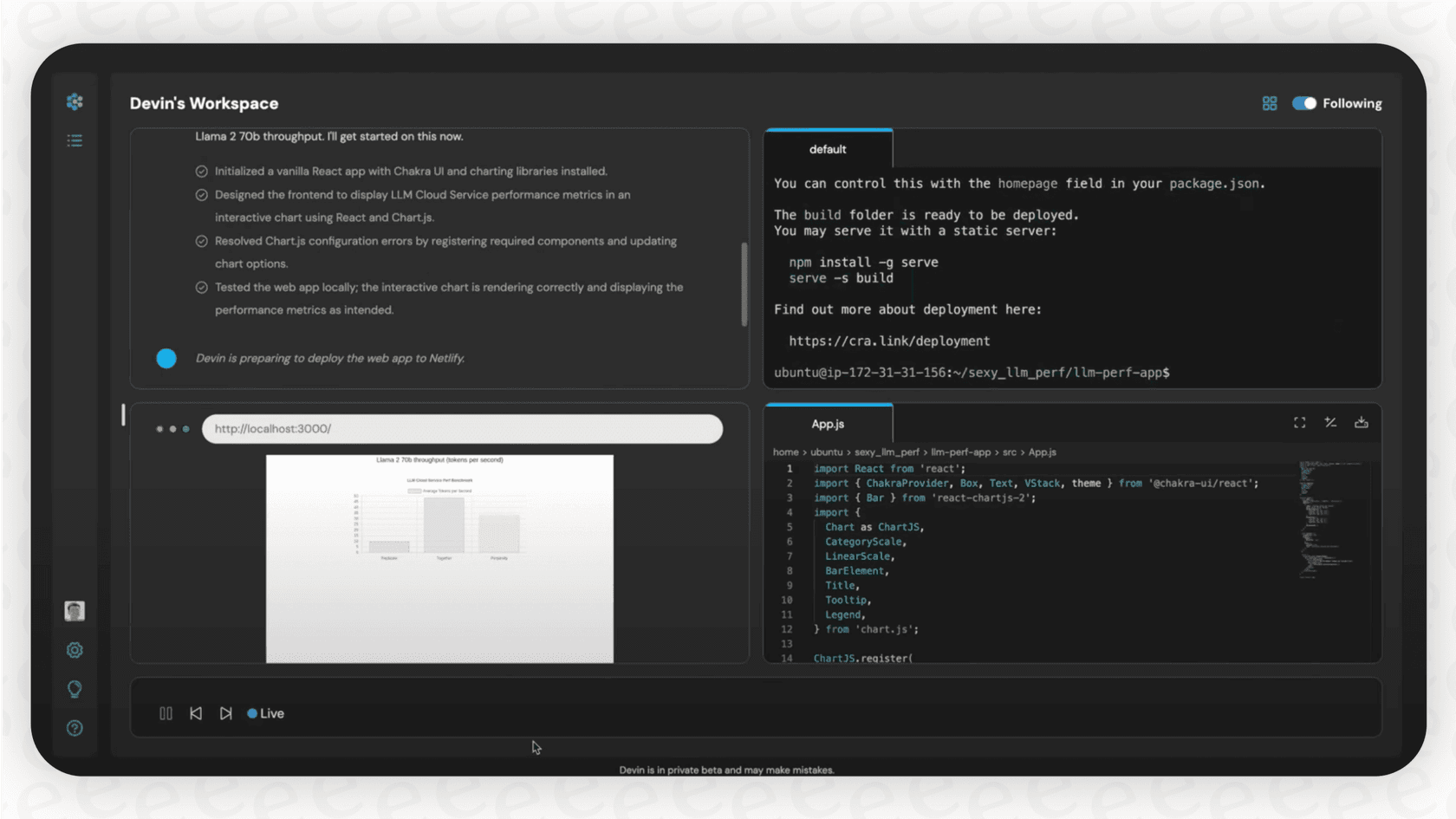
Simply put, Devin is made to be a force multiplier for engineering teams, freeing them up from thousands of hours of heavy lifting.
Who is Cognition AI for (and who is it not for)?
This is probably the most important question to ask. Devin is an incredibly powerful tool, but it's a specialist. Knowing its intended audience is key to figuring out if it makes sense for you.
Primary use cases for Cognition AI
Devin is built for software engineers, developers, and large IT departments. Its job is to build, debug, and maintain software, not to chat with or support the people using that software. It shines when it comes to technical tasks like:
-
Migrating massive amounts of code from old, clunky systems to modern cloud infrastructure.
-
Building out new application features from a set of high-level requirements.
-
Independently digging through complex codebases to find and fix bugs.
-
Acting as an autonomous data analyst to process and visualize information.
The limitations: Why Cognition AI isn't a customer support tool
If your main goal is to help customers, answer their questions, or resolve their problems, Devin is the wrong tool for the job. It writes code; it doesn't close support tickets.
An AI for customer support needs a completely different set of skills. It needs to pick up on conversational nuance, show a bit of empathy, and connect to a whole different ecosystem of business tools, from help desks like Zendesk and Freshdesk to e-commerce platforms like Shopify. Devin wasn't designed for any of that.
For teams trying to automate customer service, you need a solution built specifically for that world. This is where platforms like eesel AI come into the picture. They are designed from the ground up to plug into support workflows, learn from your company's knowledge, and give customers fast, accurate answers.
| Feature | Cognition AI (Devin) | AI for Customer Support (eesel AI) |
|---|---|---|
| Primary User | Software Engineers | Support Agents & Managers |
| Core Task | Writing, debugging & deploying code | Answering tickets, triaging issues & assisting agents |
| Data Sources | Codebases, APIs, technical documentation | Help centers, past tickets, Confluence, Google Docs |
| Setup Time | Months (Enterprise implementation) | Minutes (Self-serve, one-click integrations) |
| Pricing Model | Custom enterprise contracts | Transparent, predictable monthly plans |
Cognition AI pricing: What does it cost?
When you’re looking at any new tool, the price is a huge factor. But if you go looking for a pricing page for Cognition AI, you’ll be met with a 404 error.
There's no public pricing for Devin. As the Nasdaq Private Market page shows, Cognition AI is a private company that's focused on big enterprise deals. The lack of a public price tag usually points to a few things: a long sales process with lots of meetings, custom contracts for every client, and a price that most likely starts in the six or seven-figure range annually.
This approach makes perfect sense for a tool that can save a company millions of dollars on massive engineering projects. But it's a non-starter for most support, IT, or operations teams who need a solution they can roll out quickly and affordably.
This kind of murky pricing can be a real roadblock for teams that need predictable budgets and a clear return on investment. In contrast, solutions like eesel AI have transparent, public pricing plans with no hidden fees for each resolution. This makes it easy to get started, budget for costs, and prove the tool’s value without ever having to hop on a sales call.
Here’s what that looks like in practice:
| Plan | Monthly (bill monthly) | Effective /mo Annual | Bots | AI Interactions/mo | Key Unlocks |
|---|---|---|---|---|---|
| Team | $299 | $239 | Up to 3 | Up to 1,000 | Train on website/docs; Copilot for help desk; Slack; reports. |
| Business | $799 | $639 | Unlimited | Up to 3,000 | Everything in Team + train on past tickets; MS Teams; AI Actions (triage/API calls); bulk simulation; EU data residency. |
| Custom | Contact Sales | Unlimited | Unlimited | Unlimited | Advanced actions; multi‑agent orchestration; custom integrations; custom data retention; advanced security / controls. |
The takeaway: Choosing between Cognition AI and other AI tools
Cognition AI is a genuinely revolutionary tool for software engineering. It’s a huge step toward creating autonomous AI agents that can think and act on complex problems. But it is, first and foremost, a specialist. Picking the right AI always comes down to the job you need it to do.
For customer service, ITSM, or internal help desks, the problem isn't about building new software from scratch. It’s about delivering fast, accurate, and helpful answers by using all the knowledge your company already has. You need an AI that can plug into your existing tools, learn from your data, and start solving problems for customers and employees right away.
That’s where eesel AI is built to shine. It operates on a different philosophy:
-
Go live in minutes: It’s designed to be radically simple and self-serve. You can connect it to your help desk and knowledge bases with a few clicks, with no long onboarding process.
-
Integrates with your stack: eesel AI plugs right into the tools your team already relies on, like Zendesk, Jira Service Management, and Slack. You don't have to change your existing workflows.
-
Test with confidence: With its powerful simulation mode, you can test the AI on thousands of your past tickets. This lets you see exactly how it will perform and measure your potential ROI before you ever turn it on for your customers.
From building code to solving tickets
Cognition AI and its agent Devin offer an exciting peek into the future of software development, a future where autonomous AI agents can work as autonomous members of an engineering team. It’s a huge development that will absolutely change how software gets made.
But while engineers are figuring out what's possible with tools like Devin, support and IT leaders have the same chance to transform their own workflows with AI built for them. If your goal is to automate frontline support, give your agents instant access to answers, and unlock the value of your company's scattered knowledge, then you need a tool designed for that specific challenge.
Ready to see what an AI agent built for customer support can do? Get started with eesel AI in minutes and connect it to your help desk today.
Frequently asked questions

Share this article

Article by
Stevia Putri
Stevia Putri is a marketing generalist at eesel AI, where she helps turn powerful AI tools into stories that resonate. She’s driven by curiosity, clarity, and the human side of technology.