What is a customer service automation platform? (2026 guide)


Last edited June 23, 2026
Table of Contents
- What a customer service automation platform actually is
- What it automates (and where the value is)
- What it actually costs (and the model that matters)
- How a modern platform works under the hood
- What to look for in a customer service automation platform
- It doesn't replace your team, it rebalances it
- The failure modes to avoid
- Try eesel AI
What a customer service automation platform actually is
At its simplest, customer service automation is using technology to handle support tasks so your team doesn't have to do them by hand. That definition is broad on purpose, because it covers everything from a saved reply you paste with a keyboard shortcut to a fully autonomous agent that reads a ticket, looks up an order, issues a refund, and closes the conversation without anyone touching it.
A platform is the difference between a single trick and a system. A standalone chatbot does one thing. A customer service automation platform brings the pieces together: it connects to your helpdesk, learns from your knowledge, answers across channels, routes what it can't answer, and reports on all of it in one place. Most teams reach for one when the same questions keep flooding the queue, which is the exact pain a support ticket automation system is built to solve.
Here's the thing the marketing pages skip: the biggest objection I hear from buyers isn't "will it work," it's trust. One CX lead at a DTC supplements brand put it perfectly on a call: "The AI will never be able to answer 100% of the questions. I need an AI who is only handling the tickets that it's confident to handle, and all the other ones, leave them alone." That instinct is correct, and it's the single best lens for evaluating this whole category. A platform you can trust is one that knows what it doesn't know.
What it automates (and where the value is)
Customer service automation isn't one feature, it's a spectrum that runs from cheap-and-simple to expensive-and-powerful. The main jobs a platform takes on:
- Answering repetitive questions. The bulk of most queues is the same handful of questions: where's my order, how do I reset my password, what's your refund policy. This is the highest-volume, highest-ROI thing to automate first, and it's what most AI customer service chatbots are built around.
- Ticket routing and triage. Reading an incoming ticket, working out the intent and urgency, and sending it to the right queue without a human reassigning it. This is the core of good ticket triage and routing automation.
- Self-service. An AI-indexed help center that lets customers solve their own problem before they ever open a ticket. Strong knowledge base management is the foundation everything else sits on.
- Agent assist (copilots). Drafting replies, summarizing long threads on handoff, adjusting tone, translating. This makes your humans faster instead of replacing them, and tools like AI agent assist live here.
- Proactive messaging. Sending the shipping update before the customer asks "where's my order," so the ticket never gets created at all.
- Actions, not just answers. The top tier: issuing refunds, looking up order status via an API, updating a subscription. This is where deflection turns into genuine resolution.
The dividing line that matters most across all of these is rule-based versus LLM-based, because it determines how much you can actually automate.
| Dimension | Rule-based bot | LLM agent |
|---|---|---|
| Setup | Manual decision-tree building | Connect knowledge sources |
| Maintenance | High (update branches by hand) | Lower (retrain on updated docs) |
| Language understanding | Keyword matching | Semantic understanding |
| Multi-step questions | Fails | Handles well |
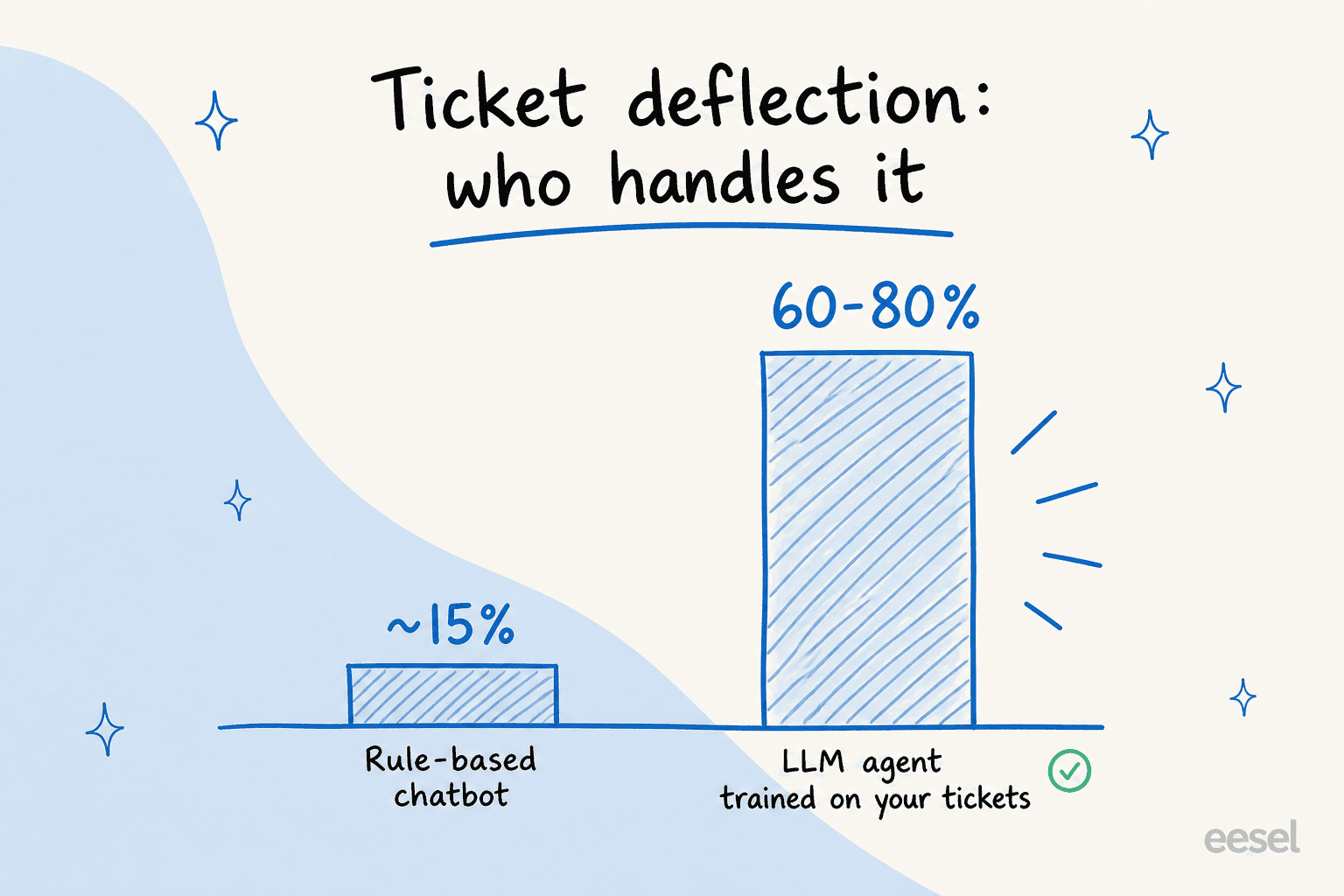
| Deflection rate | 10-20% | 60-80% |
| Human handoff | Configurable | Essential, built in |
| Actions (refunds, lookups) | Limited | Possible via integrations |
| Cost | Lower per interaction | Higher per interaction |
The numbers in that table aren't hypothetical. A B2B SaaS operator on r/SaaS documented exactly what the jump looks like when you move from one to the other:
"We'd tried a traditional chatbot before, the rule-based kind with decision trees. It was painful to build, required constant maintenance, and customers hated it because it could only handle the exact scenarios we'd programmed. Anything slightly off-script and it would say 'I don't understand, let me connect you with an agent.' The deflection rate was maybe 15%. Basically expensive wallpaper."
After switching to a custom agent trained on their docs and past tickets: "Ticket volume dropped from ~380/week to ~145/week, a 62% reduction. Average first response time went from 48 hours to literally instant. Customer satisfaction scores actually went UP." - u/sjlan30, r/SaaS
That 62% drop, with CSAT going up not down, is the prize. But it only shows up when the AI is trained on the right material, which I'll get to.
What it actually costs (and the model that matters)
Before the feature checklist, the money question, because it's where most buying decisions actually turn. The cost of an automated interaction runs a fraction of a human-handled one, and the gap is wide enough that even modest deflection pays for itself quickly. The trap is in how platforms charge: per-seat plans get more expensive as your team grows, and per-resolution add-ons get more expensive as you succeed. The number to optimize is cost per resolved conversation, not the monthly sticker price.
Plug your own numbers into the calculator below to see what the human-versus-automated math looks like for your volume.
For a concrete reference point, eesel AI charges $0.40 per resolved ticket with no platform fee and no per-seat cost, and you only pay for tickets the AI actually handles. A 1,000-ticket month routed entirely through it is about $400. The deeper comparison of automated versus human economics lives in my piece on AI agent vs human agent cost.
How a modern platform works under the hood
The reason an LLM agent outperforms a decision tree comes down to where it gets its knowledge and what it does when it's unsure. A good platform indexes everything it can learn from (your help center, product docs, and crucially your resolved ticket history), then for each incoming question it retrieves the relevant material, drafts a grounded answer, and runs a confidence check before it does anything.
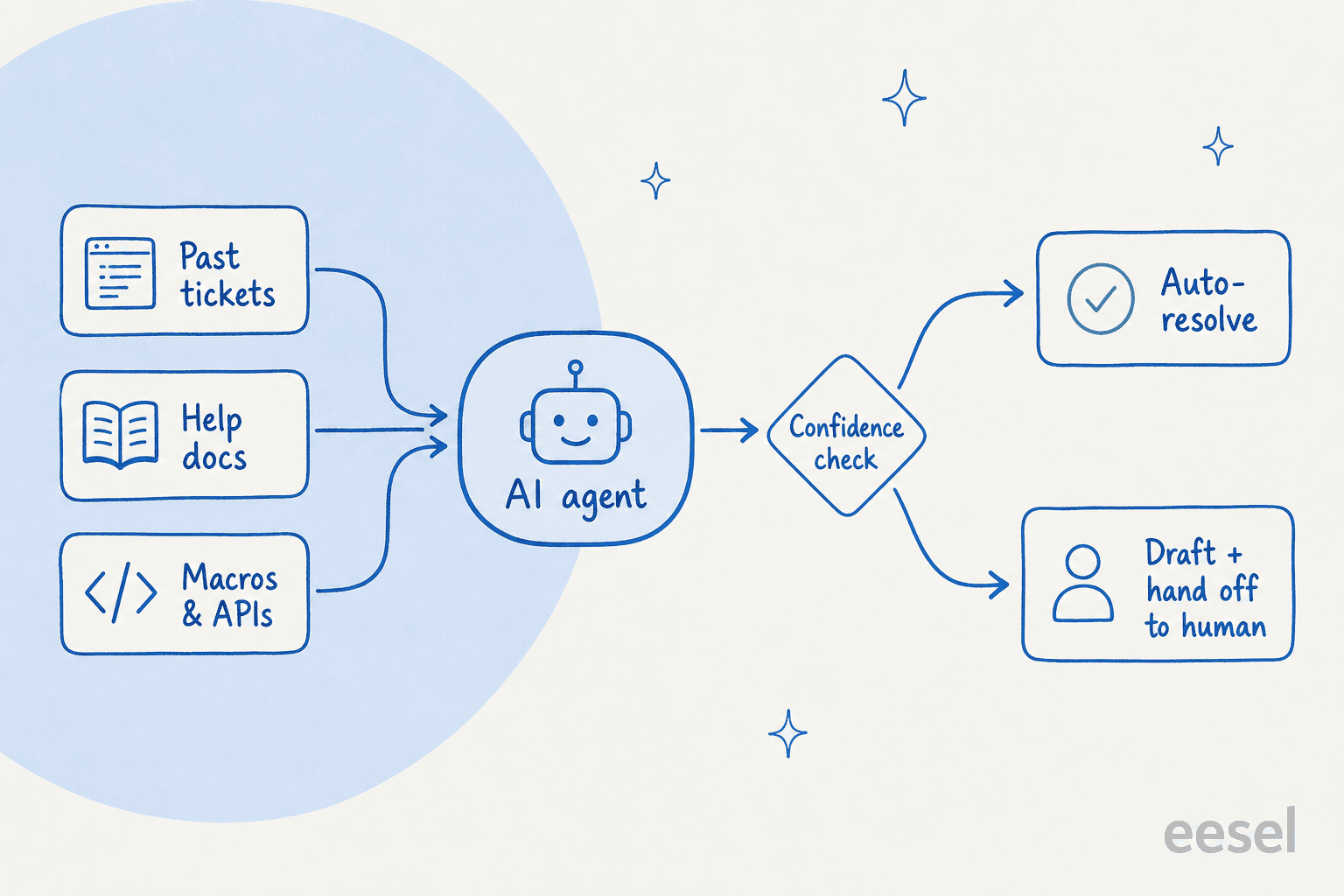
That confidence check is the whole game. High-confidence answers get sent or auto-resolve; low-confidence ones become a draft for a human or an escalation with the full conversation attached. It's the technical answer to the trust objection: the AI handles what it's confident about and leaves the rest alone, exactly like that CX lead wanted. If you want the failure side of this, weak grounding is what produces the dreaded confidently-wrong reply, which I dug into in why your AI chatbot isn't answering correctly.
The single biggest quality lever is the training data. As one founder put it on r/automation:
"Your help center only documents the questions someone already bothered to write up. The messy stuff, the multi-step bugs, the 'works on my plan but not yours' tickets, that knowledge lives in your resolved tickets. A KB-only bot nails the easy 60% and then either stalls or makes something up on the rest."

This is why I'm so insistent on platforms that learn from solved tickets. The help center handles the easy 60%; the resolved-ticket history is what gets you the rest.
What to look for in a customer service automation platform
I've tested most of the top customer service AI platforms at this point, and once you strip away the marketing there are five things that separate the ones that stick from the ones that get ripped out after a month:
- It learns from your resolved tickets, not just help articles. This is the moat. A platform trained only on FAQ content caps out at the easy questions, so it pays to train the AI on your knowledge base and your ticket history.
- It grounds answers and routes by confidence. Every answer should trace back to a source document, and anything the AI isn't sure about should become a draft or an escalation rather than a guess.
- It hands off to a human cleanly. The number one design failure is a bot that dead-ends a frustrated customer. Handoff should carry the full conversation history so the person doesn't start from zero.
- It takes actions, not just answers. Looking up an order, issuing a refund, updating an account. A platform that only retrieves text is doing half the job.
- You can simulate before you launch. The best platforms run against your historical tickets and show you projected coverage and accuracy by topic before a single customer sees the AI. This is the difference between hoping it works and knowing.
A practical test I always recommend: pull your last 200 tickets and split them into "answerable from a doc" versus "needed real troubleshooting." That ratio tells you which kind of platform you're actually shopping for. Then take your 20 most common real tickets and run them through any tool's free tier before you commit. If a vendor won't let you test on your own content, that's the answer.
It doesn't replace your team, it rebalances it
The fear that automation means layoffs is the most common reason these projects stall internally, and it's mostly misplaced. Gartner actually predicts that half of organizations will abandon plans to cut their support workforce because of AI by 2027. The teams getting it right aren't shrinking, they're rebalancing.
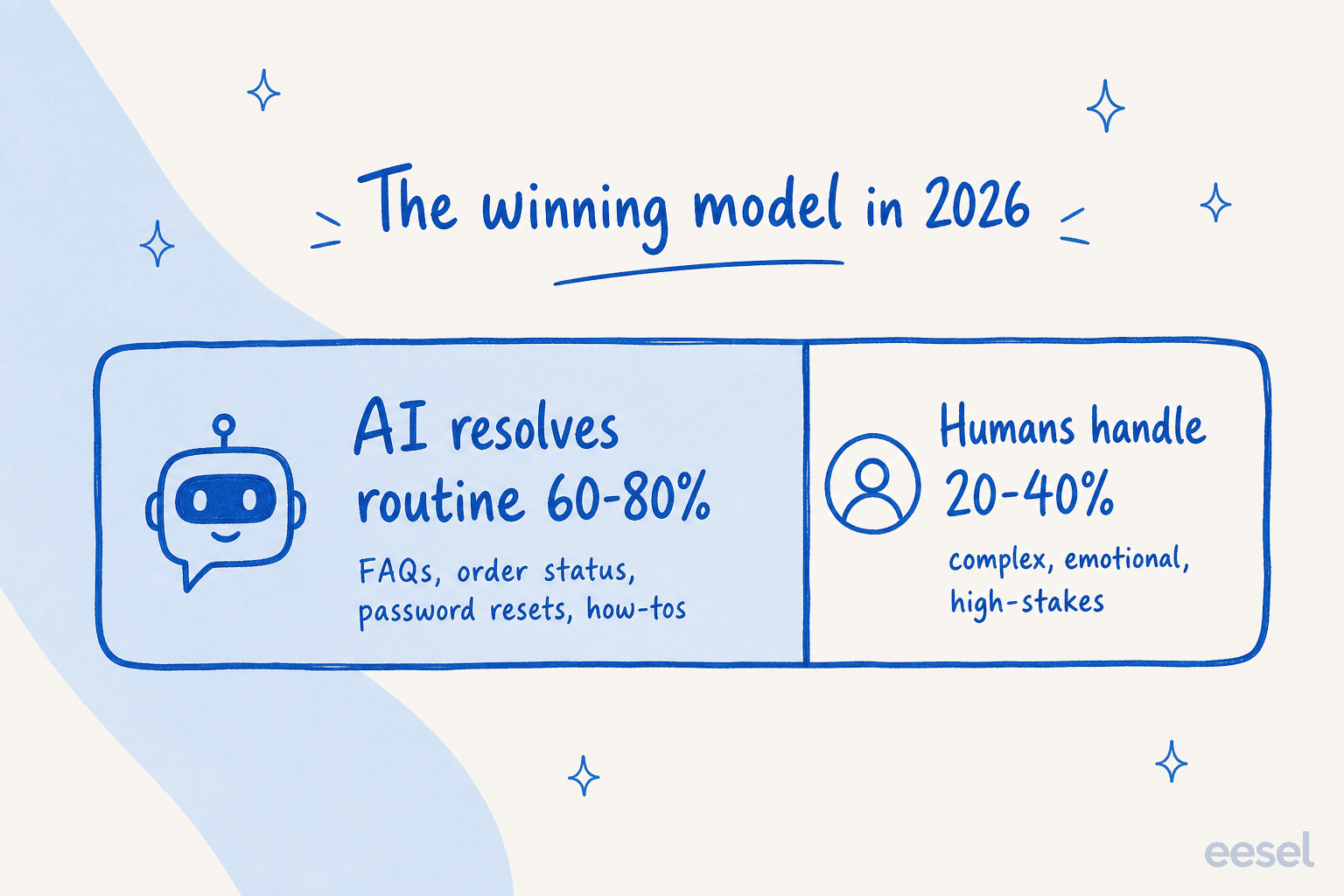
The model that works in 2026 is human plus AI: the platform resolves the routine 60-80% (FAQs, order status, password resets, how-tos), and your people handle the complex, emotional, and high-stakes 20-40% where empathy and judgment matter. The B2B operator from earlier kept all three support agents and moved two into customer success and onboarding, roles that drive revenue instead of answering the same Zapier question for the 400th time. A support manager I spoke with framed the goal as wanting the AI to handle 60% of tickets and know when to pull a real person in. That "know when to escalate" half is non-negotiable.
The failure modes to avoid
For balance, here's where automation goes wrong, because plenty of deployments do. The loudest complaints I see across r/CustomerSuccess and similar threads cluster into three patterns:
- Deflection theater. A bot that "deflects" tickets on paper by frustrating customers into giving up, or pushing them to a different channel where they re-contact you. The metric looks great; the experience is worse than nothing.
- No human handoff. The fastest way to torch CSAT. A dead-end bot costs more goodwill than it ever saves in ticket volume.
- KB-only training. Trained on help articles alone, the AI handles the easy questions and hallucinates on the rest. This is the single most common reason a deployment underperforms.
The throughline: automate the routine, keep a clear path to a human, and never deploy without testing on your real tickets first. Get those three right and the downside mostly disappears.
Try eesel AI
If you've read this far, you already know what to look for, and eesel AI was built around exactly these principles. It learns from your past tickets and help docs on day one, routes by confidence so it only auto-handles what it's sure about, and plugs into your existing helpdesk (Zendesk, Freshdesk, Gorgias, Front, HubSpot, and more) without a migration.

The part I'd actually start with is simulation mode: it runs the agent against thousands of your historical tickets and shows you the projected resolution rate and accuracy by topic before you turn anything on for a real customer. That's how Gridwise saw eesel resolve 73% of tier-1 requests in the first month, with results visible during a 7-day trial. Pricing is usage-based at 40¢ per resolved ticket with no per-seat fees, so the cost scales with value rather than headcount. You can try it free and see your own numbers before you decide.
Frequently Asked Questions

See a customer service automation platform on your own tickets
Simulate eesel AI on your past tickets and watch the resolution rate before you commit.
Share this article