The Gorgias AI chatbot: what it does, what it costs, and where it fits


Last edited June 12, 2026
What is the Gorgias AI chatbot?
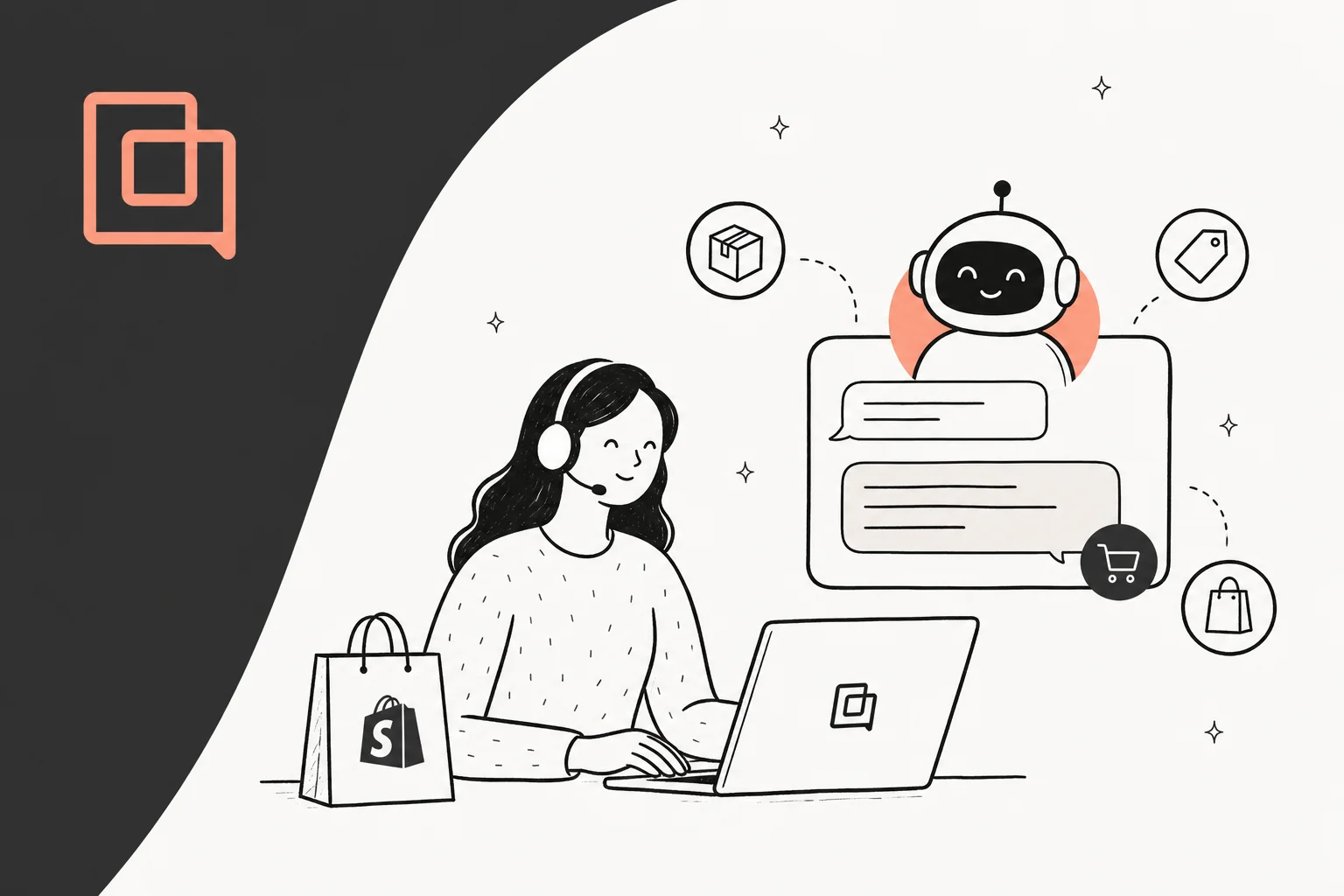
Gorgias is a customer experience platform built specifically for ecommerce, and it's Shopify's only Premier Partner for CX. It powers around 40% of the top 1,500 Shopify brands and serves 17,000+ stores in total. The "AI chatbot" people search for is the Gorgias AI Agent, the automation layer that sits on top of the helpdesk and answers customers directly.
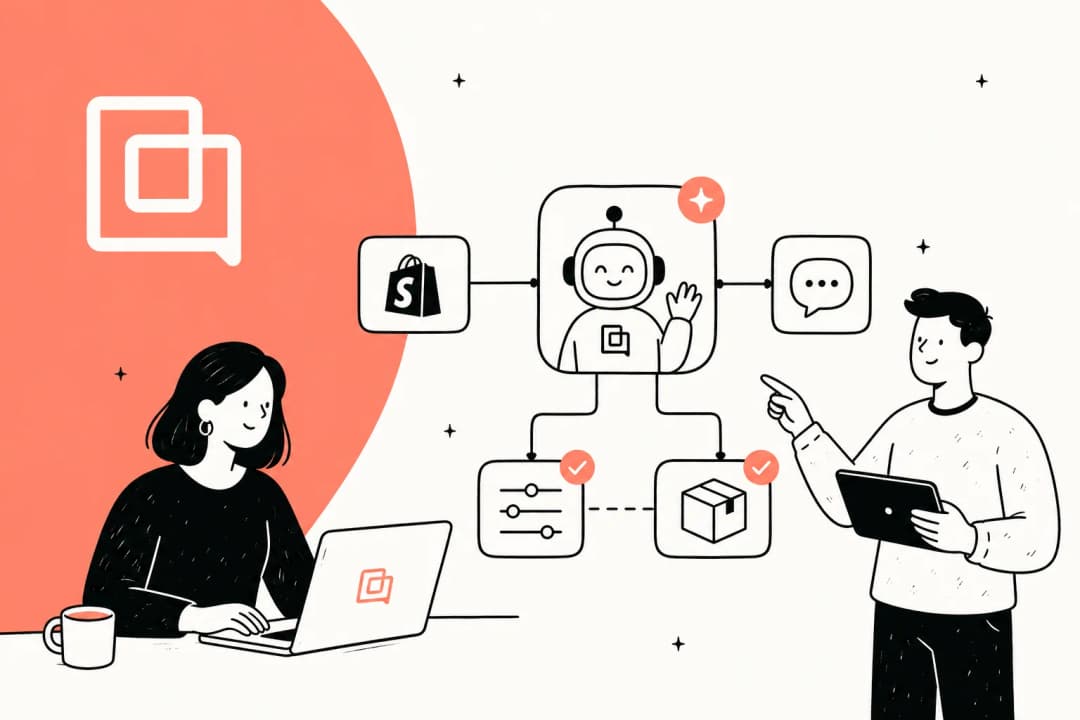
Here's the thing that makes it different from a generic chatbot you'd bolt onto any website: it isn't reading a static FAQ and guessing. The Gorgias AI Agent has the customer's full Shopify context, order history, current cart, subscription status, in front of it on every message. So when a shopper asks "where's order #4832 and can I swap the size," the bot isn't deflecting to a help article. It's looking at the actual order and taking the actual action.
It runs on both email and the chat channel, which is the part most people mean when they say "Gorgias AI chatbot", the floating chat bubble on your storefront, answering 24/7. On G2, Gorgias holds a 4.6 out of 5 from 560+ reviews, and reviewers there note it has a slight edge over Shopify Inbox on AI text generation and summarization.
How the Gorgias AI chatbot actually works
The AI Agent splits into two modes, and understanding the split is the fastest way to understand the product.
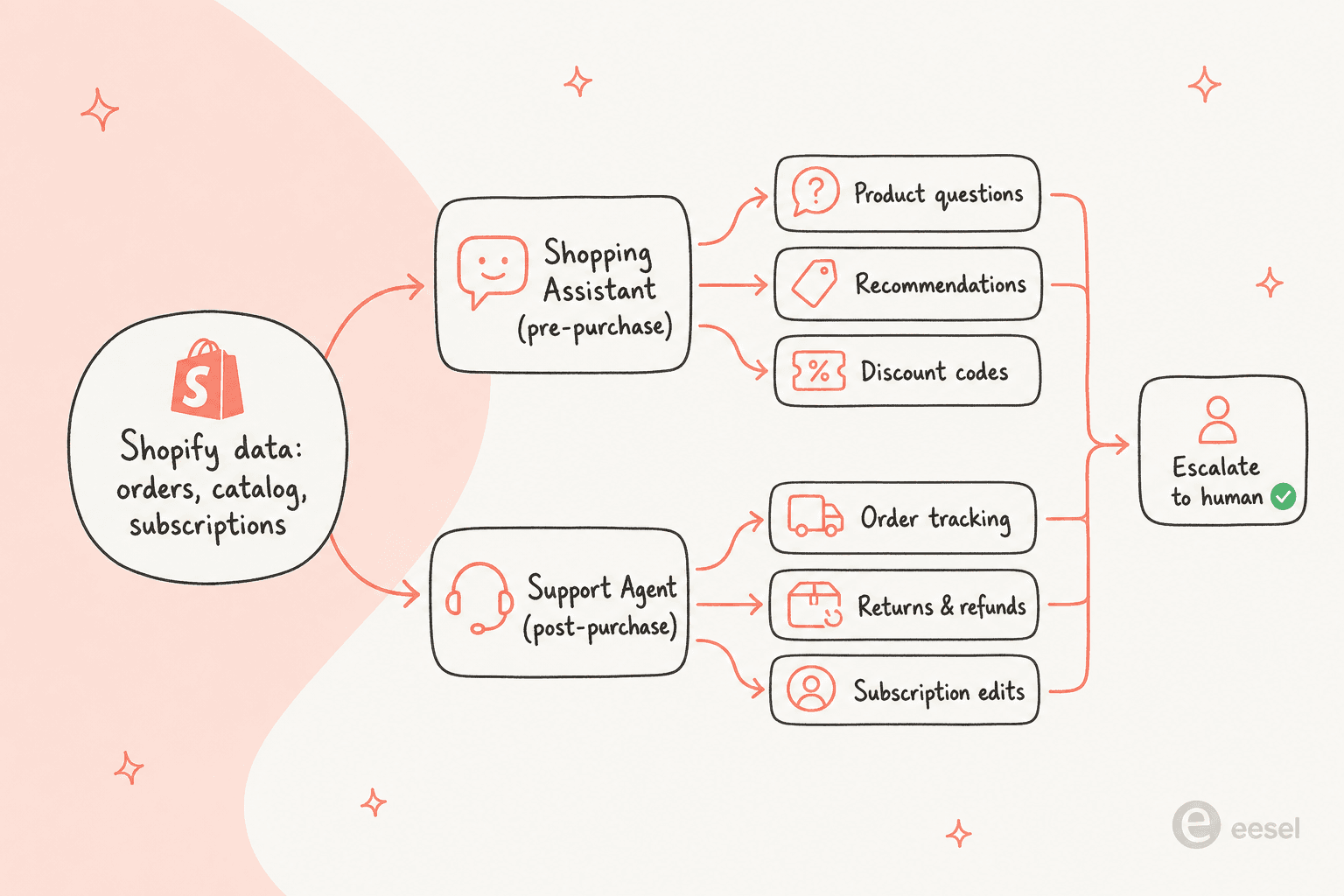
The Shopping Assistant handles the pre-purchase side. It engages shoppers before they buy, answers product questions, suggests sizes, makes recommendations, and can even deliver a personalized discount code to nudge a conversion. The Support Agent handles the post-purchase side: order tracking, returns, refunds, subscription edits, and FAQs, fully automated.
Underneath both, Gorgias runs what it calls cascading prompt orchestration on top of an OpenAI partnership, each reply is built from the in-conversation context plus the shopper's personal history. It draws on your help center, your internal guidance, your product catalog, and 100+ ecommerce integrations (Recharge, Klaviyo, Loop Returns, Yotpo, and the rest) so it can actually take action rather than just talk.
When it can't handle something, it's built to escalate to a human with the full conversation context handed off. That deflect-then-handover pattern is the whole game for a support bot, and it's where a lot of cheaper tools fall down.
What the Gorgias AI chatbot can actually do
This is where the Shopify integration stops being a marketing line and starts being the product. Because the bot has real order data and can call real Shopify actions, the list of things it handles end-to-end is genuinely long:
- Order tracking - instant, real-time status updates, so no human ever touches a "where's my order" again
- Returns and refunds - processed automatically against your policy
- Order and subscription edits - change a shipping address, edit an order before fulfillment, pause a subscription
- Dynamic discount codes - generated on the fly based on shopper behavior and intent
- Product recommendations - personalized from browsing history, past purchases, and cart contents
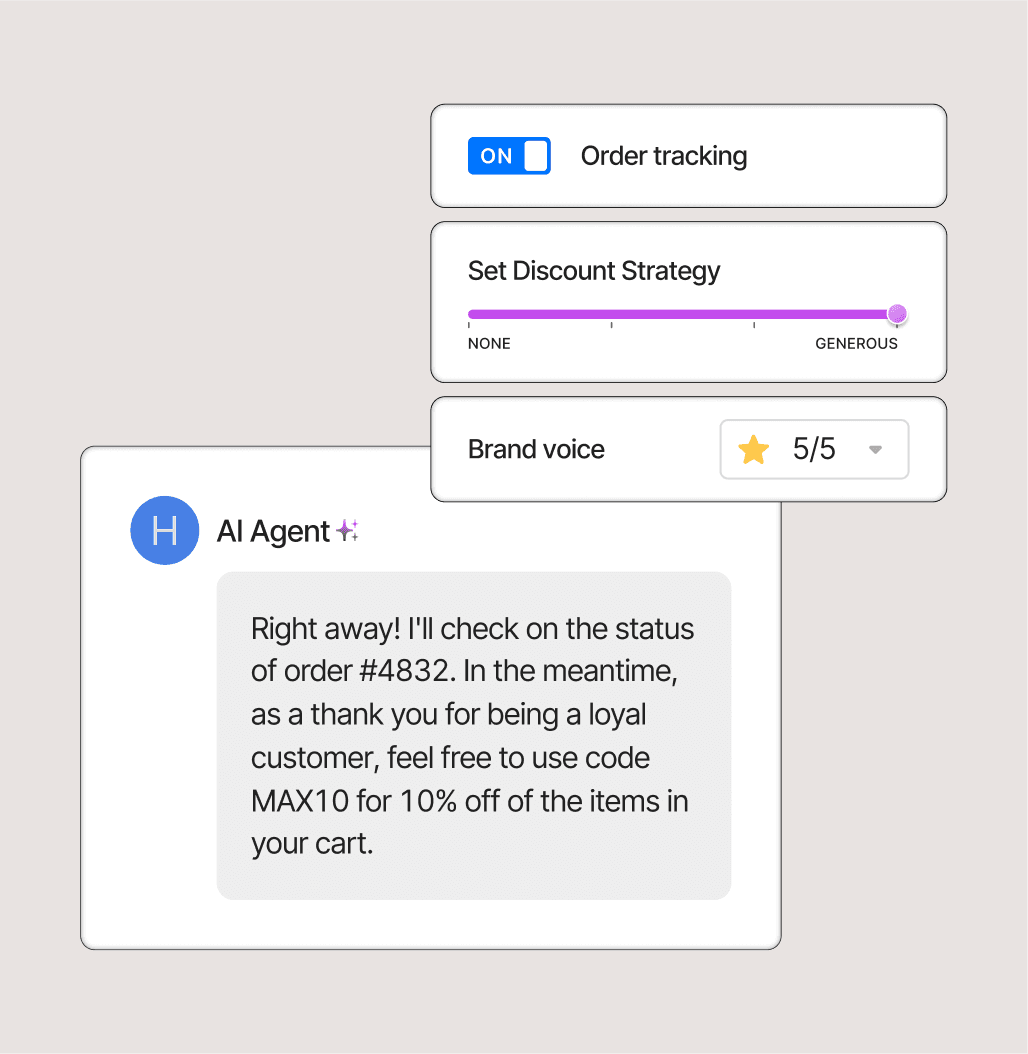
The results brands report are real and specific. Orthofeet hit a 56% automation rate in under two months. Loop Earplugs found that 70% of customers who get an AI article recommendation never follow up. As Toby Moors, a Customer Happiness Specialist at Loop Earplugs, put it on the Gorgias AI Agent page: "We spend less time answering repetitive questions, and 70% of customers who receive article recommendations don't have any follow-ups."
One more capability worth calling out, because it's the trust question every support lead asks: the AI Agent will classify intent before acting, distinguishing a refund request from an exchange request, for instance, so the action it takes matches what the customer actually wants.
Setting up the Gorgias AI chatbot
Gorgias frames setup as a four-step cycle, and it's a fair description of how you'll actually live with it.
- Onboard - connect your help center, Shopify store, and integrations, then write brand-specific AI Guidance that tells the agent exactly how to respond. Upload your policies, write your rules, launch.
- Automate - the agent starts handling order tracking, returns, and FAQs, offering discounts and upsells based on live inventory.
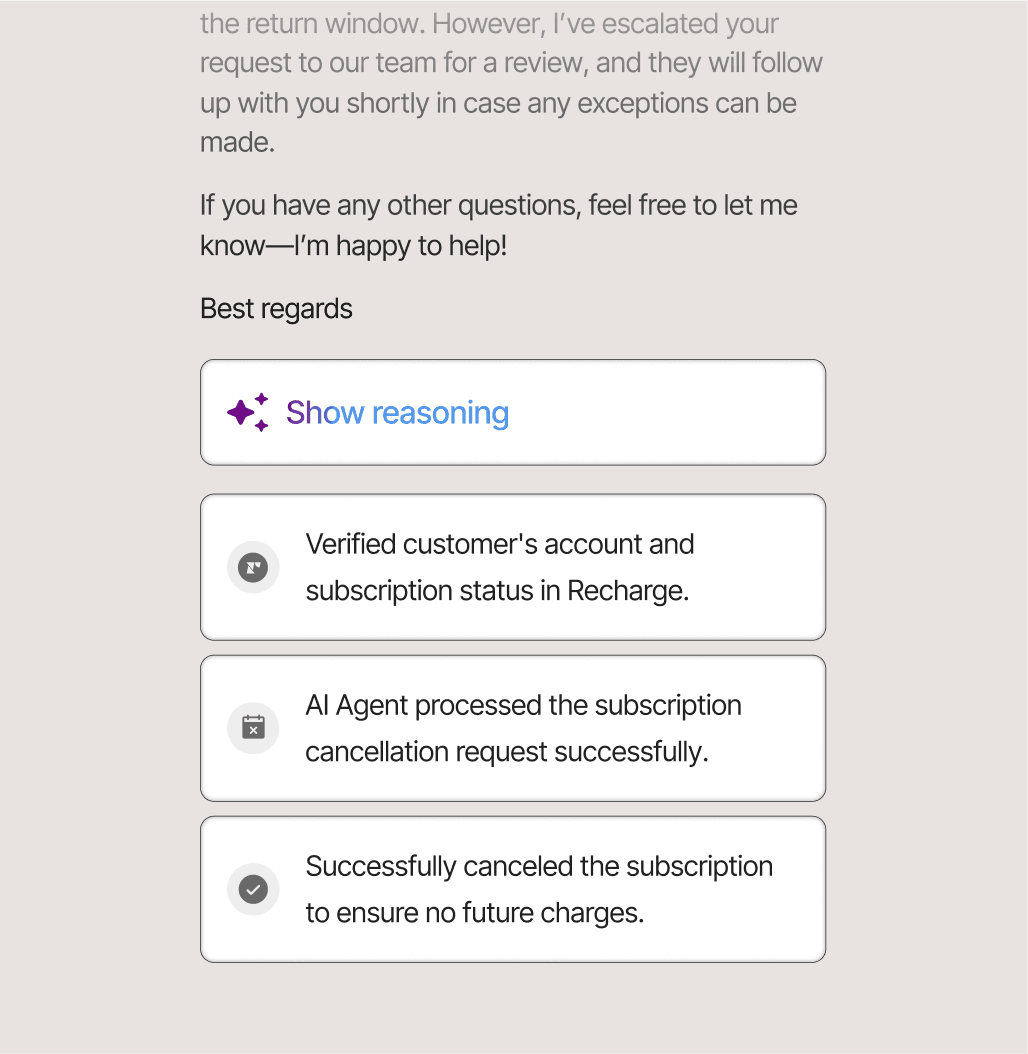
- Analyze - review success rates by intent, and read the reasoning behind every single response.
- Optimize - correct behavior instantly with a thumbs-up or a guidance tweak, and let the auto-QA process refine replies.
That "read the reasoning behind every response" step is genuinely useful, you can see why the bot did what it did, not just what it said.
If you want the full walkthrough, our Gorgias AI setup guide goes step by step. The honest caveat: setup quality lives and dies on your AI Guidance and your rules. A thin knowledge base and vague guidance get you a thin bot, no platform fixes that for you.
How much the Gorgias AI chatbot really costs
Here's the part the pricing page doesn't put in a single number. The true cost of the Gorgias AI chatbot is two charges stacked on top of each other.
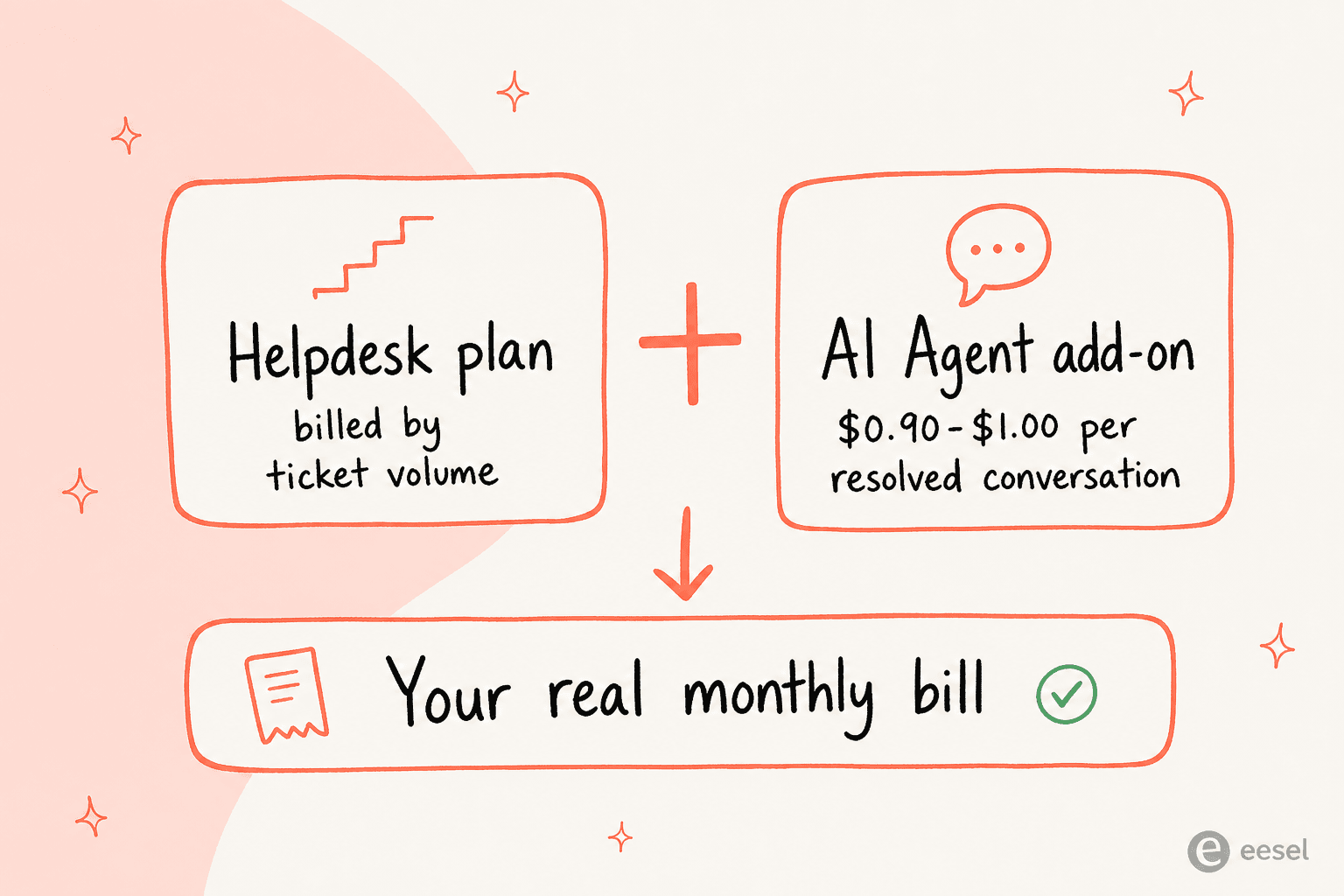
First, the helpdesk plan, priced by ticket volume, not by seats (users are unlimited):
| Plan | Monthly price | Tickets included | Overage |
|---|---|---|---|
| Starter | $10 | 50 | $0.40 / ticket |
| Basic | $60 (~$50 annual) | 300 | $40 / 100 tickets |
| Pro (recommended) | $360 (~$300 annual) | 2,000 | $36 / 100 tickets |
| Advanced | $900 (~$750 annual) | 5,000 | $36 / 100 tickets |
| Enterprise | Custom | 5,000+ | $32 / 100 tickets |
Annual billing saves up to 16% (two months free), and the pricing page lists it all out.
Then, on top of the plan, the AI Agent add-on: $1.00 per resolved conversation on Starter, $0.90 on every plan above it. You're only charged when the AI fully resolves a conversation with no human in the loop, and if a shopper talks to a human within 72 hours, it's billed as a regular ticket instead of an AI resolution.
So a worked example. Say you're on Pro: $360/mo for 2,000 tickets. If the AI Agent resolves half of those on its own, that's 1,000 resolutions × $0.90 = $900, landing you at roughly $1,260/month all in. That's the number to budget against, not the $360 sticker.
This is exactly why the community's main gripe with Gorgias is pricing creep. On a Reddit thread comparing it to Zendesk, one operator summed it up:
"Gorgias is awesome if you're super deep into Shopify workflows... The downside is the price adds up quick once your volume grows."
u/ShoddyPut8089, r/CRM

For the full picture, including overage mechanics and add-on channels like Voice and SMS, see our Gorgias AI pricing breakdown and the plans comparison.
What real users actually say
The community verdict on Gorgias is remarkably consistent, and worth reading before you commit, because the praise and the criticism both point at the same thing.
The praise is the Shopify integration. Across Reddit, G2, and LinkedIn, the recurring line is that no other tool pulls order data into the ticket view as cleanly. As one ecommerce veteran put it when weighing Gorgias against Zendesk:
"I've been around ecommerce for 10+ years and this is honestly how I'd choose: 40%+ tickets need Shopify actions → I'd lean Gorgias. Mostly conversational support → Zendesk is fine."
u/cavalry18, r/CRM
That 40% line is the most useful heuristic anyone's offered for whether the Gorgias AI chatbot is worth it. The criticism, predictably, is cost at scale, and a sharper point buried in the same conversations: most teams optimize for handling tickets faster when they should be reducing ticket volume in the first place.
"What's usually overlooked is that most teams optimize for handling tickets faster, not for reducing them."
u/Andrutex, r/ecommerce
That's the right frame. A bot that resolves tickets is only saving you money if the per-resolution cost is below your per-ticket cost of a human handling it, and on a per-resolution model, that maths needs checking at your volume.
Where the Gorgias AI chatbot falls short
Gorgias is genuinely excellent at what it's built for. But "built for Shopify" is also the boundary of where it makes sense, and there are three situations where we'd think twice.
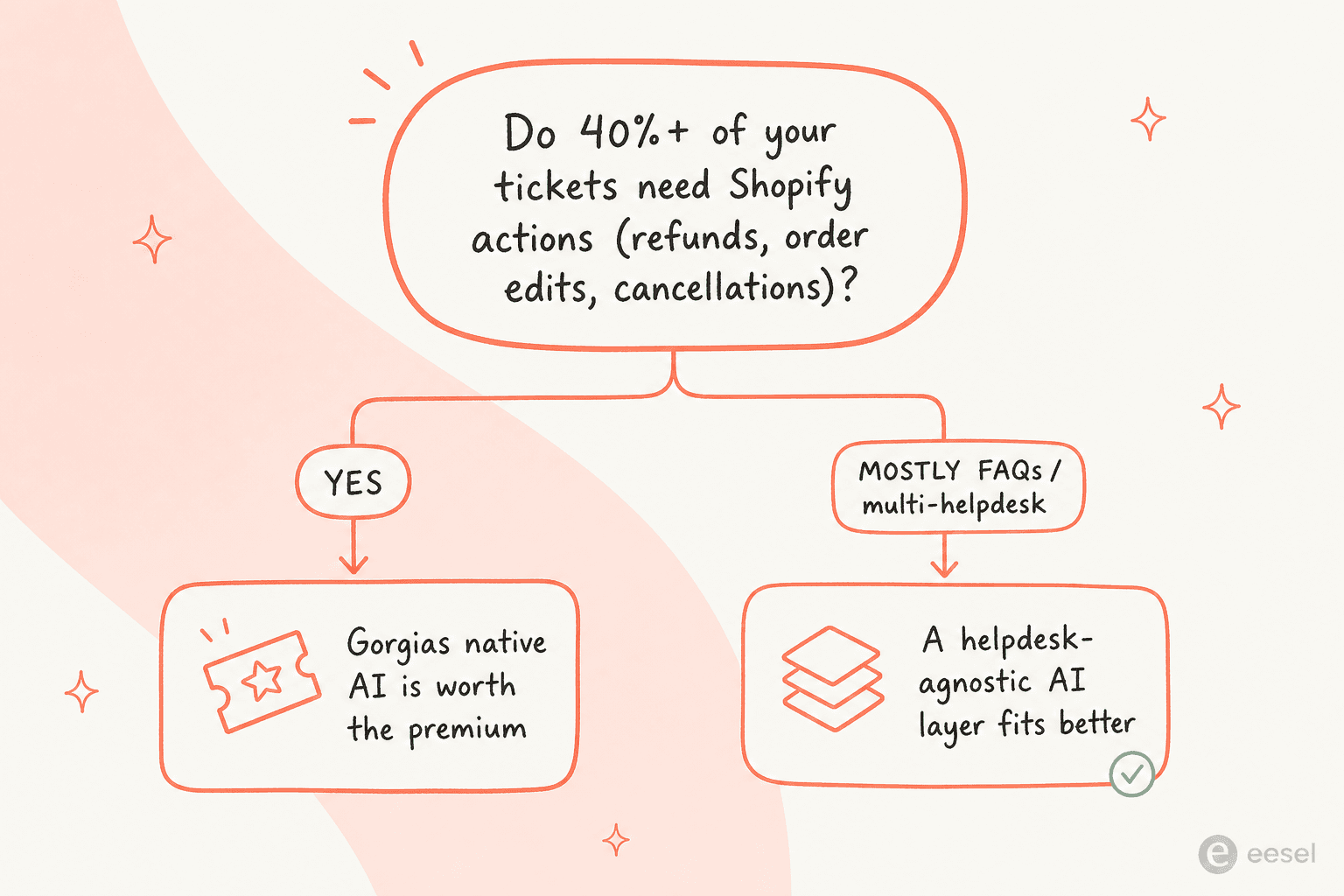
You're not deep in Shopify actions. If most of your volume is FAQs, "is this in stock," "what's your return window," then you're paying a Shopify-native premium for value you're not using. The 40% rule applies. A general-purpose AI chatbot for e-commerce might cover you for less.
You run more than one helpdesk, or you're not on Gorgias at all. The AI Agent lives inside Gorgias. If your team is on Zendesk or Freshdesk, or split across tools, adopting it means migrating your whole helpdesk, not just adding a bot.
You want tight control over what the AI touches. This is the big one, and it's the single most common objection we hear from support leads evaluating any AI agent. They don't want a bot that auto-replies to everything; they want one that only handles what it's confident about and leaves the rest alone. As one CX lead at a DTC supplements brand framed it to us: the AI will never answer 100% of questions, so what they actually need is an AI that handles only the tickets it's confident to handle, and leaves the others for a human. If that's your worry, the deciding factor isn't features, it's how much control the tool gives you over the line between "AI answers" and "human answers."
It's also worth knowing the broader switching context: on a per-resolution model, the highest-volume stores are the ones who feel the cost most, exactly the teams getting the most value, which is a slightly awkward incentive. If you're weighing options, our guides on Gorgias vs Tidio and the wider field of Shopify chatbot apps lay out the trade-offs.
Try eesel
If those last three points landed, that's the gap eesel AI is built for. Instead of being tied to one helpdesk, eesel is a helpdesk-agnostic AI layer that sits on top of what you already run, Shopify, Zendesk, Freshdesk, Slack, Gmail, and 100+ other tools, so you don't migrate anything to add an AI chatbot to your store.
Two things make it a natural fit for Shopify merchants who like Gorgias but want more control. First, eesel trains on your own past tickets and existing knowledge, so it sounds like your brand from day one, and you can simulate it against thousands of your historical tickets before it ever replies to a real customer. Second, you decide exactly which conversations it's allowed to handle and which it routes to a human, the confidence control that the support leads above were asking for. And because eesel's pricing is straightforward usage-based ($0.40 per ticket, no per-seat fees, no per-resolution surprise), the cost stays predictable as you scale.
It's one of the more common Shopify AI alternatives teams land on when they want the automation without the lock-in. You can start free and run a simulation on your own tickets to see the deflection rate before you commit a dollar.
Frequently Asked Questions

Share this article

Article by
Riellvriany Indriawan
Riell is a designer and writer at eesel AI with about two years of experience researching CX platforms, AI chatbots, and helpdesk software. She combines her design background with a sharp eye for how these tools actually look and feel in practice — making her comparisons unusually visual and user-focused.