Inflection AI: The rise, fall, and $1.5B pivot


Last edited October 1, 2025
Table of Contents
- What is Inflection AI?
- The rise of Pi: A different kind of personal AI
- The reality check: When the consumer AI dream met the real world
- Inflection AI today: A new life in enterprise
- Inflection AI pricing
- The lesson for business AI: Integration over invention
- Inflection AI: From cautionary tale to strategic lesson
For a hot minute, Inflection AI looked unstoppable. It had $1.5 billion in backing and a dream team of founders, including LinkedIn's Reid Hoffman and DeepMind's Mustafa Suleyman. Their goal was huge: build the world's best personal AI. And their chatbot, Pi, was actually winning over millions of people.
Then, in early 2024, the story took a sharp turn. The co-founders and most of the team suddenly left for Microsoft in a deal that felt more like a talent grab than an acquisition. Their ambitious project was left to find a whole new direction.
So, what really happened here? This is the story of Inflection AI, a close look at why its original mission hit a wall and what critical lessons you can pull for your own business's AI strategy, especially when you don't have billions of dollars to burn.
What is Inflection AI?
Inflection AI kicked off in 2022 with a goal that was both simple and wildly ambitious: create a "personal intelligence," or Pi for short. The founders were a real who's who of Silicon Valley. Mustafa Suleyman co-founded the AI lab DeepMind (which he later sold to Google), Karén Simonyan was a star AI researcher from the same lab, and Reid Hoffman co-founded LinkedIn and is one of the most connected investors in the tech world.
Their main product, Pi, wasn't just another ChatGPT clone designed to do tasks. It was built for empathetic, supportive, and emotionally aware conversations. Think of it less like an assistant for writing emails and more like a friendly ear you could chat with about your day.
This vision brought in some serious cash. The company raised over $1.5 billion from heavy-hitters like Microsoft, NVIDIA, Bill Gates, and Eric Schmidt. The message couldn't have been clearer: the industry was expecting massive things from Inflection AI and its unique chatbot.
The rise of Pi: A different kind of personal AI
For a while, everything seemed to be going exactly to plan. The Pi chatbot launched and quickly gathered millions of users who really connected with its unique personality. Its big differentiator was its focus on "EQ" (emotional quotient) over pure "IQ." While every other model was in a race to be the smartest, Pi was trying to be the kindest and most supportive.
This wasn't just a marketing gimmick. It was powered by some impressive tech, including their in-house Inflection-2.5 model. The company claimed it could hang with industry leaders like GPT-4 but needed a lot less computing power to train, a huge advantage in the incredibly resource-hungry world of AI.
Inflection AI looked like a textbook success story in the making. It had the money, the talent, and a product that people genuinely seemed to love. It was a bright spot in the new consumer AI space, which made its sudden change of plans all the more surprising.
The reality check: When the consumer AI dream met the real world
Behind the scenes, the founders were running up against a tough reality. The dream of building a standalone consumer AI giant was clashing with the brutal economics of going head-to-head with Big Tech.
The staggering cost of the AI arms race
The root of the problem was money. And lots of it. Building and training top-tier large language models is ridiculously expensive. According to a Bloomberg interview, the founders figured they'd need to raise another "$2 billion more merely to fund their ambitions through 2024," with billions more needed right after that.
Even with their huge pile of cash, it just wasn't enough to compete over the long haul. They were up against giants like Google and Microsoft, who were sitting on roughly "$100 billion in cash on hand." These companies could afford to offer their AI services for free or at a very low cost just to grab market share. It was an arms race that no startup, no matter how well-funded, could win. As Suleyman himself put it, the models they were building were at risk of becoming "fundamentally a commodity."
The Microsoft "acquihire"
Facing this uphill battle, the founders made a pragmatic call. In March 2024, Microsoft announced it was hiring Suleyman, Simonyan, and almost all of Inflection's 70-person team. Suleyman was tapped to be the CEO of a new division, Microsoft AI, putting him in charge of all its consumer AI products, including Copilot.
It wasn't a straight-up acquisition, which would have brought on a lot of unwanted attention from regulators. Instead, Microsoft essentially hired the whole team. According to The Information, Microsoft paid Inflection a $620 million licensing fee to use its models and another $30 million to make sure Inflection wouldn't sue for poaching its staff. Investors got a decent return, and Microsoft got one of the best AI teams on the planet without the mess of a full merger.
The lesson for your business
The Inflection saga sends a pretty direct message to every other company out there: trying to build your own foundational AI models from the ground up is a losing game. You just can't outspend Google or Microsoft.
The real opportunity isn't in creating the next GPT; it's in applying today's incredible AI to solve specific, real-world business problems. Instead of trying to build the engine, you should be focused on building the car. This is where tools that focus on application, not invention, come into play. A platform like eesel AI, for example, doesn't try to be a general-purpose chatbot. It plugs into the tools you already use for customer support and internal knowledge to automate actual work.
Inflection AI today: A new life in enterprise
The small team left at Inflection AI has completely shifted gears away from the Pi chatbot. The company has officially pivoted to a business-to-business model, with a new CEO, Sean White, leading the charge.
Instead of building a consumer product, Inflection is now an API-first company. It licenses its powerful models to other businesses, which can then use that technology to build their own AI-powered tools. In short, they’re selling the engine they originally built for their own car.
What the pivot means for business AI
This pivot highlights a bigger trend in the AI market. A few giant companies and well-funded labs (like the new Inflection AI) are building the massive, foundational models. Everyone else’s job is to figure out clever ways to use them.
But a raw API is just a starting point. It's powerful, sure, but turning it into a useful business tool takes a ton of development work, time, and money. You have to build integrations, design workflows, create user interfaces, and then manage the whole system.
That's why the application layer is so important. A platform like eesel AI does all that heavy lifting for you. It gives you the pre-built integrations, the automation engine, and the easy-to-use setup that turns a powerful AI model into a practical tool you can get up and running in minutes, not months.
Inflection AI pricing
Since moving to a business-first model, Inflection AI doesn't have public pricing for its API anymore. If you want to use their models, you have to get in touch with their sales team.
This is a pretty standard playbook for high-end enterprise software, but it has its downsides. It usually means you're in for long sales calls, mandatory demos, and custom contract talks. It creates a lot of uncertainty around the final cost and is a big hurdle for companies that just want to try something out quickly.
The lesson for business AI: Integration over invention
The story of Inflection AI isn't really a failure; it's a strategic lesson wrapped in a dramatic story. The smartest AI strategy for almost every business today is to focus on practical application, not foundational research. Don't try to build an AI, buy an AI application that solves a real problem you have.
Here’s what you should be looking for in a modern AI solution:
-
Speed to launch: Forget about projects that take months to see the light of day. You want a solution you can set up yourself, and fast. eesel AI, for example, has one-click integrations with helpdesks like Zendesk and knowledge bases like Confluence that let you go live in just a few minutes.
-
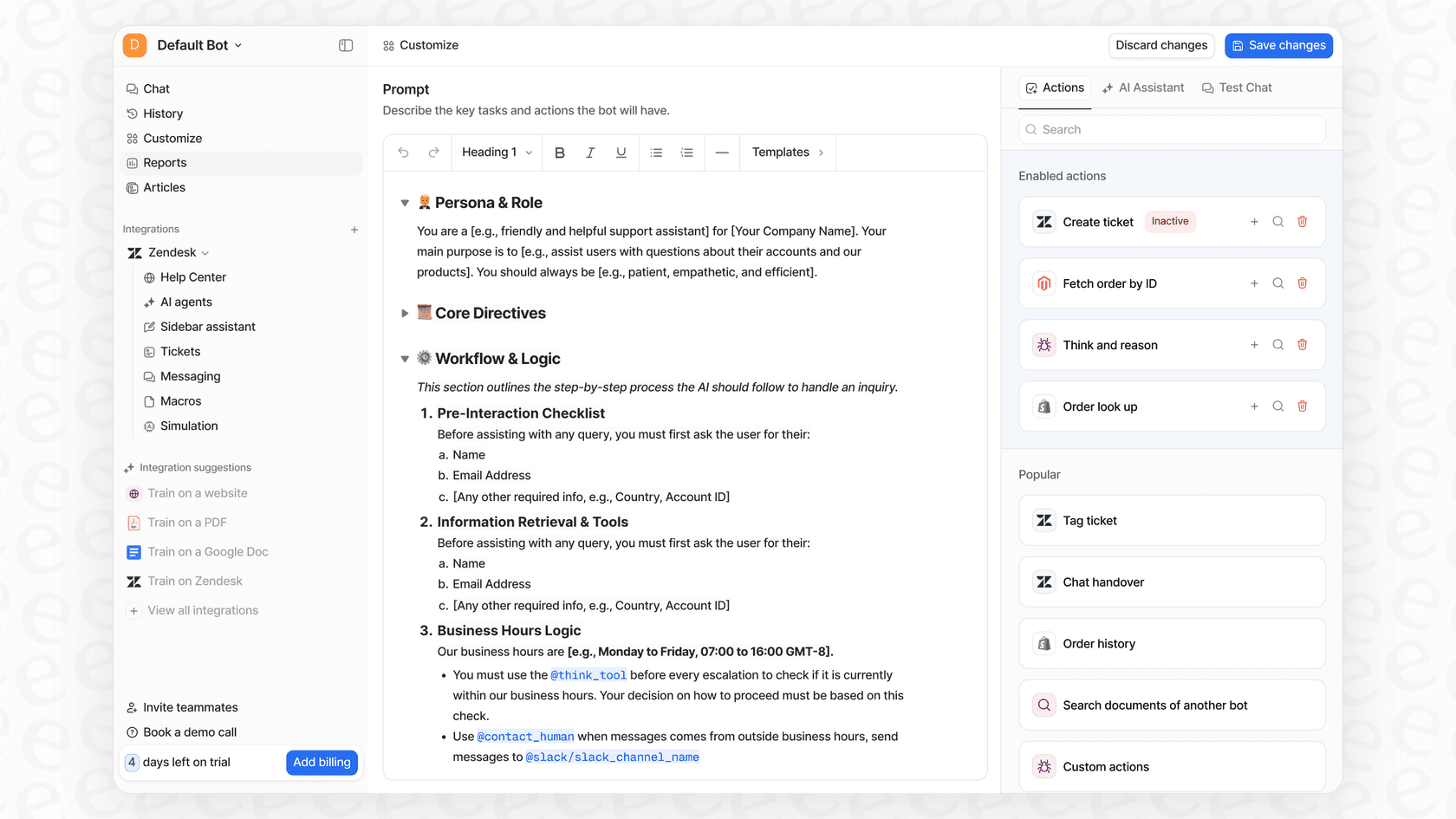
Complete control: Steer clear of "black box" AI where you have no idea what it's doing. You need fine-grained control over what gets automated and what doesn't. Look for a customizable workflow engine, like the one in eesel AI, that lets you decide exactly which support tickets the AI should handle and what it's allowed to do.
-
Deep integration: The best AI learns from your specific company data. A solid platform should train on your past support tickets, internal documents, and help center articles to give answers that are actually on-brand and relevant to your customers.
-
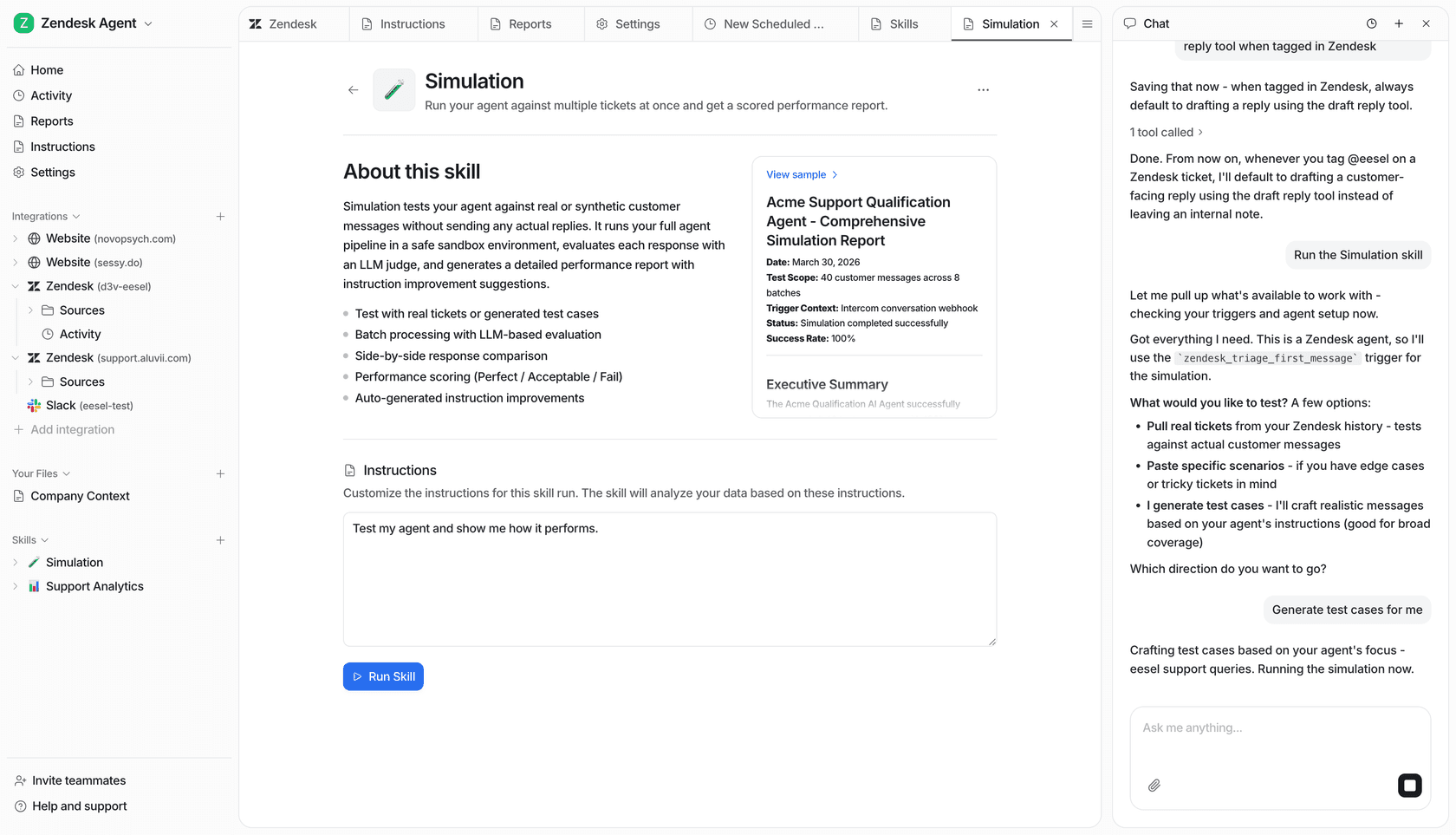
A confident rollout: You should never have to launch an AI and just hope for the best. A powerful simulation mode is a must-have. With eesel AI, you can test your setup on thousands of your past tickets to see exactly how it will perform and what your automation rate will be before it ever talks to a single customer.
Inflection AI: From cautionary tale to strategic lesson
Inflection AI's journey is a fascinating chapter in the ongoing story of artificial intelligence. It kicked off with incredible talent, a mountain of cash, and a huge dream, but it ultimately proved just how hard it is for anyone to compete with Big Tech at the foundational level.
But this isn't just a cautionary tale; it's a strategic one. The future of AI for your business isn't about trying to build the next ChatGPT. It’s about intelligently applying the power of these models to improve the tools and workflows you already use every day.
Instead of trying to build an AI powerhouse from scratch, start by applying AI where it can make the biggest difference. See how a tool like eesel AI can help automate your frontline support and bring all your internal knowledge together in minutes.
Frequently asked questions

Share this article

Article by
Kenneth Pangan
Writer and marketer for over ten years, Kenneth Pangan splits his time between history, politics, and art with plenty of interruptions from his dogs demanding attention.