|
VOOZH | about |
|
VOOZH | about |
| 👁 Altavista Babel Fish - Translate this page |
||||||||
|
| 👁 DK Wool DK Wool - Great for beginners |
Half the fun of hand-held looms is choosing material for weaving. Most of the looms have about 4 to 8 pins per inch and will accommodate threads that range from lace weight to chunky weight. It’s worthwhile to have a collection of looms with different pin spacing in order to take advantage of many thicknesses of yarn. As with floor looms, spinning wheels, sewing machines, knitting machines and golf clubs—no one piece of equipment does it all!
Looking at the outrageously creative designs of the 1930’s, when hand-held looms were in their heyday, I can’t imagine what those designers would have done with the smorgasbord of yarns we have to choose from now. Maybe their designs were innovative precisely because the yarn choices WERE limited. A lesson I take from that is to use rather plain yarn for a complex design and save the fancy stuff for something simple.
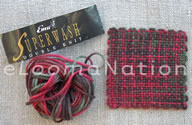
The easiest yarn to begin with is DK (double knitting) weight wool, either plied or single ply. Until you learn how to tension, choose a yarn with a little bit of elasticity, not one that is very stretchy and not one that has no stretch at all (like linen, chenille, and some cottons).
| 👁 Texture 2 |
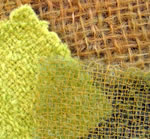
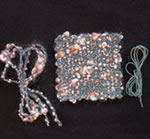
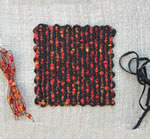
Highly textured yarns—mohair, mohair loop, angora, wool boucle, thick and thin wools, and chenille are all fair game for weaving in medium to fine weights on the 4” and 2” looms, and bulky weights for the 5” loom. |
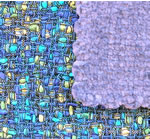
Dragging yarn through the needle-woven layer can be damaging to a fragile yarn or destroy the look of one that has long or bumpy elements. Don’t give up! Use the fragile yarn for the first two or three wrapped layers. Needle in the final layer with a smooth, finer yarn that either matches or contrasts. The textured yarn will have the needle passing under and over it, but it’s never being dragged through the warp. With some textured yarns, you may never see the plain element that made it all possible!
| 👁 Texture 2 |
👁 Texture B |
👁 Texture B |
If you can bend it, you can weave with it.
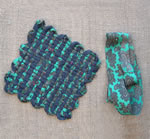
| Rag weaving is easiest on the 5” Weave-It Rug Loom, but with certain techniques, you can use thin rags on the smaller ones. Try wrapping the first two layers with rag and then work the last two layers with thread. You have to play around with the rag material, thickness and pattern until you hit on a workable combination. Silk ties? Tee shirt yarn? I’ve used both. | 👁 Texture 2 Recycled silk ties |
👁 Texture B Tee Shirt Yarn |
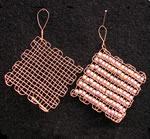
| 👁 Wire 26 Gauge Copper Wire - with 6/0 "E" beads |
Weave with wire! It’s a challenge that gets easier with practice. |
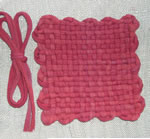
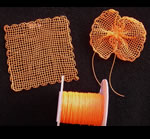
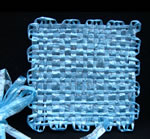
Plastic tubing is possible. A trick to needling in the last layer is to dust all of the plastic with cornstarch. (Rinse it afterward.) The material seen here is called “Jelly Cord”. It comes in colors and is sold on spools at http://www.texturatrading.com/index.html. (A great source for “techno” yarns and threads.) |
👁 Jelly Cord |
| 👁 Target Gift Cord |
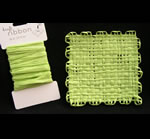
Paper cord, raffia cord and hemp twine can be woven. You never know where you’ll find stuff to weave—army surplus, hardware store, bookstore, thrift store, garage sale, eBay—you name it. | 👁 Texture B |
Things on my list to try: strips of fur, grapevines, leather, poppana, licorice, colored elastic thread, aquarium tubing, and more!