











The Complete Guide to Optimizing Datadog Costs
Datadog is widely recognized as one of the leading application monitoring tools available. It offers seamless scalability, user-friendly features, and invaluable insights for DevOps, security, and product teams. However, effectively monitoring, attributing, and reducing Datadog costs can be complex. This poses a challenge because Datadog spending often constitutes a significant portion of your overall cloud bill, and even Datadog's internal cost management tool fails to break down these costs.
For a detailed explanation of Datadog pricing, visit our blog post: Datadog Pricing Explained.
Related Content:
- Read our guide to FinOps Tools
Understanding Datadog Cost Optimization
In today's technology-driven landscape, businesses rely on robust application monitoring and infrastructure management tools like Datadog to gain critical insights into their systems. However, as the usage of Datadog increases, so does the need for effective cost-optimization strategies. Datadog cost optimization refers to the process of managing and optimizing the expenses associated with using the Datadog platform.
While Datadog provides valuable visibility and monitoring capabilities, it's important to ensure that the costs incurred align with your budgetary requirements. Without proper optimization, the costs of utilizing Datadog can accumulate and impact your overall cloud spending. By implementing cost optimization techniques, businesses can effectively manage their Datadog expenses, eliminate wasteful spending, and ensure optimal resource allocation.
In this comprehensive guide, we will explore practical cost optimization tips to help you cut your Datadog spending without compromising performance.
Effective Strategies for Cost Optimization
- Reduce Unused Tags:
Datadog charges for metrics that are not created through its integrations. Adding unbounded tags or IDs can result in a surge of custom metrics, leading to unexpected costs. Although identifying the specific tag causing the issue may be challenging, removing unused tags can significantly reduce your expenses. - Uninstall the Datadog Agent:
Evaluate the log volume generated by the Datadog agent. A considerable portion of your monthly bill may be attributed to Datadog tracking its own performance. Disabling the Datadog agent at the ingestion level can yield substantial savings across your infrastructure. - Disable Log Management:
Sometimes, logging is unintentionally enabled for applications or services, resulting in unnecessary costs. Datadog charges based on ingested or scanned GBs and log events. While log management is disabled by default, it is essential to verify whether it has been accidentally or intentionally enabled. - Enable Spike Alerts:
Datadog costs can escalate unexpectedly, often when instances experience issues causing error logs and increased logging. Setting up spike alerts to notify you when a service exceeds predefined thresholds can help you proactively manage and control costs. - Collaborate with Your Sales Representative: If you have a designated sales representative from Datadog, consider discussing cost management strategies with them to reduce your monthly spending. They are often receptive to exploring competitive solutions and would prefer to retain you as a satisfied customer. Your sales rep can review your account for anomalies and suggest configuration changes based on your unique use case.
Furthermore, for those who are new to Datadog, the platform offers a valuable opportunity to request a free trial. This enables users to thoroughly evaluate the tool's capabilities and assess its suitability for their specific monitoring requirements before making any financial commitments or long-term agreements. By taking advantage of the free trial, you can mitigate risk and ensure that Datadog aligns with your monitoring needs before investing your resources. - Utilize a Cloud Cost Management Tool: Understanding the factors driving your costs is crucial to effectively reduce them. Deploying a comprehensive cloud cost management tool like Finout provides detailed insights into your Datadog costs, including APM, infrastructure, logs, and more. Finout integrates seamlessly with Datadog, offering a breakdown of your cloud costs directly within the Datadog interface. Additionally, it provides unique features like cost per customer, empowering you in negotiations, prioritization, and decision-making.
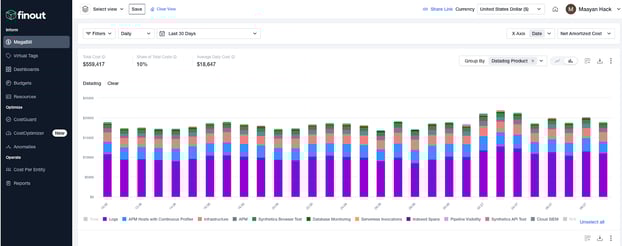
Figure: Datadog spending in Finout
Final Thoughts
Datadog is an exceptional application monitoring tool, but comprehending the associated costs can be challenging. We highly recommend implementing the above practices to reduce your spending while maintaining optimal performance. By leveraging cost optimization techniques, utilizing cloud cost management tools, and collaborating with your sales representative, you can gain control over your Datadog expenses and maximize the value derived from this powerful tool.
Remember, optimizing costs is an ongoing process. Regularly reassess and refine your strategies to ensure continued efficiency. With the right approach and the support of tools like Finout, you can achieve substantial savings, effectively manage and reduce your Datadog costs, and optimize your bottom line.
Related Datadog content:
- Guide to Datadog Logs Pricing
- Guide to Datadog Custom Metrics Pricing
- Guide to Datadog Pricing Calculator
cloud & AI spend
FAQs

Stay ahead of FinOps trends
Get our monthly product newsletter delivered straight to your inbox.
.svg)

Related articles
One platform.
Every team. Complete control.
Built for the complexity, speed, and ownership demands of modern cloud and AI environments