|
VOOZH | about |
|
VOOZH | about |
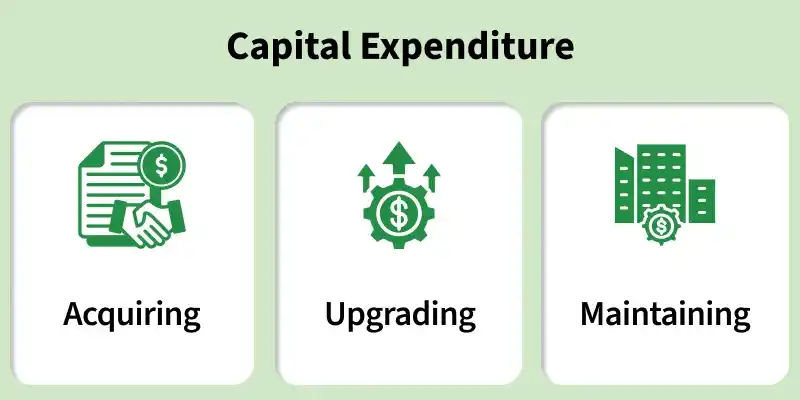
Capital Expenditure is the amount spent on purchasing fixed assets or raising the value of fixed assets. An example of capital expenditure is the money spent on acquiring land, buildings, machinery, furniture, etc.
Examples of Capital Expenditure are as follows:
Capital Expenditure is added to the cost of fixed assets; i.e., it is debited to the relevant Fixed Asset Account. It is shown in the Balance Sheet.
Illustration:
Determine which of the following is a Capital Expenditure:
1. Custom Duty paid on import of equipment.
2. ₹20,000 paid for electricity bill.
3. ₹1,00,000 spent on repainting the office building.
4. Second-hand machine was purchased for ₹50,000 and ₹3,000 was spent on its installation.
5. Cost of air-conditioning of the Manager's office.
Solution:
1. Custom duty paid on the import of equipment is a Capital Expenditure because the expenditure is incurred to acquire a new asset. It will be shown on the debit side of the Trading Account.
2. ₹20,000 paid for the electricity bill is not a Capital Expenditure because it is a part operating expense.
3. ₹1,00,000 spent on repainting the office building is not a Capital Expenditure because the fixed assets of the company have not increased by this expenditure.
4. The total expenditure ₹53,000 is a Capital Expenditure because it has resulted in an increase in fixed assets. Installation charges will also be considered as Capital Expenditure as this amount was spent to make the machine ready for use. It will be shown on the debit side of the Trading Account.
5. Cost of air-conditioning of the Manager's office is a Capital Expenditure because the benefit of this will be available to the company for more than one year. It will be shown on the debit side of the Trading Account.