|
VOOZH | about |
|
VOOZH | about |
Active transport is a cellular process that uses energy mainly in the form of ATP, to move molecules or ions against their concentration gradients. It includes primary active transport, which directly uses energy for transport, and secondary active transport, which utilizes an electrochemical gradient to move other substances. It is essential for many physiological processes, including nutrient absorption in the digestive system, the transmission of nerve impulses, and the regulation of ion concentrations in cells.
Table of Content
Active transport is a cellular process that uses energy to move molecules or ions from a region of lower concentration to a region of higher concentration against their concentration gradients across the cell membrane.
Active transport is a biological process that transport molecules or ions from regions of lower concentration to regions of higher concentration across the cell membrane. Active transport requires cellular energy, usually in the form of adenosine triphosphate (ATP), to move molecules against the concentration gradient. In passive transport, molecules move with their concentration gradient.
Active transport is highly regulated and selective, with different transporters specific to different molecules or ions. This regulation occurs through various mechanisms like the number of transport proteins on the cell membrane, feedback mechanisms, and the availability of energy sources like ATP. Active transport is important for various physiological processes, such as hormone secretion, nutrient uptake, and nerve impulse transmission. Problem in active transport can lead to various disorders, including diabetes, cystic fibrosis, etc.
Also Read:
👁 Na K pumpThere are two main types of active transport:
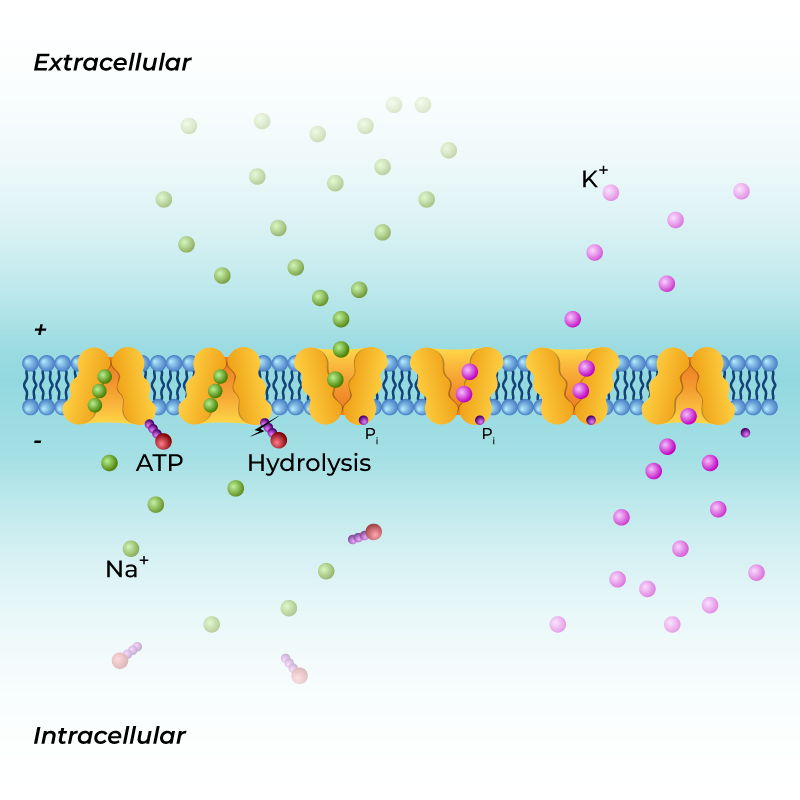
Primary active transport, also called direct active transport, directly uses metabolic energy to move molecules across a membrane against their gradient. The most common example of this is the sodium-potassium pump (Na+/K+ pump), present in the cell membrane of most animal cells. The pump actively transports potassium ions into the cell and sodium ions out of the cell against their respective concentration gradients. This pump is crucial for maintaining the resting membrane potential and regulating the volume of individual cells. Different types of active transport are as follows:
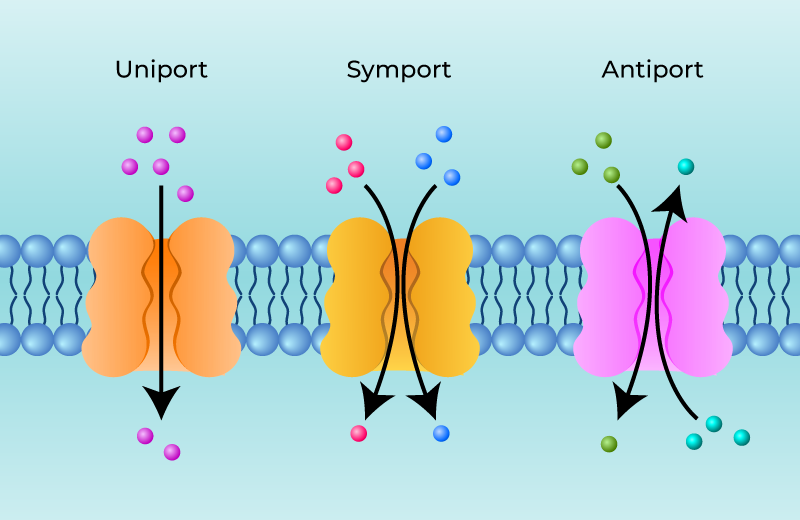
Secondary active transport, also known as cotransport, uses the energy created by primary active transport to transport other molecules against their concentration gradients. There are two subtypes of secondary active transport:
👁 Types of Active TransportActive transport in plants help in the transport of materials, such as water, minerals, and necessary nutrients to all parts of the plant for its growth and development. Plant roots uses specialized proteins called carrier proteins, like the proton pump (H+-ATPase). It actively transports protons out of root cells,that creates an electrochemical gradient. It help in the uptake of minerals like calcium, potassium, and magnesium. It results in the accumulation of ions towards one side of the membrane and transports the substance from the lower concentration to higher concentration.
The process contributes to the plant's ability to adapt to various environmental conditions through efficient nutrient absorption and internal distribution. Plant adaptations, such as root hairs and mycorrhizal associations, increases the efficiency of active transport. It enables the plants to thrive in a range of ecosystems.
Some examples of active transport processes are as follows:
Features | Active Transport | Passive Transport |
|---|---|---|
Energy Requirement | Requires energy to move molecules against their concentration gradient. | Does not require energy; molecules move with their concentration gradient. |
Movement of Molecules | Moves molecules from areas of lower concentration to areas of higher concentration. | Moves molecules from areas of higher concentration to areas of lower concentration. |
Transport Proteins | Involves specific transport proteins, such as pumps and carriers, to facilitate movement. | May involve transport proteins, like channels and carriers, but can also occur directly through the lipid bilayer. |
Saturation | Exhibits saturation kinetics, where the rate of transport may reach a maximum when transport proteins are fully occupied. | Follows linear kinetics, as transport is limited by the availability of transport proteins and the concentration gradient. |
Direction of Movement | Can move molecules against their natural diffusion direction. | Moves molecules in the direction of their concentration gradient. |
Role in the Cell | Essential for maintaining ion gradients, nutrient uptake, and various cellular processes. | Facilitates the passive movement of molecules like gases, water, and small polar compounds. |
Also Read: Transport System in Plants Class 11 Biology