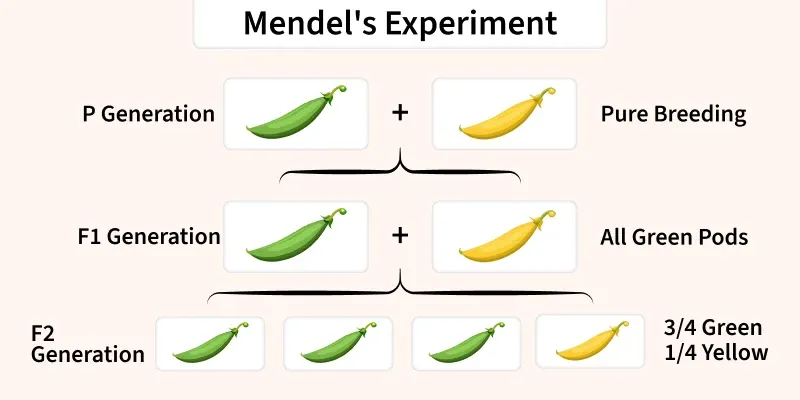
Mendel's law of inheritance states that offspring inherit from their parents that resulting in similar characteristics of parents and offspring. This law of inheritance depends upon three other laws, including the law of dominance, the law of segregation, law of independent assortment. Gregor Mendel was an Austrian monk who conducted groundbreaking experiments on pea plants in the mid-1800s. Mendel's experiments focused on the inheritance of certain traits, such as seed colour, pod shape, and flower colour.
A gene that expresses itself in the presence of its contrasting gene in a hybrid is termed a dominant gene. A recessive gene is one whose expression is suppressed in the presence of a dominant gene, e.g. in a hybrid (Tt) tall plant, the t gene for dwarfness is recessive, and the T gene for tallness is dominant, and T is dominant over t.
Why was Pea Plant Selected for Mendel’s Experiments?
Mendel selected the pea plant (Pisum sativum) for the following reasons:
Many varieties were available with observable alternative forms for a trait or characteristics.
Peas are normally self-pollinated, as their corolla completely encloses the reproductive organs until pollination is completed. But cross-pollination can also be done.
Peas are easily available.
Peas have contrasting characters that are seed colour, pod colour, pod shape, flower shape, the position of the flower, seed shape, and plant height.
Its life cycle was short and produced a large number of offspring.
The plant is an easily grown annual plant and does not require care except at the time of pollination.
Mendel explains the concept of dominant and recessive alleles. The following table shows each of the traits and which traits are dominant and which are recessive.
Mendel's experiments focused on the inheritance of certain traits, such as seed colour, pod shape, and flower colour, and he discovered that these traits are passed down predictably.
Monohybrid Cross
Mendel crosses two homozygous traits and forms a heterozygous trait, which is known as a monohybrid cross or the inheritance of a single gene. It is a single cross between two organisms of a species that is made to study the inheritance of single pairs of genes or factors. A monohybrid cross helps to study the principle of dominance given by Mendel, are shown below:
It is a cross in which only one character is considered at a time, e.g. in a cross between a tall and a dwarf plant, the size of the stem is considered.
Mendel made a cross between a pure tall (TT) and a pure dwarf (tt) pea plant.
He obtained all the tall (hybrid) plants in the F1 generation.
On self, these plants produced tall and dwarf in the ratio 3:1. The genotypic ratio of 1:2:1 and the phenotypic ratio of 3:1 is termed the monohybrid ratio.
Dihybrid Cross
The cross between pea plants having yellow wrinkled seeds with those having green round seeds is a dihybrid cross that is shown below:
Mendel had given three laws of inheritance after observing his experiments. These are:
Law of Dominance
Law of Independent Assortment
Law of Segregation
1. Law of Dominance
The law of dominance states that the expression of only one of the forms of the parental trait occurs in the F1 hybrid. In a heterozygous condition, i.e. different alleles, the dominant allele gets expressed. Only one is dominant and will be expressed when two different alleles are present. F1 generation expresses dominant alleles. The suppressed allele is known as the recessive allele or trait.
TT × tt (parents) ------> Tt; F1 generation
2. Law of Independent Assortment
The law of independent assortment is also the second law of Mendel's. It states that completely different pairs of alleles are passed on to the offspring independently of each other, that is, during gamete formation, two genes segregate independently of each other as well as of the other trait. The inheritance of one gene does not affect the inheritance of any other gene.
3. Law of Segregation
The law of segregation is the third law of Mendel. The law of segregation states that for any trait, each pair of alleles of a gene segregates, and one gene passes from each parent to an offspring. Two alleles do not mix when they come together in a hybrid pair and are independent of each other.
Mendel proposed the three laws of inheritance after conducting observations from its different crosses on the Pea Plant.
Mendel's third law, i.e., the Law of Segregation, states that at the time of gametogenesis, both copies of gametes segregate so that the offspring get one copy of each gene from both parents.
Mendel's Law of Independent Assortment states that at the time of gamete segregation, gametes segregate independently.
Modern Applications of Mendel's Laws of Inheritance
Below are the modern applications and examples of Mendel's Laws of Inheritance: Farmers and breeders use Mendelian principles to selectively breed plants and animals with desired traits. This has led to the development of crops with improved yield, resistance to diseases, and other desirable characteristics.
Medical genetics: It helps in predicting the likelihood of genetic disorders and diseases in individuals based on their family history. Genetic counselling often involves explaining Mendelian patterns to individuals or families at risk.
Genetic engineering: Mendel's laws guide the understanding of how genes segregate and assort, providing a basis for the design of genetically modified organisms (GMOs).
Pharmacogenetics: researchers study how genetic variations influence an individual's response to drugs. This information is used to tailor drug treatments based on a person's genetic makeup.
Mendelian genetics: explores how gene frequencies change over time in populations. This has applications in evolutionary biology and understanding the genetic diversity within species.
Forensic genetics: DNA analysis is used to identify individuals based on their genetic profiles. Understanding inheritance patterns is essential for interpreting genetic data in forensic investigations.
Cancer genetics: Mendelian principles are used to understand the inheritance of genetic mutations that may predispose individuals to certain types of cancer. This knowledge informs cancer risk assessments and preventive measures.