|
VOOZH | about |
|
VOOZH | about |
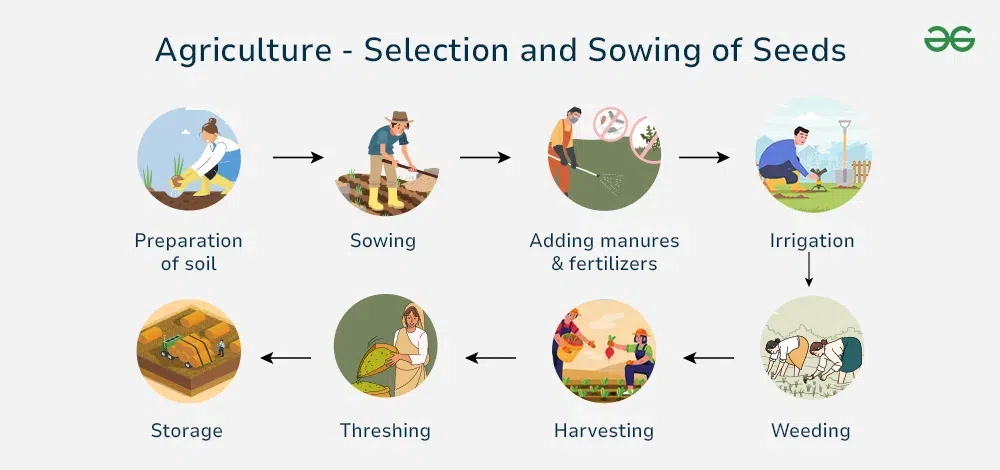
Selection and sowing of seeds are important steps in growing crops. Agriculture is cultivating crops to produce food in large amounts to feed the population. Agriculture involves various activities such as soil preparation, seed selection, sowing of seeds, protection of crops, irrigation, harvesting and storage of harvests. In this article, we will cover the steps of selection and sowing of seeds in detail.
Table of Content
Selecting the right seed is the first and most important step in agriculture. The seed's quality determines the success of the crop, as it must withstand various challenges to yield a high output. There are various methods for seed selection which are selected on different bases such as selection of disease resistance, yield potential, germination rate, drought resistance, pest resistance etc. All seed traits are determined by the genes which keep on transferring from one generation to the next generation of the crop.
Seed selection is crucial for crop performance and sustainability in agriculture. To understand in detail let us look at the importance of seed selection:
Crop performance involves overall productivity of crops. The choice of seed directly impacts the resilience to crop yield, pest, disease and environmental condition. Selecting high quality seed like pest resistance and adaptability of seed to a local condition can enhance the crop performance. Moreover, the genetic capability of a plant to produce biomass or harvestable products play a very important role in crop performance.
Choosing seeds for crops that have high market demand and price can enhance profitability. Also, selecting seed with high yield capacity can lead to higher output per unit of land hence can increase the overall revenue generated by the farmer.
Sustainability in seed selection involves choosing seeds that maintain ecosystem, biodiversity, and resilience to climate change. While seed selection, prioritize the selection of genetically diverse seeds to preserve various genetic traits within crop species.
There are various method of seed selection, some of the common methods involved are:
Also Read: Ethical Issues Related to Genetically Modified Organisms
Sowing of seed is another important step in agriculture. The process involves planting seeds in well-tilled soil, which can be done either manually,(conventional method) or with a machine (modern method). Seeds must be sown during their specific seasons, as not all times or seasons are suitable for successful germination and growth. On the basis of season, seeds are classified into three types:
The different methods of sowing of seeds are:
This method is also called broadcasting. Here, seeds are scattered and sown by hands. Farmers dig the soil and place the seeds inside by their hands or by some handheld tools. It is an economical method.
In modern methods, specialized equipment like seed drills or mechanical planters are used to place the seeds at precise depths. These equipments also help in spacing the soil which optimizes growth conditions. This method ensures uniformity and efficiency, saving time and labor compared to traditional hand planting. Modern seed sowing also allows use of advanced technologies such as GPS guidance systems, which enhance accuracy and reduce environmental impact.
The steps involved in sowing seed are:
In conclusion, seed selection is important to maintain the quality of crop success and crop yield. Various methods help in selecting seeds with desired traits like disease resistance and yield potential. The significance of seed selection lies in its impact on crop performance, profitability, and sustainability. Furthermore, the sowing of seeds, whether through traditional or modern methods, marks a crucial step in the agricultural process. It ensures proper soil preparation, seed selection, and watering for optimal growth.
Also Read: