|
VOOZH | about |
|
VOOZH | about |
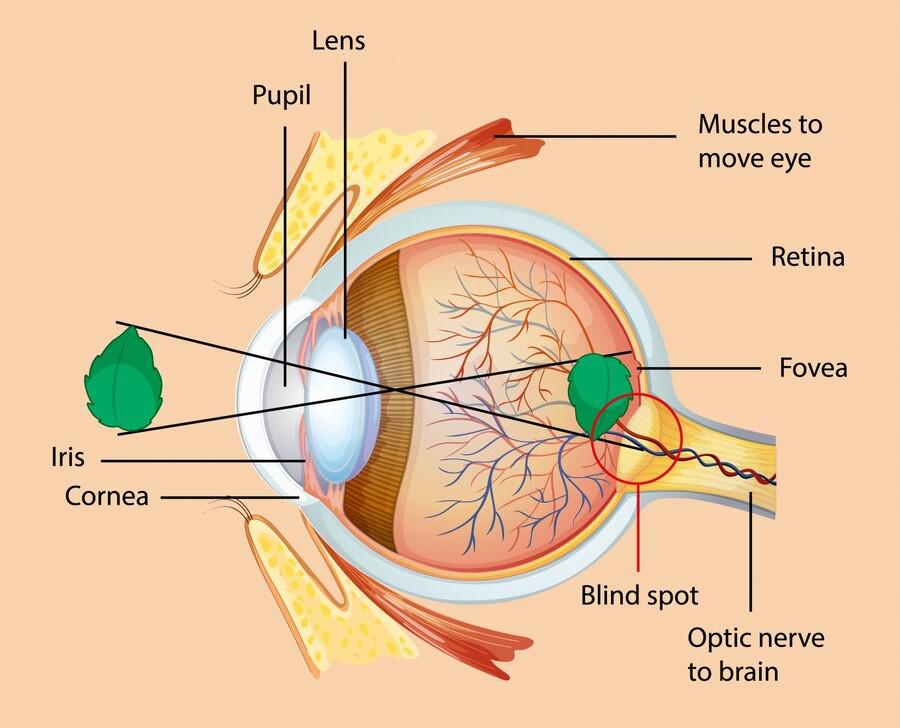
The eye is a highly specialised sensory organ responsible for vision. It allows us to detect light, perceive images, and interpret the surrounding environment. The study of the eye involves both its structure (anatomy) and its function (physiology), which work together to produce the sense of sight. The human eye is nearly spherical in shape and is located within the bony socket called the orbit. It is protected by eyelids, eyelashes, and tear glands.
👁 Human EyeThe wall of the eye consists of three main layers:
This layer provides protection and shape to the eye.
This layer is rich in blood vessels and supplies nutrients.
The retina is the innermost layer responsible for vision. Contains light-sensitive cells called photoreceptors:
The physiology of the eye explains how vision occurs.
Step 1: Entry of Light
Light rays enter the eye through the cornea and pass through the aqueous humour, pupil, and lens.
Step 2: Refraction and Focusing
The cornea and lens bend (refract) the light rays. The lens adjusts its shape (accommodation) to focus light onto the retina.
Step 3: Image Formation
A real, inverted image is formed on the retina.
Step 4: Conversion into Nerve Signals
Photoreceptors (rods and cones) convert light into electrical signals.
Step 5: Transmission to the Brain
These signals are transmitted through the optic nerve to the brain.
Step 6: Interpretation of Vision
The brain interprets the signals, allowing us to perceive a clear and upright image.