|
VOOZH | about |
|
VOOZH | about |
Antibody proteins are Y-shaped proteins that recognise and neutralise pathogens in the immune system. Antibodies play an important role in immune defence. Antibody structure consists of four polypeptide chains—two heavy and two light—and they form a distinctive structure with variable and constant regions. There are five main types of antibodies: IgM, IgG, IgA, IgD, and IgE, each having a specific role in the immune responses. Antibody functions include recognising and binding to specific antigens, marking them for destruction or neutralisation by the immune system.
The antigen, or distinctive molecule of the infection, is recognised by the antibody. These two structures can bind together precisely because each Y-shaped tip of an antibody has a paratope (like a lock) that is specific for one particular epitope (like a key) on an antigen.
Antibodies, also known as immunoglobulins (Ig), have a Y-shaped structure.
In detail, the antibody molecule structure is described below:
An antibody (Ab) is a large, Y-shaped protein that the immune system utilises to recognise and destroy foreign substances, including harmful bacteria and viruses. They are spread throughout the body and have several functions.
There are 5 types of antibodies based on antibody structure and function that are given below:
IgG is a Y-shaped molecule with two antigen-binding sites.
IgM is pentameric structure with ten antigen-binding sites
IgA has a monomeric form in blood and a dimeric form with two Y-shaped molecules linked by a J chain in mucosal secretions.
IgD is a monomeric molecule similar to IgG.
IgE shows a monomeric structure.
B lymphocytes, often known as B cells, are specialised white blood cells that produce antibodies. A clone is a collection of identical cells that are created when a B cell divides and matures in response to an antigen binding to the B cell surface. Millions of antibodies are secreted into the lymphatic and circulation by mature B cells, also known as plasma cells.
The immune system can identify foreign substances when they enter the body because the antigen's surface molecules are different from those found in the body. The immune system uses a number of methods, including one of the most crucial ones, antibody production, to get rid of the pathogen.
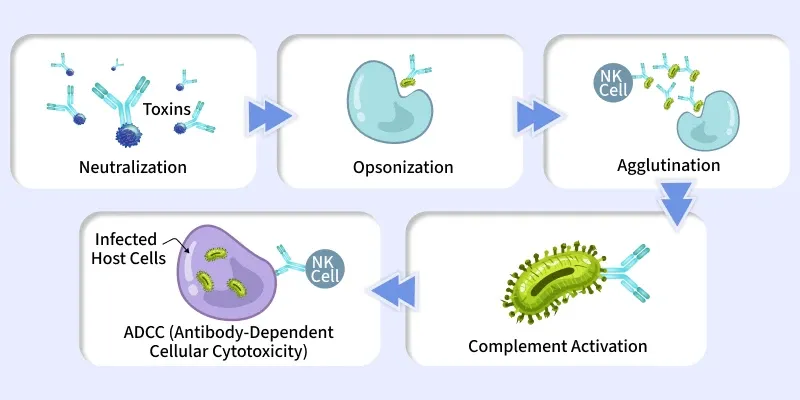
The mechanism of action of the antibodies is as follows:
The following are some of the functions of antibodies:
In medicine, scientists have found many ways to use these antibodies to help people stay healthy:
1. Treating Diseases: Antibodies can be used as medicines to target and destroy specific harmful substances in the body, such as cancer cells or disease-causing bacteria.
2. Vaccines: Vaccines contain weakened or harmless versions of viruses or bacteria, which help our bodies produce antibodies to fight off those germs. This helps us build immunity against diseases like measles or the flu.
3. Diagnostic Tests: Antibodies can also be used in tests to detect if someone has a particular disease. For example, in COVID-19 tests, antibodies help identify if a person has been infected with the virus in the past.
4. Targeted Therapy: Some medicines use antibodies to specifically target certain cells in the body, like cancer cells, while leaving healthy cells unharmed. This helps reduce side effects and make treatments more effective.
The following points highlight the differences between antigens and antibodies:
| Feature | Antigen | Antibody |
|---|---|---|
| Definition | A substance that triggers an immune response and can stimulate the production of antibodies. | Proteins produced by the immune system in response to the presence of an antigen. |
| Origin | Can be derived from pathogens (bacteria, viruses), foreign substances, or even self-substances in certain autoimmune conditions. | Produced by B cells (a type of white blood cell) in response to the presence of antigens. |
| Nature | Antigens can be proteins, carbohydrates, lipids, or nucleic acids. | Antibodies are proteins (immunoglobulins) with specific structures that recognise and bind to antigens. |
| Function | Initiates and elicits an immune response. | Acts against antigens by binding to them and neutralising or marking them for destruction by other immune cells. |
| Recognition | Recognised by the immune system as foreign or non-self. | Specifically binds to the complementary antigen that triggered its production. |
| Diversity | Diverse; various antigens can elicit an immune response. | Highly diverse; numerous types of antibodies, each specific to a particular antigen. |
| Specificity | Generally not highly specific, the immune system can recognise a broad range of antigens. | Highly specific; each antibody is designed to recognise and bind to a specific antigen. |
| Production | Produced by the body or introduced through vaccination. | Produced by B cells through a complex process called somatic recombination. |
| Role in Immunity | Initiates the immune response by triggering the production of antibodies. | Essential for the immune system's ability to recognise, neutralise, and eliminate pathogens or foreign substances. |
| Examples | Pathogen proteins, toxins, allergens. | IgG, IgM, IgA, IgD, IgE (classes of antibodies). |
| Size and Structure | Variable depending on the type of antigen. | Y-shaped structure; composed of two heavy chains and two light chains. |
| Half-life in Blood | Antigens may persist for a shorter duration. | Antibodies can circulate in the bloodstream for an extended period |