|
VOOZH | about |
|
VOOZH | about |
Autophagy comes from Greek words "auto" (self) and "phagy" (eating), which means cells eating themselves. Autophagy is a process where cells get rid of damaged parts to stay healthy. The various types of autophagy include macroautophagy, microautophagy, and chaperone-mediated autophagy. In this article, we will cover in-depth about autophagy types, examples, and more.
Table of Content
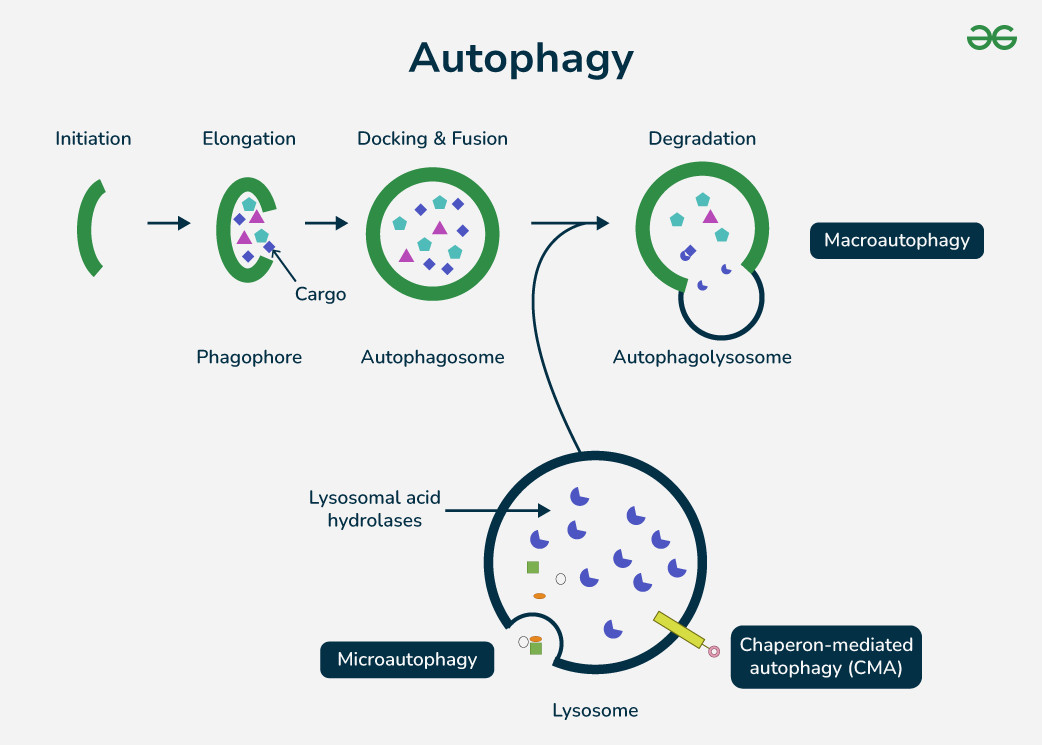
Autophagy is a cellular process in which cells degrade and recycle their own components. When cells undergo autophagy, they break down and remove damaged or unnecessary components. This process keeps cells healthy and functioning properly. Autophagy helps cells get rid of waste and old parts, making space for new ones. Without autophagy, cells would accumulate junk, leading to problems like aging and disease.
Autophagy acts like a recycling system, breaking down and removing dysfunctional parts to make way for new ones. The mechanism it follows is given below:
The many reasons and causes due to which autophagy occurs are given below:
Autophagy serves functions which are essential for maintaining cell health and overall well-being. Here are some of its key roles:
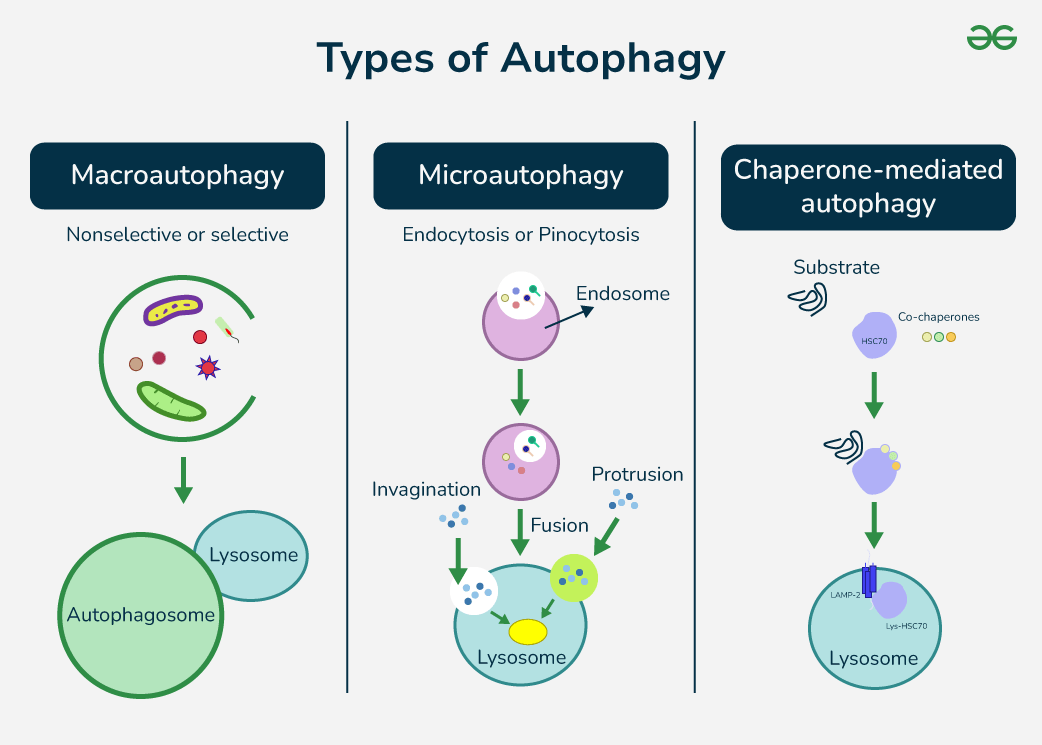
Here are some different types of autophagy:
Macroautophagy involves the formation of double-membraned structures called autophagosomes, which engulf cellular components targeted for degradation. These autophagosomes then fuse with lysosomes, where their contents are broken down by lysosomal enzymes.
Microautophagy directly involves the engulfment of cytoplasmic material by lysosomes through invagination or protrusion of the lysosomal membrane. This process allows for the selective degradation of small portions of cytoplasm and organelles.
Chaperone-mediated autophagy is a selective process in which specific proteins are recognized by chaperone proteins and targeted for degradation by lysosomal receptors. The targeted proteins are translocated across the lysosomal membrane one at a time and degraded by lysosomal enzymes.
Selective autophagy involves the specific targeting and degradation of particular cellular components, such as damaged organelles or aggregated proteins. This process relies on autophagy receptors that recognize cargo destined for degradation and facilitate its engulfment by autophagosomes.
Mitophagy is a type of selective autophagy that specifically targets and removes damaged or dysfunctional mitochondria. This process helps maintain mitochondrial quality control and prevents the accumulation of defective mitochondria, which can lead to cellular dysfunction and disease.
Pexophagy is the selective degradation of peroxisomes, cellular organelles involved in various metabolic processes, including fatty acid oxidation and reactive oxygen species metabolism. Pexophagy helps regulate peroxisome abundance and function, ensuring cellular homeostasis.
Lipophagy is the selective degradation of lipid droplets, which store excess lipids in cells. This process plays a crucial role in lipid metabolism and energy homeostasis, allowing cells to utilize stored lipids for energy production during times of nutrient scarcity.
Cytophagy involves the selective degradation of portions of the cytoplasm. It is also known as cytoplasmic autophagy. This process contributes to cellular remodeling and turnover, helping maintain cellular integrity and function.
Autolysis is the self-digestion of cells through the release of enzymes that break down cellular structures. This often occur during programmed cell death (apoptosis) or in response to injury or infection. The major difference between autophagy and autolysis is given below:
Aspect | Autophagy | Autolysis |
Definition | Cellular process of self-degradation and recycling of unnecessary or dysfunctional cellular components | Process of self-digestion or breakdown of cells by their own enzymes |
Purpose | Maintains cellular homeostasis, removes damaged organelles, and recycles cellular components for energy and building blocks | Occurs after cell death and leads to the breakdown of cellular structures |
Initiation | Initiated by cellular stress, nutrient deprivation, or signals from the cell signaling pathways | Typically occurs after cell death due to factors such as injury, disease, or aging |
Regulation | Regulated by autophagy-related genes (Atg) and cellular signaling pathways such as mTOR and AMPK | Not actively regulated, as it occurs as a consequence of cell death |
Process | Involves the formation of autophagosomes, which engulf damaged organelles and cytoplasmic material, followed by fusion with lysosomes for degradation | Involves the release of enzymes from lysosomes into the cytoplasm, leading to the breakdown of cellular structures |
Cellular State | Occurs in living cells and is a dynamic process that helps maintain cellular health and adapt to stress | Occurs in dead or dying cells and is a passive process that leads to cellular disintegration |
Biological Role | Essential for cellular health, longevity, and adaptation to stress conditions | Part of the process of tissue remodeling, clearance of dead cells, and resolution of inflammation |
The difference between autophagy and phagocytosis are given below:
Feature | Autophagy | Phagocytosis |
Definition | Cellular process of self-degradation | Cellular process of engulfing particles |
Purpose | Degrades and recycles cellular components | Engulfs and digests extracellular material |
Type of Material | Self-derived, intracellular components | External, extracellular particles |
Mechanism | Involves formation of autophagosomes | Formation of pseudopods for engulfment |
Selectivity | Can be selective or non-selective. | Can be selective or non-selective |
Organelle Involvement | Lysosomes and autophagosomes | Phagosomes and lysosomes |
Cellular Response | Response to stress, starvation, and aging | Response to infection and foreign bodies |
Role in Health | Maintains cellular homeostasis and health | Part of immune response and defense |
Autophagy plays a key role in maintaining cellular health and overall well-being. It is important because of the following reasons:
In conclusion, autophagy is a cellular process essential for maintaining health. Its role in cellular cleanup, energy production, and immune defense highlights its importance in sustaining optimal function. Autophagy promotes longevity, supports tissue regeneration, and regulates metabolism. It also contributes to neuronal health and aids in stress adaptation, enhancing cellular resilience.
Also Read: