|
VOOZH | about |
|
VOOZH | about |
CBSE class 10 previous year question papers helps you to understand the level of questions asked in the previous exams, along with the changes in pattern. Practicing the biology class 10 previous year question papers enhances time-management skills while appearing in the board examination. It makes you understand the importance of different topics that have been asked previously.
CBSE Class 10 pyq Biology will boost your confidence level to appear in the examination with proper knowledge of different topics that are going to be asked. It enhances the understanding of the topic and acts as a checkpoint to see the level of preparation that you have done. CBSE biology previous year question paper 2020 is available here.
Two common signs of sexual maturation in boys and girls are:
- Thick hair growth in armpits, genital area/thinner hair on arms, legs, face.
- More active oil secretion from glands on skin/Occurrence of pimples.
Reckless female foeticide causes imbalance in male – female ratio/ decline in child sex ratio.
Oral pills change the hormonal balance of the body.
Two factors which determine the size of population are:
- Birth rate
- Death rate
Human beings are at the top level in any food chain. That’s why maximum concentration of pesticides found in human beings.
Washing of vegetables, fruits, grains thoroughly is one method which could be applied to reduce our intake of pesticides through food to some extent.
The various steps which are represented in the food chain are known as trophic level. Hence the correct option is (b).
According to food chains, a man is a consumer which does not produce anything of its own. Hence the correct option is (a).
The immediate changes that take place in its body so that the squirrel is able to either fight or run are:
- The adrenaline hormone is secreted into the blood.
- The heart beats faster resulting in supply of more oxygen to the muscles.
- Blood is diverted to skeletal muscles.
- The breathing rate increases.
- The blood supply to digestive systems and skin is reduced.
OR
Chemical communication better than electrical impulses as a means of communication between cells in a multi-cellular organism because:
- Electrical impulses have limited access to only those cells that are connected by nervous tissue/ neurons, whereas chemical signals can reach each and every cell of the body.
- Cells need time to reset in order to create repeated/ new electrical impulses whereas no such time is required for chemical communication.
Definition: Pollination can be defined as the act of transferring of pollen grains from the anther of male flower to stigma of female flower.
Difference between self-pollination and cross-pollination:
Self-pollination | Cross-pollination |
|---|---|
Transfer of pollen in the same flower. | Transfer of pollen from one flower to another. |
Pollinating agents are not required. | Pollinating agents are required for transfer of pollens. |
Significance of pollination: Pollination leads to fertilization resulting in the formation of zygote.
Homologous structures are those that share a basic structure but carry out different roles or functions. Therefore, homologous structures are similar to one another while having been altered to serve different purposes.
For example, although the anatomy of the forelimbs of reptiles, amphibians, and mammals is the same, their functions vary. Human arms, avian wings, and horse front legs are examples of homologous structures.
Yes, homologous structures share common ancestors, but they have undergone modifications to perform different roles. Although the fundamental structure of a bird's wings and a human arm are identical, each species' wings have various functions due to modification. Human arms are not designed for flight, but those of birds are. Therefore, even if they serve diverse purposes, we can claim that they have common ancestors.
One full breath consists of a single inhale and exhalation of air. The number of times a full breath is taken in a minute is hence the measure of breathing rate. The rate at which aquatic and terrestrial organisms breathe varies. This is because dissolved water, which is found in the gills of aquatic species like fish, provides them with oxygen. And we know that there is less dissolved oxygen in water than there is in air when it comes to oxygen in its undissolved state.
To fulfill their respiratory needs, they consequently breathe quickly. To keep up with the body's need for oxygen, they breathe more quickly than humans do. Swimming over a river causes swimmers to breathe more quickly, as can be observed. Consequently, the rates at which aquatic and terrestrial creatures breathe vary.
The human respiratory system can be shown as:
OR
Human excretory system consists of following organs:
1. Two kidneys: One on each side of the spine, near the liver. The kidneys are a vital organ found in pairs in the human body. The kidney aids in blood cleansing.
2. The urinary bladder: This structure resembles a sac and holds urine until it is out. Urine is sent to it through ureters that are attached to each kidney independently.
3. Urethra: This structure, which resembles a tube, emerges from the bladder. In males, it is longer, whereas in females, it is shorter. It is a typical route for both urine and sperm in males.
Chemical waste products produced by our bodies include uric acid and urea. The kidneys remove these waste products from the circulation. Thus, the kidney functions only as a blood filter. It has nephrons, which are the basic kidney structures that aid in the filtering of blood.
The renal tubule and Bowman's capsule make up its two components. The cup-shaped Bowman's capsule contains the Glomerulus, a coiled blood capillary tube that aids in blood filtration. The renal tubule receives the filtrate.
However, as the first filtrate travels through the renal tubule, some of the substances such as glucose, amino acids, and salts are more frequently absorbed together with an immense quantity of water in the capillaries surrounding the tubule. The remaining liquid travels to the bladder through the collecting duct to be stored. Urine travels down the urethra and exits the body when the bladder is full.
Also Read: Urine Formation
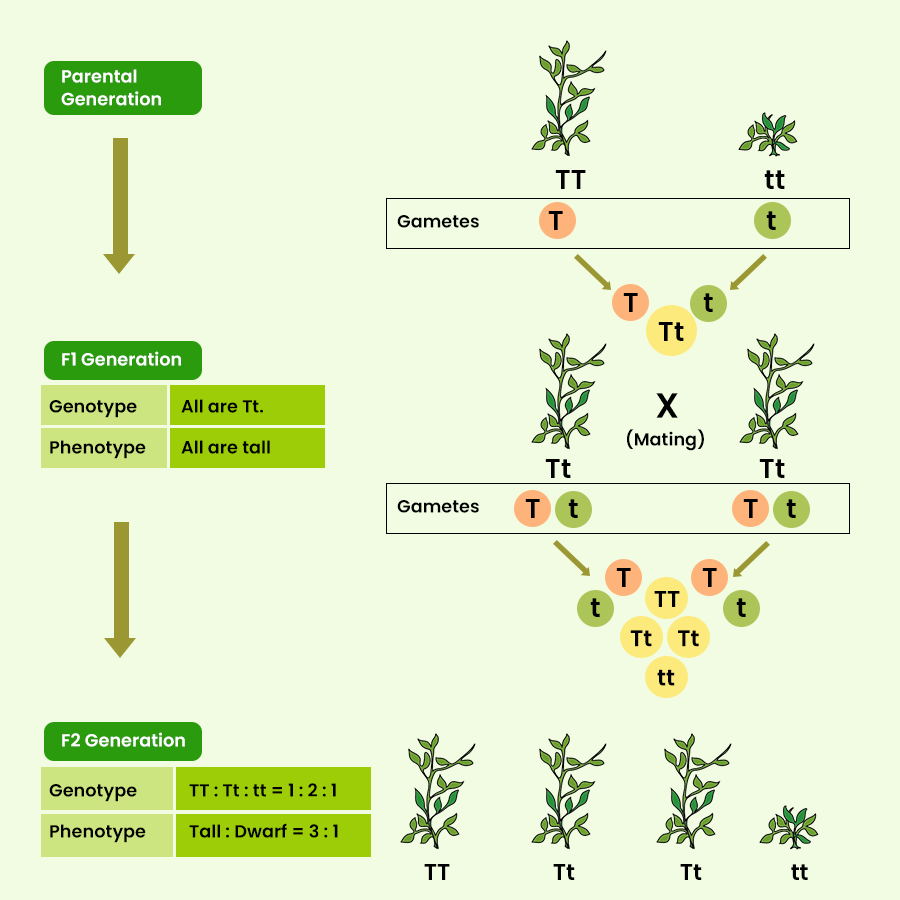
Gregor Mendel, who discovered the fundamental principles of heredity, established the Law of Dominance. According to this, "only one form of trait appears in the next generation when parents with pure, contrasting traits are crossed together." An organism's appearance of a trait is typically caused by two alleles, of which the dominant allele manifests its effects more strongly than the recessive one. In other words, in heterozygous individuals, the dominant allele suppresses the recessive allele.
Consider the plant's height; 'T' indicates tallness, whereas 't' indicates dwarfism.
In the pea plant, the allele "T" is dominant over the allele "t."
Consider a plant that has genotype Tt crossed with Tt and exhibits "tall" phenotypic traits.
Below is a diagram of a Punnett square representation of the cross.
👁 Monohybrid-CrossIn the above cross, the genotypic ratio is 1:2:1, meaning that one plant appears tall due to two dominant alleles, two plants have one dominant and one recessive allele, and one plant appears dwarf due to two recessive alleles. With a 3:1 phenotypic ratio, three plants appear to be tall and one is dwarfed.
The characteristics that an individual acquires throughout their lifetime are known as acquired traits. Changes in lifestyle, injuries, loss of blood components, and food intake are the causes of acquired attributes. In contrast, hereditary traits are those that are determined by genetics. These are traits, like eye color or bone structure, that parents pass on to their children. However, every mutation—a change in the gene sequence—is also transmitted to the DNA sequence, which is the source of heredity. However, because these modifications occur in somatic cells, which are non-reproductive tissues, they cannot be passed on to the following generation, making acquired features not inherited. Therefore, characteristics that a person acquires over their lifetime are not inherited.
The CBSE Class 10 previous year question papers for biology exams is an important tool for preparing for CBSE Class 10 Board Examinations. Students who practice many CBSE Class 10 pyq can learn useful tips that will assist them in scoring good marks in CBSE Class 10 Biology exam. The main purpose of providing the previous year question papers is to give an idea about exam pattern and the types of questions asked in exam. Questions are often repeated in exams as well. Hence, solving class 10 previous year question paper for biology is important while studying.