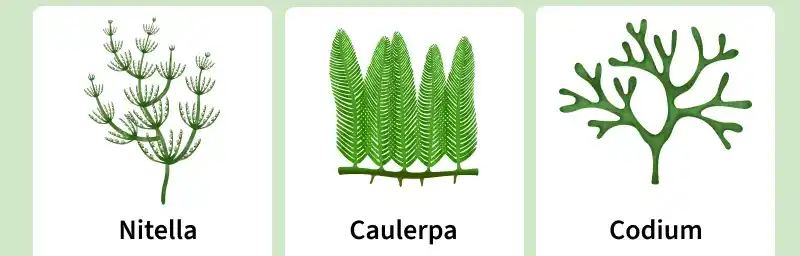
Chlorophyceae is a large and important class of green algae commonly found in freshwater habitats, though some members occur in marine and terrestrial environments. They are called green algae because of the presence of chlorophyll pigments that give them a bright green colour. Chlorophyceae play a vital role in aquatic ecosystems as primary producers.
The chloroplast might be discoid, plate-like, reticulate, cup-moulded, winding, or lace formed in various species. The greater part of the individuals have at least one storage body called pyrenoids situated in the chloroplast. Pyrenoids contain proteins other than starch. Some green growth might store food as oil drops. They generally have a cell wall comprised of an inward layer of cellulose and an external layer of pectin.
Characteristics of Chlorophyceae
The Chlorophyceae are one of the classes of green growth, recognised primarily based on ultrastructural morphology. They are typically green because of the strength of the colours chlorophyll a and chlorophyll b. More characteristics are given below:
The majority of Chlorophyceae species are aquatic, though a small number also grow on land and in brackish and saline water.
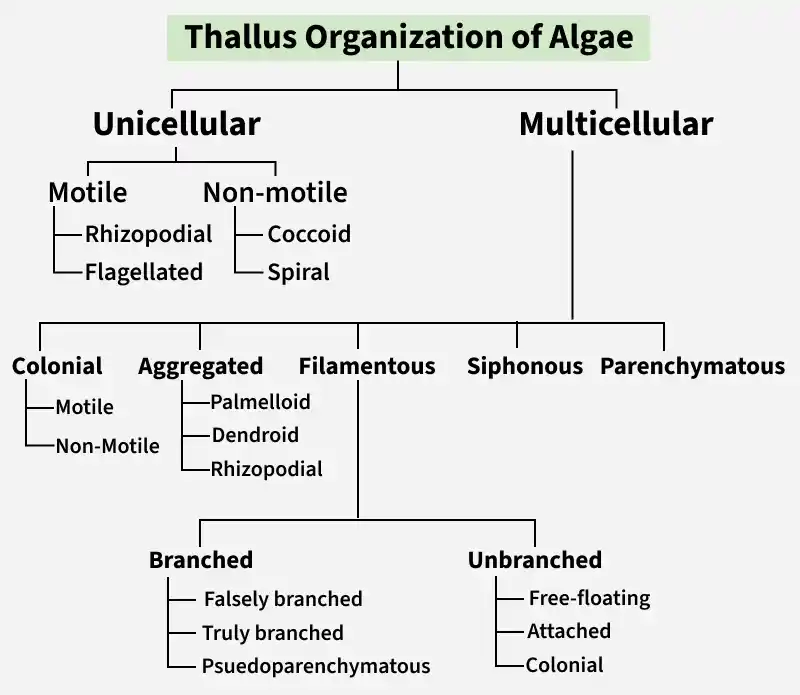
They exhibit a wide range of variations in their thallus structures, including heterotrichous (Coleochaete), siphonaceous (Vaucheria), palmelloid (Tetraspora), dendroid (Ecballocystis), unbranched (Spirogyra), unicellular motile (Chlamydomonas), and unicellular non-motile (Chlorella) (Ulva).
Flagella are inserted either apically or subapically, are one in number, and are of equal size. Viewed under E.M., the flagella have a typical 9+2 configuration.
Eukaryotic cells make up the organism. In most cells, there is only one nucleus, but the coenocytic bodies of Siphonales and Cladophorales have many nuclei. In contrast to the normal rule of one nucleolus per nucleus, Conjugales members have several nucleoli.
Cellulose, which is primarily composed of xylans and mannans and hydroxyproline glycosides, makes up the majority of the cell wall. In Chara, calcium and magnesium carbonate are embedded in the cell wall.
The protoplast is surrounded by a semipermeable cell membrane that is found inside the cell wall. Numerous tiny vacuoles in the cytoplasm push the nucleus and surrounding cytoplasm outward and are known as primordial utricles.
The anterior portion of the flagellate cells has an eye spot or stigma that is still inserted on one side of the chloroplast.
The chloroplast is where the pigments are found. A pyrenoid is typically present in chloroplasts.
Thallus Organisation of Chlorophyceae
The structure of plants in the Chlorophyceae class exhibits a wide variety of variations (thallus). It includes both single- and multicellular structures, such as Chlamydomonas, Chlorella, Sphaerella, etc. Different types of multicellular formations could exist.