|
VOOZH | about |
|
VOOZH | about |
Mammalia is a class of the Kingdom Animalia. The organisms belonging to the class Mammalia are called mammals. The mammals have unique characteristics, such as mammary glands for milk, warm-blooded, and different types of teeth. The body parts of all mammals are similar, including the limbs, digestive systems, lungs for breathing, circulatory systems with a heart, kidney excretions, and taste organs. About 6000 different species of mammals can be found in deserts, seas, polar regions, rivers, and rainforests.
Class Mammalia represents the most evolved group of vertebrates, exhibiting high intelligence, complex behaviour, and advanced physiological systems. Their adaptability and diversity make them an essential part of the natural ecosystem.
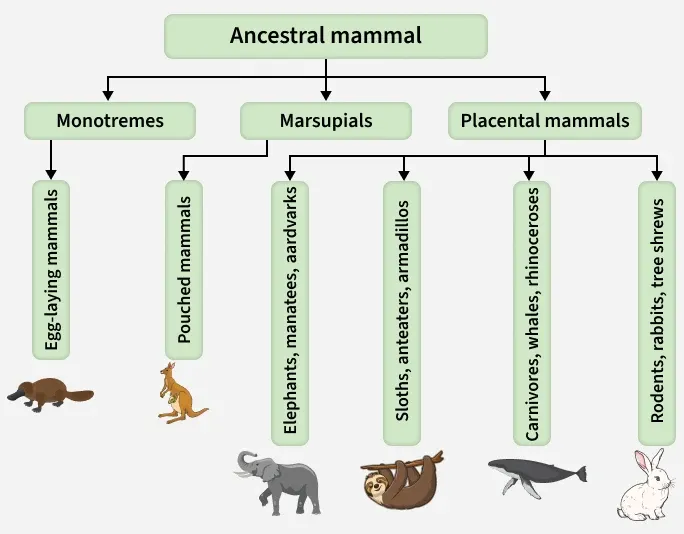
Mammals are broadly classified into three categories:
The distinguishable characteristics make mammals different from other animals. The characteristics of mammals are as follows:
The Mammalia is the largest class in the Animalia Kingdom. There are several types of mammals, such as small, large, and marine mammals etc.
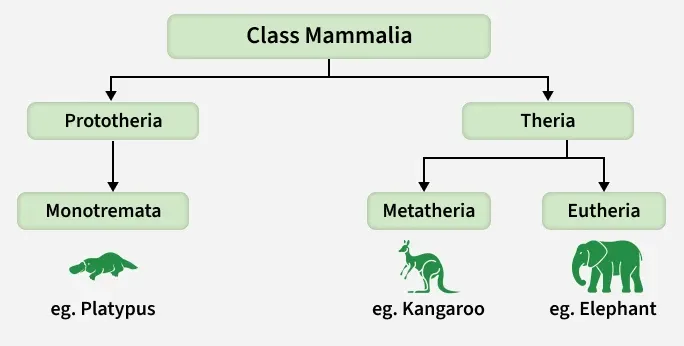
Based on reproduction, mammals are grouped into two subclasses:
The most primitive type of mammal is Prototheria, also known as Monotremata. These are restricted to Australia and nearby places such as Tasmania and New Guinea. Prototheria are unique due to their egg-laying nature. Monotremata is an order under subclass Protheria that consists of six species.
Example: Ornithorhynchus (Duck-Billed Platypus) and Tachyglossus (Echidna)
It includes animals that give birth to their children. Two infraclasses of this subclass are Metatheria and Eutheria:
Metatheria
Animals belonging to Metatheria are called marsupium marsupials or pouched mammals. The female animals belonging to this infraclass have pouches. The offspring of these mammals are immature and live in their mother's pouch until adulthood. The infraclass Metathesis is divided into 7 orders as follows:
Metatheria has more than 250 species found in Australia, Papua New Guinea, and some parts of the United States. E.g.: Kangaroos, koalas, etc
Mammals that give birth to the child directly belong to the infraclass Eutheria. An embryo formed inside the mother's stomach develops into an offspring. These offspring get their nutrition inside the mother's womb through the placenta. This infraclass is divided into 19 orders.
The following table lists the orders of Eutheria:
Order | Example |
|---|---|
Insectivora | Sorex (Shrew) |
Chiroptera | Pteropus (flying fox) |
Edentata | Dasypus (Armadillo) |
Pholidata | Manis (Pangolin/scaly anteater) |
Tubulidentata | Orycteropus (Aardvark/cape anteater) |
Rodentia | Rattus (Rat) |
Lagomorpha | Oryctolagus (Rabbit) |
Cetacea | Delphinus (Dolphin) and Balaenoptera (Blue whale) |
Sirenia | Halicore (Dugong) |
Carnivora | Panthera tigris (Tiger) |
Hyracoidea | Hyrax (Procavia) |
Artiodactyla | Bubalus (Water buffalo) |
Perissodactyla | Equus (Horse) |
Proboscidea | Elephas maximus (Indian elephant) |
Primates | Homo sapiens (Human) |
Dermoptera | Cynocephalus (flying squirrel) |
A group of vertebrate animals are known as mammals. A few examples are: