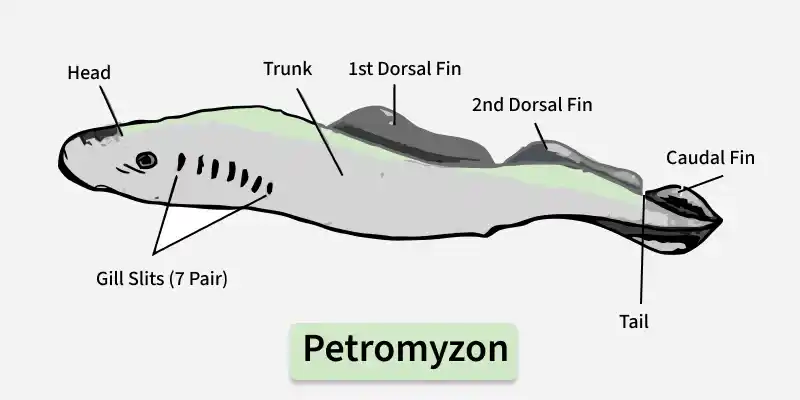
Cyclostomata are unique jawless fishes belonging to the class Agnatha. Cyclostomata include lampreys and hagfishes and have a soft body. They get their name because of their round mouth. Cyclostomata are found in different aquatic environments. They are also known as jawless fish due to rudimentary jaw development.
Cyclostomata have 6-14 pairs of gills and a cartilaginous skeleton. They can be found in both marine and freshwater and thus they are adaptable to many conditions. Cyclostomata are different from fish in many ways, such as they do not have paired fins or true jaws.
Characteristics of Class Cyclostomata
The following points describe the characteristics of Cyclostomata:
Cyclostomata are the only vertebrates without true jaws. The body is round and elongated like an eel.
Some species of hagfish are believed to be hermaphrodites.
The spleen is not present.
Exoskeletons do not exist. The cartilaginous endoskeleton does not include any bones.
The notochord is present throughout their lives.
The nostril is single and median.
Five to sixteen pairs of gills are present.
The heart has two chambers. The brain is visible. The lateral line is a sensory organ.
Cranial nerves are found in around eleven pairs.
The two mesonephric kidneys are part of the excretory system.
The digestive system does not have a stomach.
Examples: Maxine and Petromyzon
Classification of Class Cyclostomata
The following outlines the classification of Class Cyclostomata:
Kingdom
Animalia
Phylum
Chordata
Group
Craniata/Euchordata
Sub-Phylum
Vertebrata
Division
Agnatha
Class
Cyclostomata
Sub-Divisions of Class Cyclostomata
Cyclostomata is a primitive class of jawless vertebrates under the phylum Chordata. Members of this class are eel-like, scaleless, and have a circular, suctorial mouth without jaws.