|
VOOZH | about |
|
VOOZH | about |
The structure of a chloroplast is highly organised and specialised for carrying out photosynthesis efficiently. A chloroplast consists of a double membrane system enclosing a fluid-filled matrix called the stroma. Within the stroma is a complex system of interconnected membranous sacs known as thylakoids, which are arranged in stacks called grana. The chloroplast also contains photosynthetic pigments, enzymes, ribosomes, and its own DNA, enabling it to perform several functions independently.
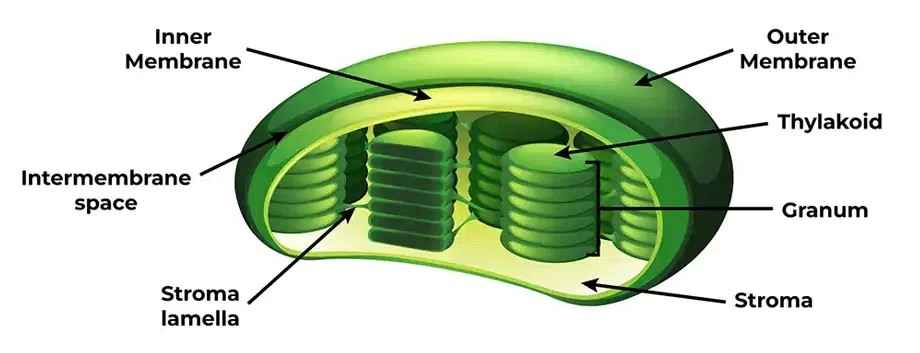
👁 Diagram-of-chloroplast1The chloroplast has a highly complex internal organisation specialised for photosynthesis. The major structural components of chloroplasts are as follows:
The chloroplast is surrounded by a double membrane envelope consisting of:
Inside the chloroplast is a complex system of flattened, disc-shaped membranous sacs called thylakoids. These thylakoid membranes contain photosynthetic pigments and proteins required for the light-dependent reactions of photosynthesis. The thylakoid membrane is highly specialised and contains:
The space enclosed within each thylakoid sac is known as the thylakoid lumen. During the light reactions, protons (H⁺ ions) accumulate within the thylakoid lumen, creating a proton gradient across the thylakoid membrane. This gradient drives ATP synthesis through chemiosmosis. Thus, the thylakoid lumen plays a major role in energy production during photosynthesis.
Thylakoid membranes are arranged in stacks known as grana (singular: granum). Each granum consists of several stacked thylakoids placed one above another like coins. Grana increase the surface area available for light absorption and therefore enhance the efficiency of photosynthesis. The number of grana varies depending on the photosynthetic activity of the plant cell.
The grana are interconnected by membrane extensions known as stroma lamellae or intergranal lamellae. These structures connect different grana and maintain communication between them. Stroma lamellae also contain photosynthetic components necessary for electron transport.
The stroma is the colourless, fluid-filled matrix surrounding the thylakoid membranes inside the chloroplast. The light-independent reactions of photosynthesis, also known as the Calvin cycle, occur within the stroma. During these reactions, carbon dioxide is converted into glucose using ATP and NADPH produced during the light reactions. The stroma contains:
Chloroplasts contain several photosynthetic pigments responsible for capturing light energy. These pigments together broaden the range of light absorption and increase photosynthetic efficiency.
Photosystems are specialised protein-pigment complexes embedded within the thylakoid membranes. These photosystems contain chlorophyll molecules and accessory pigments that capture light energy and transfer it to reaction centres. The absorbed energy excites electrons, initiating electron transport and ATP formation during photosynthesis. There are two major photosystems:
One unique feature of chloroplasts is that they contain their own DNA and ribosomes.
Chloroplasts perform several important functions essential for plant growth and survival.