|
VOOZH | about |
|
VOOZH | about |
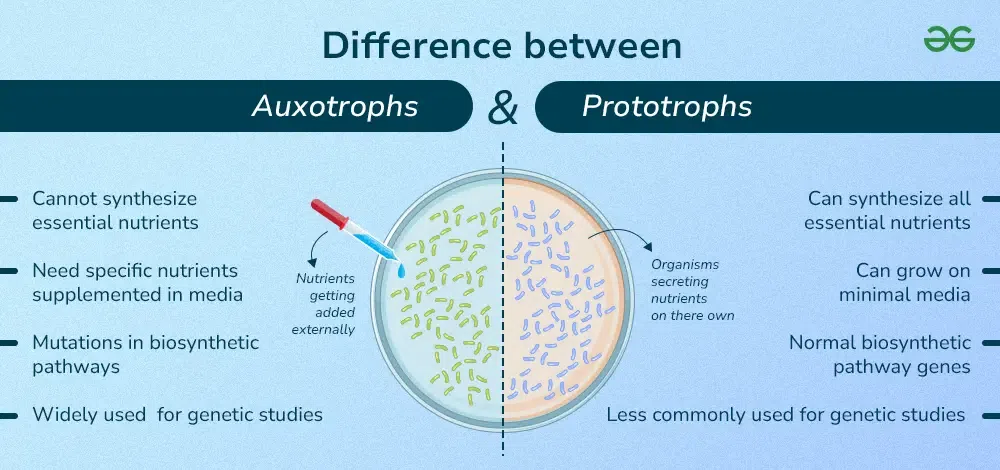
The difference between auxotrophs and prototrophs lies in their ability to synthesize essential nutrients. Auxotrophs are unable to produce certain vital compounds on their own, whereas prototrophs can synthesize all necessary nutrients independently. Auxotrophs and prototrophs are terms used in microbiology to describe the nutritional requirements of microorganisms. In this article, we will read about the difference between auxotrophs and prototrophs and their similarities in detail.
Table of Content
The auxotrophs are microbes that have lost the ability to synthesize one or more essential nutrients due to mutations or genetic alterations. As a result, auxotrophs require supplementation with the specific nutrients or growth factors that they cannot produce independently. For example, an auxotrophic strain lacking the ability to synthesize the amino acid leucine will require leucine supplementation for the growth on the minimal media.
The prototrophs are microbes capable of synthesizing all essential nutrients required for their growth and survival. They possess functional biosynthetic pathways for the synthesizing amino acids, nucleotides, vitamins and other essential metabolites. As a result prototrophs can grow on the minimal media containing only inorganic salts a carbon source and water. These microbes are often used as the standard reference in the genetic studies and laboratory experiments.
The differences between Auxotrophs and prototrophs are:
Characteristics | Auxotrophs | Prototrophs |
|---|---|---|
Nutritional Dependency | Required specific nutrients for growth | Can synthesize all essential nutrients internally |
Growth on Minimal Media | Require supplemented media for growth | Can grow on minimal media without supplementation |
Genetic Mutation | Mutation in biosynthetic pathway genes | Normal alleles of the biosynthetic pathway genes |
Laboratory Use | The widely used for the genetic studies and mutant isolation | The less commonly used in genetic studies |
Nutrient requirements | Require specific nutrients to grow | Do not require specific nutrients |
Examples | Mutant strains and genetic knockouts | Wild type strains and standard species |
Some of the similarities between Auxotrophs and Prototrophs are:
In summary, the difference between the auxotrophs and prototrophs lies in their nutritional requirements and genetic characteristics. While prototrophs are self-sufficient in nutrient synthesis auxotrophs depend on external supplementation. Understanding these differences is essential for the various applications ranging from the basic research to the industrial biotechnology and medical microbiology.