|
VOOZH | about |
|
VOOZH | about |
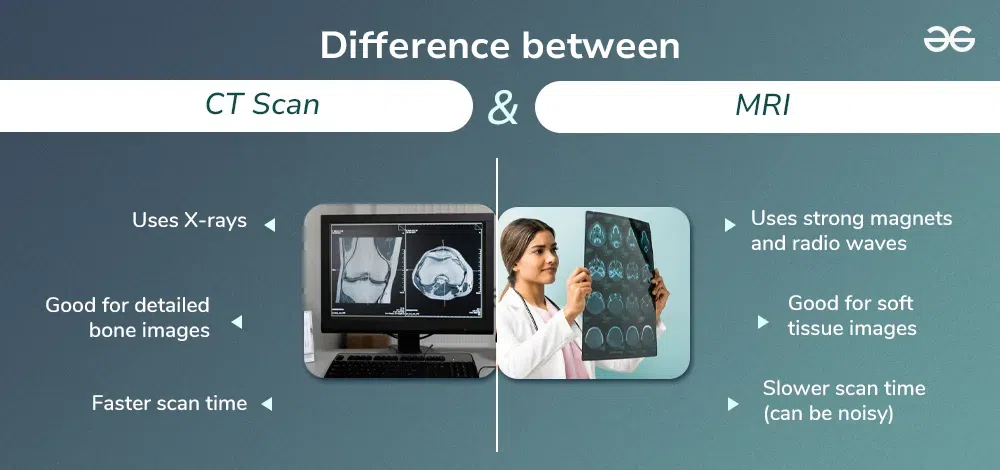
The difference between CT scan and MRI lies in the imaging technique used where CT scans utilize X-rays to produce detailed cross-sectional images, while MRI uses magnetic fields and radio waves to generate detailed images of soft tissues. CT scan and MRI are two imaging technologies used in the medical field. In this article, we will look into the differences between CT scans and MRIs as well as the similarities.
👁 Difference-Between-CT-Scan-and-MRI-
Table of Content
The CT Scan full form is Computerized Tomography Scan. CT Scan is a technology used in the medical field where the images are taken out with the help of X-Rays. The images are taken from all angles and different images are given which include images of bones and body parts. They are very informative and have a lot of detail as compared to MRIs. This can detect problems regarding the joints and body.
Advantages of CT Scan are:
Risks include:
The full form of MRI is Magnetic Resonance Imaging. It is used in the medical field which provides images of the physical body. It is helpful in giving the anatomy of the body in images. It works in radiology, where radio waves are used to make images of the human body. It does not use the X-Ray method and it is useful to diagnose diseases.
Advantages of MRI include the diagnosis of:
Risks of MRI include:
The CT Scan vs MRI is given below:
Aspect | CT Scan | MRI (Magnetic Resonance Imaging) |
|---|---|---|
Abbreviation | CT (Computed Tomography) | MRI (Magnetic Resonance Imaging) |
Imaging Technique | Uses X-rays | Uses strong magnetic fields and radio waves. |
Detailed Structure | Provides detailed images of bones, organs, and soft tissues. | Provides detailed images of soft tissues, organs, and brain structures. |
Radiation Exposure | Involves exposure to ionizing radiation. | Does not involve exposure to ionizing radiation. |
Contrast Agents | Contrast agents (such as iodine-based dyes) can be used | Contrast agents (such as gadolinium-based dyes) can be used |
Image Quality | Good for visualizing bone structures and dense tissues | Excellent for visualizing soft tissues, blood vessels, and organs |
Brain Imaging | Limited in brain imaging due to bone interference | Ideal for brain imaging, providing detailed structural information |
Allergy Risk | Possible allergic reactions to contrast agents | Risk of allergic reactions to contrast agents |
Metallic Implants | Less affected by metallic implants | Affected by metallic implants, which can cause artifacts |
Time for Procedure | Faster scanning time (seconds to minutes) | Longer scanning time (minutes to hours) |
Cost | Generally less expensive | Generally more expensive |
Common Applications | Trauma assessment, bone fractures, lung imaging, abdominal scans | Soft tissue imaging, brain scans, joint analysis, cancer detection |
In conclusion, both CT scans and MRI offer valuable imaging techniques with their own set of advantages and applications. The difference between CT scan and MRI help in understanding which imaging modality is most suitable for different medical conditions. While CT scans excel in visualizing bone structures and are faster and more cost-effective, MRI provides superior imaging of soft tissues and organs without exposing patients to ionizing radiation.
Depending on the clinical scenario, the choice between CT and MRI depends on factors such as the specific area of interest, the need for detailed soft tissue visualization, patient preferences, and any contraindications such as metallic implants.