|
VOOZH | about |
|
VOOZH | about |
Mitosis and meiosis are two fundamental types of cell division that are essential for sustaining life processes. Mitosis results in the formation of two genetically identical daughter cells with the same chromosome number as the parent cell, whereas meiosis produces four genetically distinct haploid cells that are vital for sexual reproduction. Mitosis plays a key role in growth, tissue repair, and asexual reproduction, while meiosis is crucial for the formation of sperm and egg cells, thereby promoting genetic variation in organisms.
Mitosis, cell division, is a type of karyokinesis in which the nucleus divides to form two nuclei having the same number and kind of chromosomes as the parent cell. It is an equational division. The daughter nuclei formed are identical to the parent cell.
The mitosis stages are:
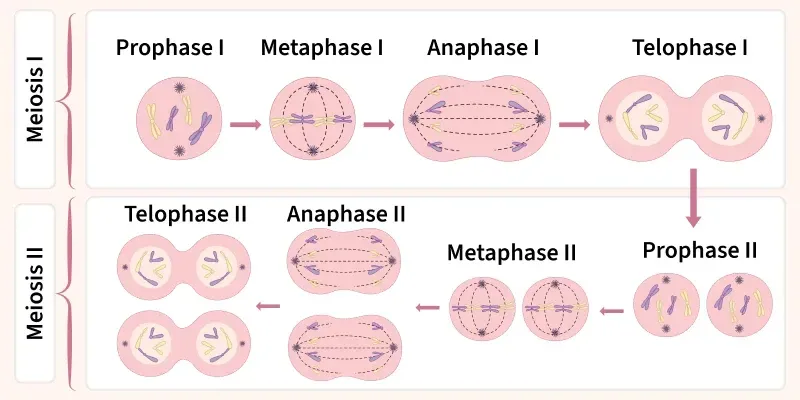
Meiosis is a type of Karyokinesis in which the nucleus divides to form four nuclei having half the number of chromosomes of the parent cell. It is a reductional division.
Between meiosis I and meiosis II, a phase known as 'interkinesis' is present where centrosome replication occurs. Meiosis I involves the pairing of homologous chromosomes, crossing over between them, and their separation, leading to a reduction in chromosome number. Meiosis II is similar to mitosis, where sister chromatids are separated, resulting in the formation of four genetically non-identical haploid cells.
Despite their differences, mitosis and meiosis exhibit some common characteristics, which are as follows.
The difference between mitosis and meiosis is as follows:
| Feature | Mitosis | Meiosis |
|---|---|---|
Discovered By | Walther Flemming | Oscar Hertwig |
| Type of Division | Equational division | Reductional division |
| Number of Nuclei | Two nuclei with the same chromosomes | Four nuclei with half the chromosomes |
| Similarity to Parent | Daughter nuclei are identical | Daughter nuclei are not identical |
| Phases | Prophase, Metaphase, Anaphase, Telophase | Meiosis I and Meiosis II, each with four phases |
| Cell Type | Occurs in both haploid and diploid cells | Occurs in diploid cells only |
| Genetic Variation | Produces genetically identical cells | Produces genetically non-identical cells |
Cytokinesis | Occurs in Telophase | Occurs in Telophase I and in Telophase II |
Mode of Reproduction | Asexual Reproduction | Sexual Reproduction |
| Role | Help in growth and repair | Help in reproduction by maintaining chromosome numbers, promotes variation |