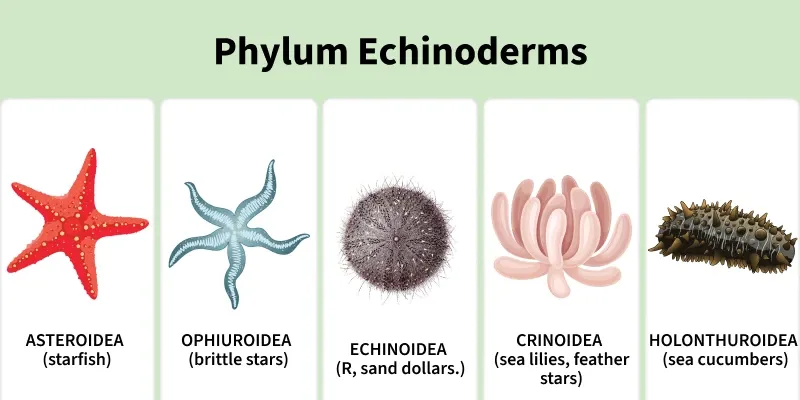
Echinodermata is a phylum of exclusively marine animals known for their spiny skin and unique body organisation. The name Echinodermata is derived from the Greek words echinos (meaning "spiny") and derma (meaning "skin"). These organisms are primarily found on the seafloor and play a crucial role in marine ecosystems. Echinoderm is a phylum of creatures that includes only marine life. There have been no signs that any land or water would be fresh echinoderms up to this point.
Classification of Phylum Echinodermata
The Phylum Echinodermata includes marine animals characterised by radial symmetry, a calcareous endoskeleton, and a unique water vascular system.
The phylum Echinodermata includes the following five classes:
1. Asteroidea
They have five arms and a flattened, star-shaped body.
Their feet are tube-shaped suckers.
Through papillae, they breathe.
Calcareous plates and mobile spines make up the body. Calcareous ossicles help in the protection.
There is a pedicellaria.
Example: Asterias and Zoroaster
2. Ophiuroidea
The body has pentamerous discs and is flat.
There are no suckers on the tube feet.
Through the bursae, they breathe.
The middle disc is separated from the lengthy arms.
Example: Ophiderma and Amphuria
3. Echinoidea
It has a hemispherical shape.
Suckers are present in the tube foot.
There are no arms on the body.
The spines can move, and the organ has a little skeleton.
Aristotle's Lantern is the name for the complex mouth mechanism that sea urchins have on the bottom of their bodies. This muscular framework comprises a strong set of jaws and 5 pointed structures that resemble teeth and may work in different directions.
Example: Echinus and Cidaris
4. Holothuroidea
The body is cylindrical and long.
There are no arms, spines, or pedicellariae.
The cloacal pulmonary branch is how they breathe.
They have suckers on their tube-shaped feet.
Example: Cucumaria and Holothuria
5. Crinoidea
It has a star-like body.
These would exhibit unique characteristics of shedding.
None of the tube feet are suckers.
The arms split in two.
Pedicellariae and spines are not present.
Example: Antedon, Neometra, etc.
Characteristics of Phylum Echinodermata
Some of the characteristics of Phylum Echinodermata are given below:
They are round or elongated and have a star-like appearance.