Gymnosperms are seed-bearing plants whose name comes from the words gymnos, meaning naked and sperma, meaning seed. They do not produce flowers or fruits, and their seeds are not enclosed within a fruit, which distinguishes them from flowering plants. These plants are believed to have first appeared during the Carboniferous period and became dominant land plants during the Mesozoic era. To reduce water loss through transpiration, gymnosperms typically have needle-like leaves with sunken stomata.
All gymnosperms are wind-pollinatedbecause the stigma is absent in gymnosperms.
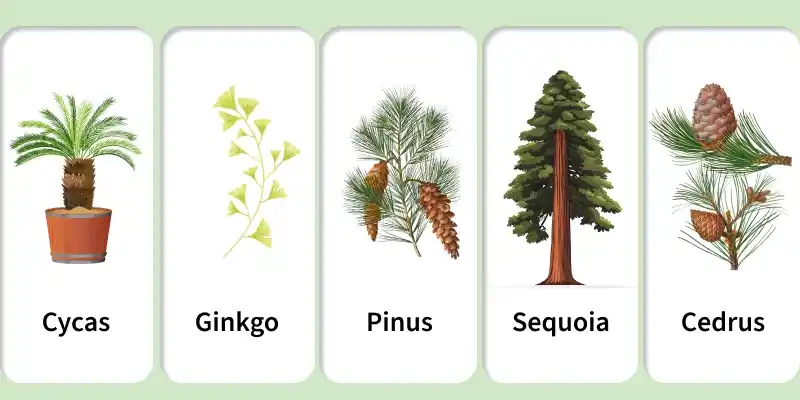
The number of cotyledons in a seed is one or two, as in Cycas, or many as in Pinus.
Classification of Gymnosperms
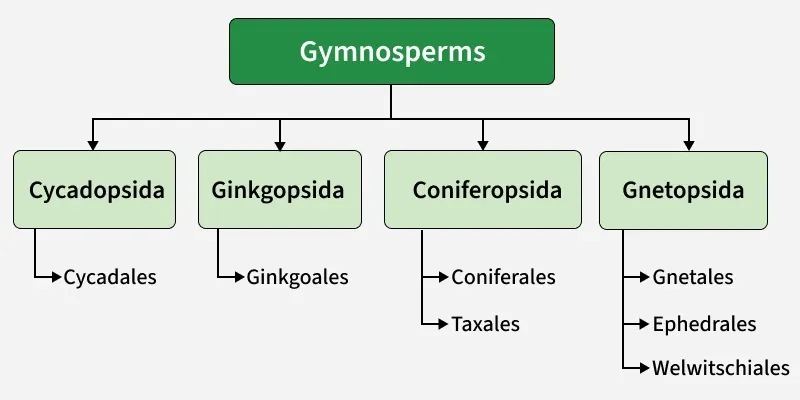
Gymnosperms are classified into 4 types. Each group is distinguished by its unique characteristics, and they all play important ecological roles in their respective habitats.
Given below are the details of four types of Gymnosperms:
1. Cycadophyta
Cycads are dioecious (meaning: individual plants are either all male or female).
Cycads are seed-bearing plants, and most of the individuals are presently extinct.
They grew during the Jurassic and late Triassic times.
These gymnosperm plants generally have big compound leaves, thick trunks, and little pamphlets which are connected to a central stem.
They range in level from a few centimetres to a few meters.
Cycads are generally seen in the tropics and subtropics. Some Cycadophyta are adapted to dry conditions, while others have adjusted to oxygen-poor, damp environments.
Examples: Cycas, Zamia, Zamiaceae.
2. Ginkgophyta
Only one, Ginkgophyta, is a living animal group. Any remaining individuals from this class are extinct.
The Ginkgo trees are described by their big size and their fan-like leaves.
Ginkgo trees have an enormous number of uses, ranging from medicine to cooking.
Ginkgo leaves are ingested as a solution for memory-related diseases like Alzheimer's.
Example: Ginkgo biloba
3. Gnetophyta
Gnetophytes are additionally relics from an earlier time. Today, just three individuals from this family exist.
Gnetophytes typically comprise tropical plants, trees, and shrubs.
They show the phenotype of colourful leaves that are covered with a soft coating.
This cover tells a hereditary association with angiosperms.
Gnetophytes vary among different individuals from this class as they have vessel components in their xylem.
Example: Ephedra, Gnetum.
4. Coniferophyta
These are the most commonly known species among the gymnosperm family.
They are evergreen; consequently, in winter, they don't shed their leaves.
These are essentially described by male and female cones with structures like a needle.
Coniferous trees are normally found in temperate zones where the typical temperature is 10 ℃.
Monterey sequoia, pines, cedar, and redwood are instances of Conifers.
Examples: redwood trees, junipers, cypress trees, tidy trees, and hemlocks.
Life Cycle of Gymnosperm
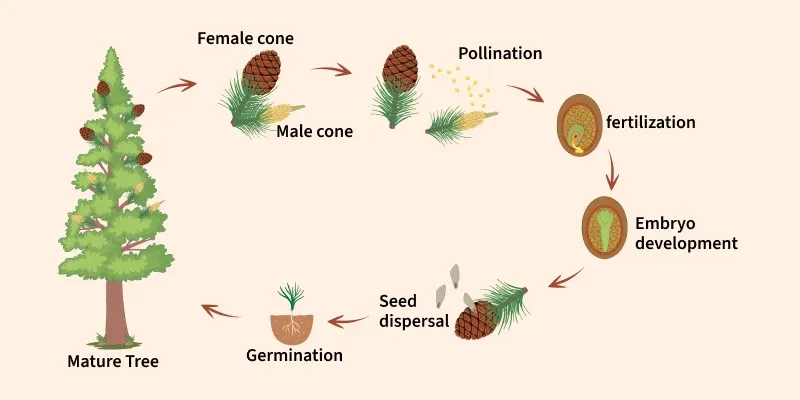
Gymnosperm plants have both haploid and diploid life cycles; that is, they reproduce via generation alteration. The life cycle of gymnosperms involves a complex process of alternation between two generations, the sporophyte and the gametophyte. Gymnosperms have a sporophyte-dominant life cycle.
Gymnosperms are heterosporous plants, i.e., plants produce spores that are haploid microspores or megaspores. The gametic phase of the gymnosperm is short. Reproductive organs of gymnosperms are:
Male Cones: The male cones of gymnosperms develop from the sporophyte. They contain the male gametophyte, which produces a pollen grain. Microsporangiaform microspores that are haploid in structure; some microspores develop into pollen grains, and others degrade.
Female Cones: The female cones of gymnosperms develop from the megasporophylls. Megasporangium contains the female ovule, which produces megaspores.
Once the pollen reaches the female cones via wind or any pollinating agent, it fertilises the eggs, resulting in the formation of a diploid zygote. The zygote develops into an embryo, which is enclosed in a seed. The seed is then dispersed and can grow into a new sporophyte plant. The life cycle of gymnosperms is an essential process that ensures the continued growth and reproduction of these plants.
Economic Importance of Gymnosperms
Gymnosperms have significant economic importance, as outlined below:
Timber: Gymnosperms, such as pines, firs, and spruces, are valuable sources of timber for construction, furniture, and paper production.
Paper Production: Gymnosperm wood pulp is used in the papermaking industry.
Resin: Some gymnosperms, like pines, produce resin, which is used in various products such as varnishes, adhesives, and pharmaceuticals.
Ornamental Plants: Certain gymnosperms, like cedars and junipers, are cultivated for their ornamental value in landscaping and gardens.
Medicinal Uses: Extracts from certain gymnosperms have medicinal properties and are used in traditional medicine for treating various ailments.
Gymnosperms Vs Angiosperms
The key differences between gymnosperms and angiosperms are listed below: