|
VOOZH | about |
|
VOOZH | about |
Obelia is a small, marine, colonial organism belonging to the phylum Cnidaria (Coelenterata) and class Hydrozoa. It is commonly found attached to rocks, shells, or seaweed in shallow seawater.
Obelia is an important organism studied in zoology because it clearly shows alternation of generations in its life cycle. Obelia are diploblastic, primitive organisms with a unique life cycle in the Animal Kingdom.
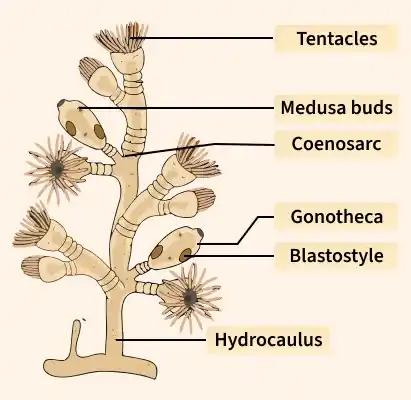
Obelia, under a microscope, looks like a complex structure, with many small polyps connected by branching tubes. The structure of the Obelia body resembles that of sea anemones that remain attached to the substrate at the bottom, like rock or seabed, and have tentacles that they use for feeding and reproduction. However, during the life cycle of Obelia, they also have a free-moving stage of life.
The scientific classification of Obelia is:
Kingdom | Animalia |
|---|---|
Phylum | Cnidaria |
Class | Hydrozoa |
Order | Leptothecata |
Family | Campanulariidae |
Genus | Obelia |
The following characteristics can identify Obelia:
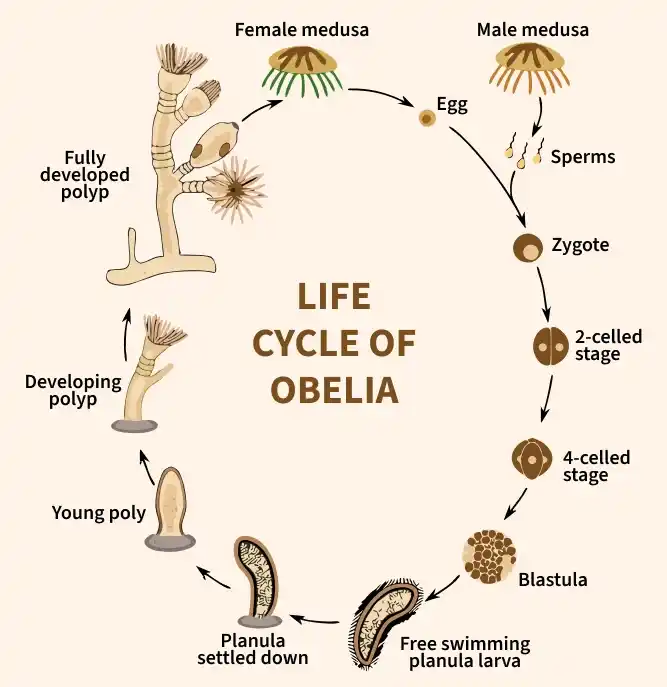
Obelia is a dioecious organism with distinct sexual and asexual life stages. The life cycle of Obelia can be studied in various stages. The different stages of the life cycle of Cnidarians are also called zooids. The life cycle of Obelia is characterized by alternation of generations, involving both asexual and sexual reproduction with different body structures and functions.
The cycle begins with the release of sperm and egg from male and female reproductive medusae, respectively, into the water, where external fertilization occurs. The sperm are flagellated and swim around to find and fertilize the female medusa’s egg.
Once fertilized, the zygote undergoes complete cleavage to form the blastocysts that develop into ciliated, motile, free-swimming larvae known as planulae. Planulae are oval-shaped larvae that swim in the water, settle on substrates, and grow into sessile, feeding polyps known as hydranths through metamorphosis.
The obelia polyps, or hydranths, are the sessile phases in the life cycle of Obelia, with the primary function of feeding and propagating the colony. This stage is also called the gastrozooid or trophozooid. They reproduce asexually by budding, giving rise to additional feeding polyps and extending the colony. In Obelia, certain specialized polyps called gonozooids produce reproductive structures called gonangia, which give rise to the next stage in the life cycle.
Meanwhile, certain hydranths transform through a process known as strobilation to form the medusae stage. These are the sexual zooids and are also called the gonophores. Medusae are jellyfish-like structures equipped with tentacles and capable of sexual reproduction. The medusae release gametes (sperm and eggs) into the water, where fertilization occurs externally. In this way, the life cycle of Obelia continues.
Alternation of generations is a reproductive strategy observed in certain organisms, particularly among some groups of plants and algae, as well as in some animal groups such as cnidarians (e.g., jellyfish and hydroids) and certain fungi.