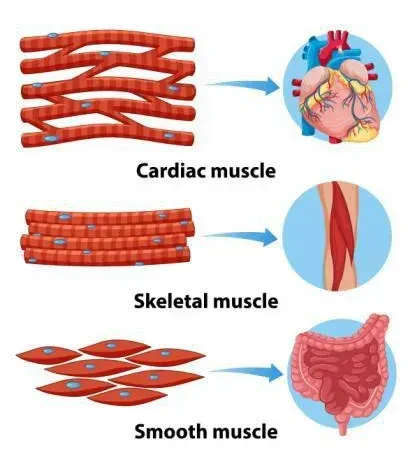
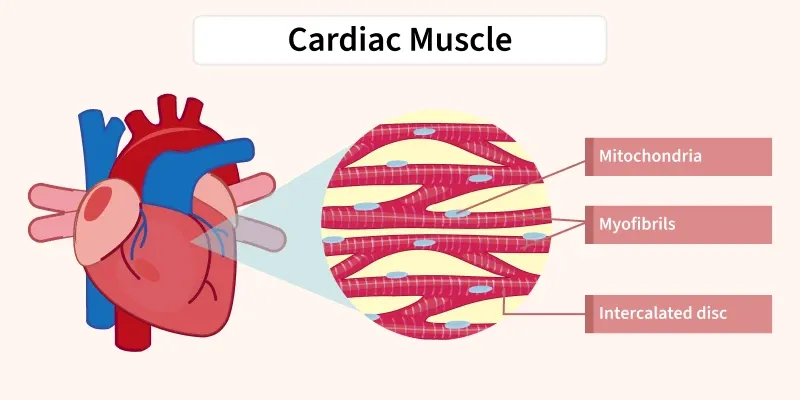
Muscular tissue is a specialised tissue found in animals that is responsible for contraction and movement. Muscle tissue is a specialised animal tissue responsible for movement. It is characterised by its ability to contract and generate force, facilitating bodily movement and maintaining posture. There are three types of muscle tissue: Cardiac, Skeletal and Smooth Muscles.
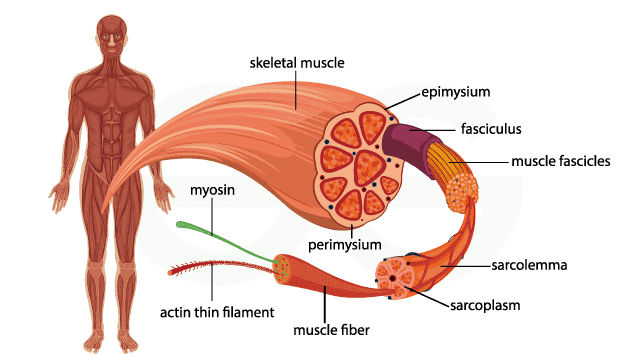
The cytoplasm of a muscle cell is called sarcoplasm. It contains an organisation of membranes called the sarcoplasmic reticulum. The membrane encompassing the muscle strands is called the sarcolemma. There are three types of muscle tissue:
1. Skeletal/ Striated Muscle Tissue
Skeletal Muscles are joined with the skeleton and help in the movement of the organism.
Skeletal Muscles are also called striated muscles because of their striped appearance, i.e. alternate patterns of light and dark bands in their cells under a microscope.
Almost 40% of total body mass is composed of skeletal muscles
Striated muscle tissue contain myofibrils.
Striated muscle cells are multinucleated.
Blood vessels, elongated mitochondria, and glycogen-containing granules are present in skeletal muscles.
Movement of the body is carried out by skeletal muscles
Some of the properties of muscular tissue are given below:
Contractibility: It is the capacity of muscle cells to powerfully shorten.
Extensibility: Muscles can be stretched without being damaged.
Elasticity: The muscles can regain their original length after stretching.
Excitability: The muscle tissue reacts to the external stimulus carried by motor neurons.
Highly vascularized: Muscular tissue is richly supplied with blood vessels, which provide oxygen and nutrients to the tissue and remove waste products.
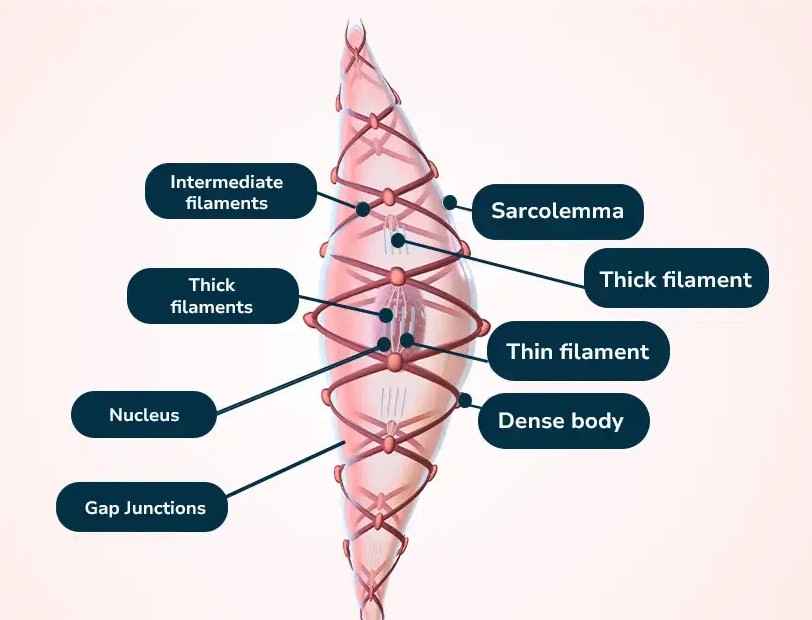
Striated or smooth appearance: Depending on the type of muscular tissue, it may have a striped or smooth appearance under a microscope. Skeletal and cardiac muscle tissue are striated, while smooth muscle tissue is not.
Function of Muscular Tissue
The functions of muscular tissue are given here:
Muscular tissue is responsible for the movement of the body and internal organs.
Skeletal muscles are responsible for maintaining the posture of the body and supporting the weight.
Muscular tissue produces heat as a byproduct of metabolic processes. The heat helps to maintain body temperature.
Muscles also help protect and support internal organs.
Muscles can be found in and around openings in the body.