|
VOOZH | about |
|
VOOZH | about |
NCERT Notes for Class 8 Science Chapter - 6: Reproduction in Animals: Reproduction is essential for species to survive; it ensures their continued existence for many generations by passing on traits from one generation to the next. Without it, individuals of similar genetic makeup would not continue beyond a single generation. Through these notes, the students will be able to revise essential topics like different modes of reproduction, sexual reproduction, Male reproductive organ, female reproductive organ, fertilization, test tube babies, external fertilization, development of an embryo, internal; fertilization, asexual reproduction, budding, binary fission and an introduction to the cloning process and the story of Dolly the sheep.
Reproduction is a vital process that is essential for the survival of all living organisms. In animals, reproduction involves the production of offspring that share genetic traits with their parents. The process of animal reproduction can be complex and varied, with different species exhibiting unique reproductive strategies.
There are two ways that animals can reproduce, just like there are two ways that plants can reproduce:
The egg could be very little, like in humans, or a lot bigger, like in hens. The biggest egg is an ostrich egg.
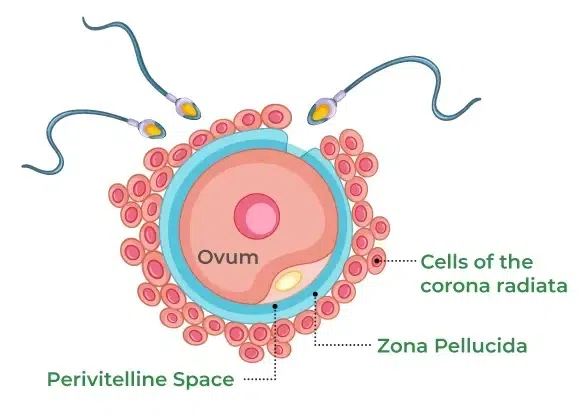
The reproductive process begins with the union of a sperm and an ovum. The egg may be fertilized when it interacts with one of the sperms, leading to fusion. It is known as fertilization when an egg and sperm combine in this manner. The sperm and egg nuclei combine to create one nucleus during fertilization, which is found inside the zygote
Fertilization happens when a mother's egg cell and the father's sperm cell combine, resulting in the creation of a new individual who has inherited characteristics from both parents. This is evident by the similarities between some characters of brother and sister with their parents.
Test Tube Babies
Some women have impaired oviducts, meaning they are unable to carry eggs. This impediment means these women may not be able to become pregnant due to the blocked oviducts. With the introduction of IVF, female eggs and male sperm can be externally combined to produce a fertilized egg.
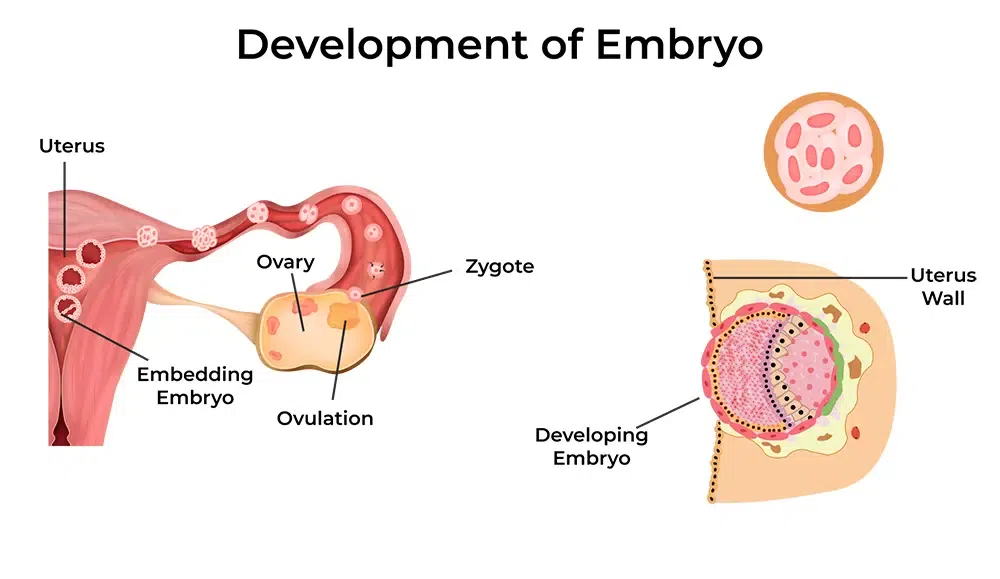
A zygote is formed by the fusion of an egg & a sperm and is implanted in a woman's uterus after it has been nurtured for about a week. IVF babies are commonly referred to as Test Tube Babies.
During springtime and the rainy season, frogs and toads move to ponds & slow-flowing streams. The female then lays hundreds of eggs when these amphibians mate in water. Unlike chicken eggs, frog eggs are incredibly fragile & come without a shell. The eggs are encased in a jelly-like substance to keep them safe and stable. After being laid, the male fertilizes them by scattering sperm all over them.
The sperm's long tail helps it to move randomly in the water and eventually come into contact with the egg, leading to fertilization. External fertilization enables the fusion of a male and female gamete to take place outside the body of the female. This process can be seen in abundance among aquatic organisms, including fish and starfish.
Though these animals generate vast amounts of sperm and eggs, not all of them get fertilized due to their exposure to wind, rain, and swift water. Additionally, some predators like fish also consume the eggs present in the pond. In order to ensure that at least some of the eggs and sperm are fertilized, enormous quantities of both must be produced.
Viviparous animals are those that reproduce by giving birth to offspring. The infants are born by their mothers. A few examples of viviparous creatures are dogs, cats, cows, etc. Oviparous animals are defined as those that lay eggs. This is because the mother will lay them in an external environment instead of keeping them inside her own body.
A hen’s egg is white in color and spheroid in shape. Lizard eggs are the size of fingernails and white in color. Crow eggs are bluish-green in color. These are all examples of oviparous animals that lay eggs.
Also Read: Difference between Oviparous and Viviparous Animals
From the moment they are born, babies grow and develop until they reach adulthood. However, their youthful appearance may not remain the same as it was when they were young. For example, adults possess a different look than younger frogs and silkworms.
Frogs experience three different phases in their life cycle - egg, tadpole (larva), and adult. Tadpoles look nothing like adults, but with time, they turn into frogs capable of jumping and swimming. Metamorphosis is an important process when it comes to the transformation of larvae into adults. This transformation involves a lot of physical changes that do not take place in humans as they age, hence why it does not occur in them.
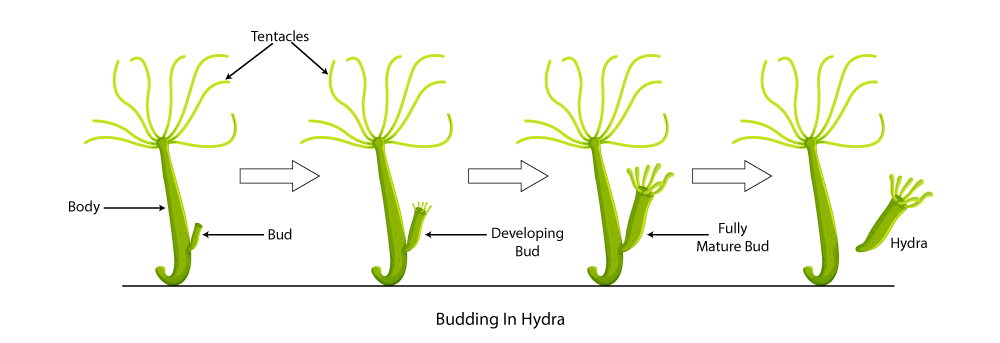
Only one parent is involved in asexual reproduction. It occurs in microbes like amoebas and small creatures like hydras. Regenerative cells are used by Hydra to give rise to new individuals during its budding phase. This happens due to repeated cell division at one single point which causes the formation of buds as an outgrowth.
Budding is a process wherein small individual buds gradually detach from their parent's body and grow into new, young organisms. This unfolding of events occurs when the buds have fully developed.