NCERT Solutions for Class 11 Biology Chapter 7 Structural Organisation in Animals
Last Updated : 19 May, 2023
NCERT Solutions for class 11 Chapter 7 Structural Organisation in Animals: The chapter on Structural Organisation in Animals is important for students approaching the home exams. This article introduces NCERT solutions designed to help students explain the concepts of further learning and how to write to get good grades on exams. The solutions are presented in very simple language for ease of understanding.
NCERT CBSE Chapter 07 Structural Organisation In Animals of Class 11 explains that the life processes of the human body are functional at various levels of structural organization which include cellular, tissue, organ, organ system, and the organism level. Higher organizations are built from the lower levels of the organization. The study of the structures and their organization in a body is known as Anatomy. This is associated with a proper understanding of the structures based on the formation of specific systems like digestive, circulatory, excretory, etc. Revise the basic concepts of for quick revision and class notes.
Q1: Draw a neat diagram of the Digestive System of a Frog.
The mouth is located on the ventral side of the first segment
(b)Diffrence Between Septal nephridium and Pharyngeal nephridium
Septal nephridium
Pharyngeal nephridium
These are present on both the sides of the intersegment septa from the 15th septa to the last.
These are present as the clusters in 4th, 5th, and 6th segments.
They open into the intestine
They open into the the pharynx
Q6: What are the Cellular Components of Blood?
Answer:
The cellular components of blood are:
Reb blood cells or erythrocytes: They transport oxygen from the lungs to the other body parts.
White blood cells or leukocytes: They are known as the soldiers of our body because they fight against infections and assist in the immune process.
Platelets or thrombocytes: They help in blood clotting at the time of injury.
Q7: What are the Following, and where do you find them in an Animal Body?
(a) Chondrocytes
(b) Axons
(c) Ciliated epithelium
Answer:
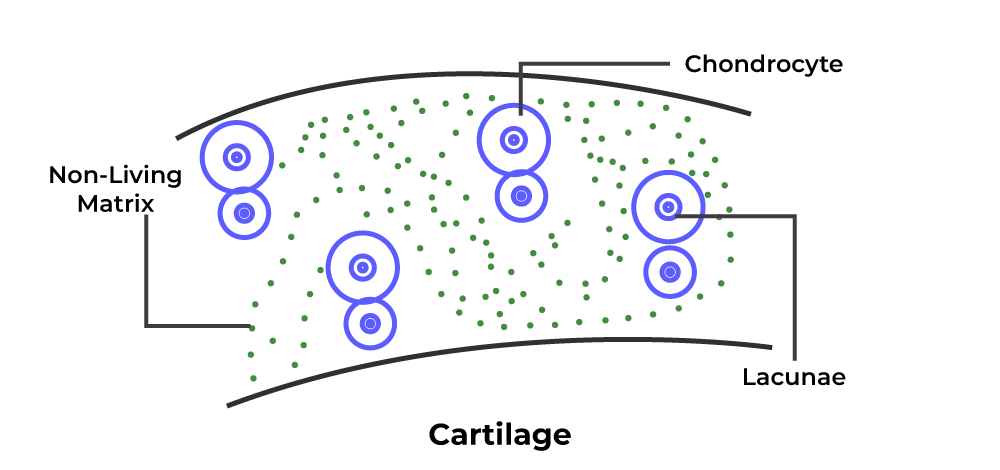
(a) Chondrocytes: Cartilage is formed by some special cells known as Chondrocytes. Cartilage is a strong and flexible connective tissue that provides protection to the joints and bones by acting as a shock absorber. Location- They are located in the matrix or ground base of the cartilage.
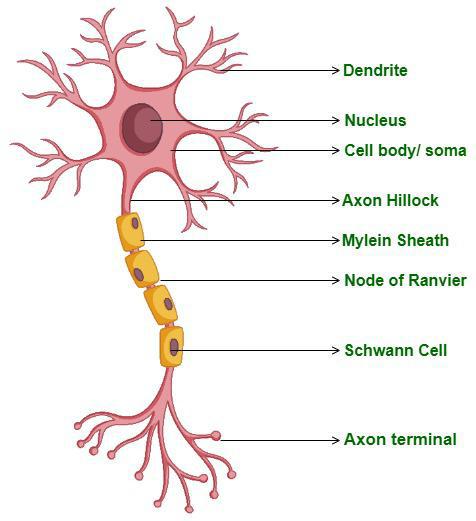
(b) Axons- An axon or nerve fiber is the elongated part of a nerve cell or neuron that carries nerve impulses or signals away from the cell body. A typical neuron has an axon that connects it with other neurons or muscles or glands. Location- Axons are located between the cell body and axon terminals or ends.
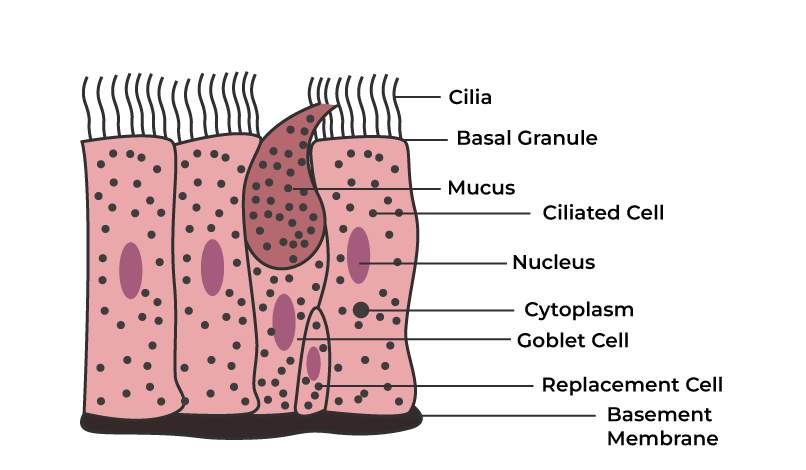
(c) Ciliated epithelium- Ciliated Epithelium is a thin tissue that has some hair-like structure known as cilia, which helps in the locomotion of our body. Location- They are located in the human respiratory tract and the fallopian tubes of women.
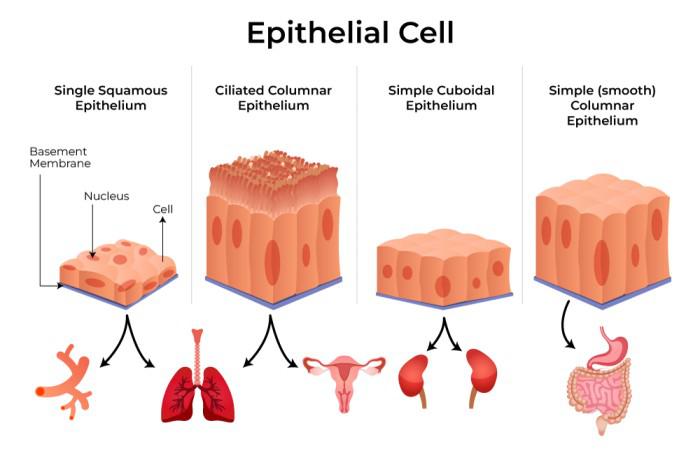
Q8: Describe Various Types of Epithelial Tissues with the Help of Labeled Diagrams.
Answer:
The epithelium is a type of body tissue that lines the covering on all internal and external surfaces of your body which includes body cavities and hollow organs. Epithelial tissues are formed of a compact layer of cells. One surface of the epithelial tissue is attached to the external environment or body fluid. The other surface is attached to the tissue. There are two types of epithelial tissues:
Simple epithelial tissues: These consist of a single layer of cells resting on the basement membrane. It lines the body cavity, ducts, and tubes.
Compound epithelial tissues: Compound epithelium tissue is shaped of numerous layers of epithelial cells of dissimilar shapes representing newly shaped and mature cells. This tissue forms the covering of all body surfaces and they are the major tissue in glands.
Simple epithelial tissues are divided into the following types:
Columnar epithelium: It is made up of cells that appear like columns that line the small intestine and ducts of many glands.
Cuboidal epithelium: It is made up of cells that are cube-like in appearance and line the kidney tubules
Squamous epithelium: It is made up of thin sheets-like or flat cells which give protection against microorganisms. The outer layer of the skin (the epidermis) is made of stratified squamous epithelial cells. The lining of the blood vessels is also made up of these tissues.
Ciliated Epithelium: They are made up of rectangular cells which line the respiratory tract.