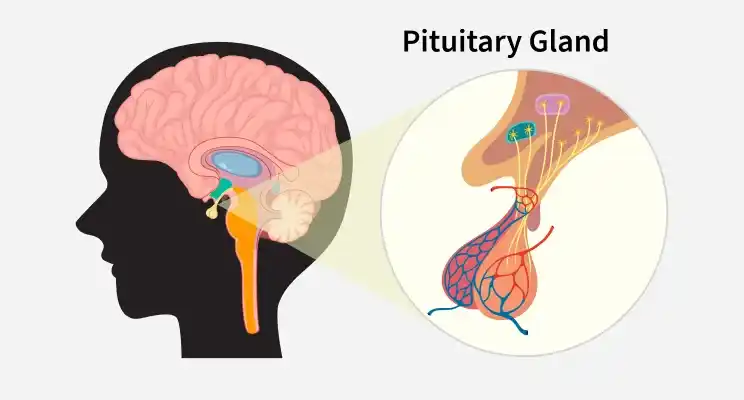
The pituitary gland is a small, pea-sized endocrine gland that plays a crucial role in regulating various functions of the human body. It is often called the “master gland” because it controls the activity of many other endocrine glands. It is a part of the endocrine system that produces several important hormones. The pituitary gland also directs other glands in the endocrine system to release hormones.
It is located in a bony cavity called the Sella turcica, below the brain
It is a part of the endocrine system, which secretes hormones directly into the bloodstream
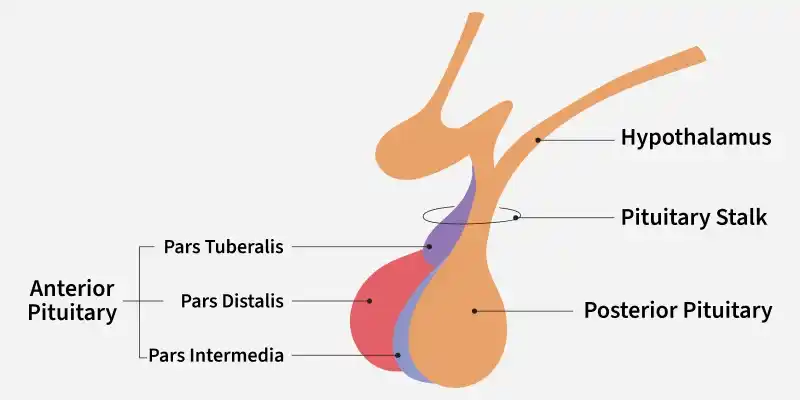
Divided into two main parts: Anterior pituitary (adenohypophysis) and Posterior pituitary (neurohypophysis)
Hormones Secreted by the Pituitary Gland
Anterior Pituitary Hormones
Adrenocorticotropic Hormone (ACTH): ACTH stimulates the synthesis and secretion of steroid hormones called glucocorticoids from the adrenal cortex
Follicle Stimulating Hormone (FSH): FSH, along with androgens, regulates spermatogenesis, and it stimulates the growth and development of the ovarian follicles in females.
Growth Hormone (GH): Promotes the growth of bones and muscles
Luteinizing Hormone (LH): In males, LH stimulates the synthesis and secretion of hormones called androgens from the testis. In females, LH induces ovulation of fully mature follicles (Graafian follicles) and maintains the corpus luteum, formed from the remnants of the Graafian follicles after ovulation.
Prolactin: Prolactin regulates the growth of the mammary glands and formation of milk in them
Thyroid Stimulating Hormone (TSH): TSH stimulates the synthesis and secretion of thyroid hormones from the thyroid gland
Posterior Pituitary Hormones
Oxytocin: Oxytocin acts on the smooth muscles of our body and stimulates their contraction. In females, it stimulates a strong contraction of the uterus at the time of childbirth and milk ejection from the mammary gland.
Antidiuretic Hormone (ADH/Vasopressin): Vasopressin acts mainly at the kidney and stimulates reabsorption of water and electrolytes by the distal tubules and thereby reduces loss of water through urine (diuresis). Hence, it is also called as antidiuretic hormone (ADH).
Functions of the Pituitary Gland
Regulates growth and development and water balance
It controls metabolism
Maintains reproductive functions and regulates lactation and childbirth
It helps in stress response
Interaction with the Hypothalamus
The pituitary gland works closely with the hypothalamus, forming the hypothalamic–pituitary complex.
The hypothalamus controls the pituitary using releasing and inhibiting hormones
It connects to the pituitary via the pituitary stalk
It communicates with the anterior pituitary through blood vessels and with the posterior pituitary through nerve fibres
The hypothalamus produces hormones such as Corticotropin-releasing hormone (CRH), Gonadotropin-releasing hormone (GnRH), Growth hormone-releasing hormone (GHRH), Thyrotropin-releasing hormone (TRH), and Dopamine and somatostatin (inhibitory hormones)
Growth Hormone Deficiency: low secretion of GH results in stunted growth, resulting in pituitary dwarfism
Gigantism: Over-secretion of GH stimulates abnormal growth of the body, leading to gigantism
Acromegaly: Excess secretion of growth hormone in adults, especially in middle age, can result in severe disfigurement (especially of the face) called Acromegaly, which may lead to serious complications and premature death if unchecked
Cushing’s Disease: Excess ACTH leading to high cortisol levels