Reptiles and Amphibians Characteristics and Examples
Last Updated : 23 Jul, 2025
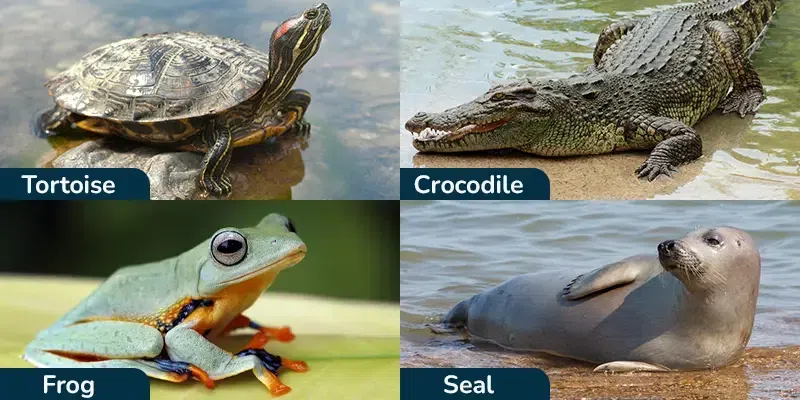
Reptiles and amphibians are two different kinds of organisms which are commonly mistaken for one another because of their similar physical traits and behaviours. Studying the reptiles and amphibians differences, similarities and examples help us understand them better.
In this article, we will cover the reptiles and amphibians in detail.
The phylum Chordata contains cold-blooded, air-breathing vertebrate creatures known as reptiles. With more than 10,000 species currently recognized, they are a diverse collection of animals that can be found everywhere but Antarctica. Reptiles differ from other animal classes in several ways that make them stand out.
Scales: Reptiles have scaly, dry skin that acts as insulation and a barrier against moisture loss. They can have scales on their skin that are made of various substances, such as keratin or bone, and these scales help in the animal's defence against predators.
Lungs: The lungs of reptiles are more effective in drawing oxygen from the air than the gills of fish.
Cold-blooded: Ectothermic indicates that reptiles depend on their surroundings to maintain their body temperature because they are unable to regulate it internally.
Eggs: The majority of reptiles produce eggs with a tough, leathery exterior that protects and traps moisture for the developing embryo. Several snake species and other reptiles can store their eggs internally and give birth to live young.
Limbs: Nonetheless, certain species of reptiles have evolved to exist without limbs. Reptiles normally have well-developed limbs with claws or fingers that allow them to move readily on land.
Teeth: Certain reptiles have venomous fangs that assist them to subdue their food, and the majority of them have well-developed teeth that they utilize to grab and rend their prey.
Behaviour: Depending on the species, reptiles are typically lone animals that are active either during the day or at night.
Amphibians Meaning
Amphibians are a class of cold-blooded vertebrates that typically begin life in water with gills and later develop lungs for breathing air as adults. They undergo metamorphosis and often inhabit both aquatic and terrestrial environments during their life cycle.
Here are some of the key characteristics of amphibians:
Moist Skin: Amphibians have smooth, moist skin, unlike reptiles, which enables them to breathe through their skin. Moreover, their skin is quite porous, allowing them to take in moisture and nutrients from the surroundings.
Life Cycle: The majority of amphibians change from a larval stage that breathes water to an adult stage that breathes air. They often shed their gills during this process and grow lungs, limbs, and other adult features.
Habitat: Although they can be found in a variety of terrestrial and aquatic settings, amphibians need moist surroundings to exist. Numerous animals live part of their life on land and part in the water.
Diet: The majority of amphibians consume tiny animals, insects, and other small invertebrates as their primary sources of food. Several larger species may also eat fish, rats, and other animals.
Reproduction: The majority of amphibians lay eggs, which are often placed in water or other damp areas. Larvae that breathe through gills and feed on microscopic creatures develop from the eggs. The larvae eventually transform into adults through metamorphosis.
Sensory Systems: Because of their acute hearing, smell, and vision senses, amphibians are able to locate prey, escape predators, and locate mates.
Adaptations: In order to survive in their settings, amphibians have developed a number of adaptations, such as sticky pads on their feet for climbing, camouflage to hide from predators, and toxins to protect themselves against them.
Similarities Between Reptiles and Amphibians
The similarities between reptiles and amphibians are given below:
Cold-blooded: Rely on external heat (ectothermic).
Backboned: Vertebrates with spinal columns.
Egg layers: Reproduce by laying shelled eggs on land (reptiles) or in water (some amphibians).
Shedders: Molt or shed their skin as they grow.
Lung breathers (mostly): Use lungs for primary respiration (except some amphibians that can absorb oxygen through skin).
Amphibians vs Reptiles - Difference Between Reptiles and Amphibians
The difference between amphibian and reptiles are given below:
Feature
Amphibians
Reptiles
Habitat
Often found in both aquatic and terrestrial environments
Primarily terrestrial, though some may inhabit water
Skin
Moist, permeable skin
Dry, scaly skin
Reproduction
External fertilization, eggs laid in water
Internal fertilization, eggs laid on land or in nests
Life Cycle
Larval stage with gills, undergo metamorphosis
No larval stage, direct development from egg to adult
Temperature Control
Cold-blooded (ectothermic), reliant on external heat
Cold-blooded (ectothermic), reliant on external heat
Conclusion - Reptiles and Amphibians
Reptiles and amphibians, while sharing some common traits as cold-blooded vertebrates, exhibit distinct differences that set them apart. Reptiles, with their scaly skin, efficient lungs, and leathery eggs, are well-adapted to life on land. In contrast, amphibians have moist skin, undergo metamorphosis, and require aquatic environments for their reproductive cycle. Understanding these differences helps highlight the unique adaptations and ecological roles of each group, emphasizing the diversity of life forms within the animal kingdom.