|
VOOZH | about |
|
VOOZH | about |
Restriction enzyme is a bacterial protein that cleaves DNA at particular locations, these sites are called restricted sites. The restriction enzymes guard against bacteriophages in living bacteria. They identify the bacteriophage and cleave it at its restriction sites, destroying its DNA. Important genetic engineering tools include restriction enzymes. They may be separated from bacteria and applied in research facilities. The recognition sequences, or short and distinct nucleotide sequences, are recognized by restriction enzymes in DNA. When a DNA sequence is recognized by the restriction enzyme, it hydrolyzes the bond between neighboring nucleotides and cleaves the DNA molecule. The bacteria use the enzyme methylases to add the methyl group at the adenine or cytosine bases within the recognition sequence, preventing the DNA sequences from disintegrating.
In the year 1970, the first restriction enzyme was discovered and identified as such. Since then, more than 3000 restriction enzymes have been thoroughly investigated, and more than 600 of them are now commercially available and often employed in labs to modify and alter DNA. In 1963, scientists discovered the two enzymes that limit bacteriophage development in E. coli. One was an enzyme that sliced DNA, whilst the other added methyl groups to DNA. Restriction endonuclease was the name given to it later. These enzymes are divided into Exonucleases and Endonucleases based on how they function.
DNA molecules contain restriction sites, also known as restriction recognition sites, that are particular (4–8 base pair long) nucleotide sequences that are recognized by restriction enzymes. Because restriction enzymes often bind as homodimers, these sequences are typically palindromic. A particular restriction enzyme may cut the sequence between two nucleotides within its recognition site or somewhere adjacent.
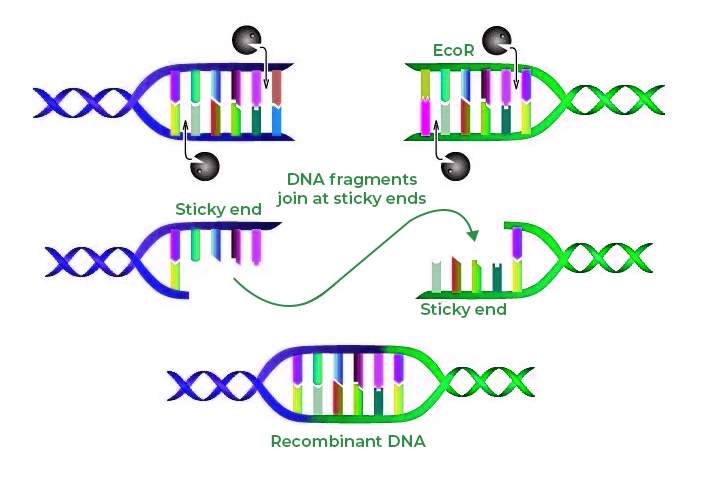
For example, when the palindromic sequence GAATTC is recognized, the common restriction enzyme EcoRI makes a cut between the G and the A on both the top and bottom strands. On each end of AATT, a sticky end—a segment of a DNA strand with no connected complement—remains as a result. A segment of DNA with a complementary overhang can then be ligated into the overhang (another EcoRI-cut piece, for example).
By linking an artificial nuclease domain to a synthetic DNA-binding domain, restriction enzymes can be created. Such synthetic restriction enzymes can bind to specific DNA sequences and can target big DNA locations (up to 36 bp). The most popular artificial restriction enzymes are zinc finger nucleases, which are typically utilized in genetic engineering but can also be used in more conventional gene cloning procedures. The DNA-binding domain of TAL effectors serves as the foundation for additional synthetic restriction enzymes.
In 2013, the genome editing tool CRISPR-Cas9, based on a prokaryotic virus defense mechanism, was developed. It was quickly embraced in labs. Also created are synthetic ribonucleases that function as RNA restriction enzymes. A PNAzyme is a PNA-based system that mimics ribonucleases for a particular RNA sequence and cleaves at a non-base-paired region (RNA bulge) of the targeted RNA generated when the enzyme binds the RNA. This region is known as the RNA bulge. This enzyme exhibits selectivity by only cleaving at one of two potential cleavage sites that are either kinetically favored or do not have a mismatch.
There have been numerous identifications of restriction enzymes since their discovery in the 1970s; for instance, more than 3500 distinct Type II restriction enzymes have been characterized. Using a naming scheme based on bacterial genus, species, and strain, each enzyme is named after the bacterium from which it was obtained.
For example, the EcoRI restriction enzyme's name
Derivation of the EcoRI | ||||
|---|---|---|---|---|
| Abbreviation | E | co | R | I |
| Meaning | Escherichia | Coli | RY13 | First Identified |
| Description | Genus | Specific Species | Strain | Order of Identification |
It is crucial to understand restriction enzymes since they are utilized in Restriction Fragment Length Polymorphisms, which reveal genetic differences and mutations, as well as in the treatment of cancer. They are composed of two long strands of DNA fused with these restriction enzymes to locate certain DNA sequences and cleave them there. It is used to distinguish the type of mutation from the variation. Restriction enzymes recognize two nucleotides on one strand of DNA, which then cleave the strand. A specific kind of nucleotide sequence in a segment of DNA can be cut by restriction enzymes. So, DNA analysis is done using these enzymes.
Here are some of the top methods for researching restriction enzymes:
In molecular biology research, restriction endonucleases are frequently employed for the following purposes:
EcoRI, HindIII, and NotI are a few well-known examples of restriction enzymes.
| Enzyme | Source | Recognition Sequence | Cut |
|---|---|---|---|
| HindIII | Haemophilus influenzae | 5'AAGCTT 3'TTCGAA | 5'---A AGCTT---3' 3'---TTCGA A---5' |
| Notl | otitis | 5'GCGGCCGC 3'CGCCGGCG | 5'---GC GGCCGC---3' 3'---CGCCGG CG---5' |
| EcoRI | Escherichia coli | 5'GAATTC 3'CTTAAG | 5'---G AATTC---3' 3'---CTTAA G---5' |
Question 1: Define restriction enzymes and Recognition sites.
Answer:
It is an enzyme that cleaves DNA into pieces at or close to particular molecular recognition sites. A recognition site is a location that a restriction enzyme selects in order to break DNA.
These locations are found on a DNA molecule and contain particular nucleotide sequences (4-8 base pairs)
Question 2: Write the applications of the restriction enzyme.
Answer:
Applications of the restriction enzyme:
- Genetic engineering
- Used in methods for DNA fingerprinting.
- They help in gene cloning, protein expression research, and the insertion of genes into plasmid vectors.
- By specifically identifying single base variations in DNA as single nucleotide polymorphism, they are also useful to distinguish gene alleles.
- DNA mapping.
- Gene sequencing.
Question 3: In which year was the first restriction enzyme identified?
Answer:
In 1970 the first restriction enzyme was identified.
Question 4: Write the difference between Endonuclease and Exonuclease.
Answer:
Endonuclease | Exonuclease |
|---|---|
| A class of enzymes known as endonucleases cleaves the phosphodiester bond found within a polynucleotide chain. | Exonucleases are enzymes that individually cleave DNA sequences from a polynucleotide chain's 5′ or 3′ end. |
| Endonucleases split the nucleotide sequence down the middle. | Exonucleases cleave the ends of a nucleotide sequence. |
| There is a lag phase before some endonucleases, such as restriction endonucleases, start to work. | There is no delay in the commencement of exonuclease activity |
| The endonuclease slices a piece of DNA in the middle, forming oligonucleotides. | DNA sequences are broken down by exonucleases into single nucleotides or nucleosides. |