|
VOOZH | about |
|
VOOZH | about |
Viroids are the smallest known infectious agents and are important pathogens of plants. They consist only of a short, circular, single-stranded RNA molecule and lack both a protein coat and protein-coding genes, distinguishing them from viruses. Despite their extremely simple structure, viroids can infect plants and cause several economically important diseases. The discovery of viroids provided valuable insights into the role of RNA in disease causation and significantly advanced the understanding of molecular biology and plant pathology.
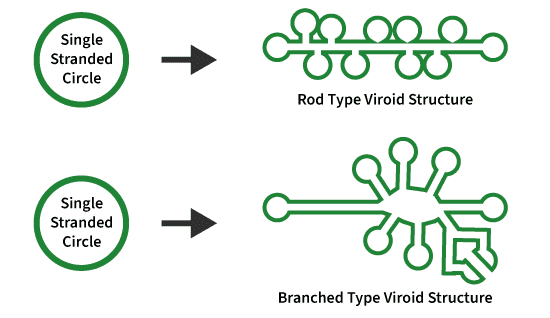
👁 ViroidViroids consist of a single-stranded circular RNA molecule that folds into characteristic secondary structures such as rod-shaped or branched forms through internal base pairing. These compact structures help maintain the stability and infectivity of viroids despite their extremely simple organization. The structure of a viroid is extremely simple. It consists of:
The RNA molecule folds upon itself due to complementary base pairing, forming a compact rod-like structure. This folding increases the stability of the RNA and helps it survive within host cells.
Viroids replicate inside the cells of infected plants. Since they do not contain any enzymes or proteins of their own, they utilize the host plant's enzymes for replication. The replication process involves the following steps:
Viroids are responsible for several economically important plant diseases.
Diseases | Description | Symptoms |
|---|---|---|
1. Potato Spindle Tuber Disease | This disease is caused by the Potato Spindle Tuber Viroid (PSTVd). |
|
2. Citrus Exocortis Disease | This disease affects citrus plants. |
|
3. Coconut Cadang-Cadang Disease | This disease affects coconut palms and may lead to severe losses in coconut production. |
|
4. Chrysanthemum Stunt Disease | This disease affects ornamental chrysanthemum plants. |
|
Viroids can spread from one plant to another through several methods.
Viroids are agriculturally important because they infect many crop plants and reduce their productivity. Infected plants often show poor growth, reduced flowering, decreased fruit and seed production, and lower yields. As a result, farmers may suffer significant economic losses. Viroid infections can also affect the quality of agricultural products and hinder international trade in plant materials.