|
VOOZH | about |
|
VOOZH | about |
Students and researchers face many challenges in writing simple to complicated research papers. They must take a deep dive into the previous articles to extract crucial information and get the summary of the paper. Nevertheless, using AI tools, such as Elicit and Scholarcy, will simplify the journey of writing a research paper.
Research assistants use these Elicit vs. Scholarcy tools to streamline their literature review process. These tools help students avoid difficulty reviewing many publications and articles and comparing the right ones for their research papers.
AI-Based Literature Review Tools use large language models to simplify research tasks. You can completely automate the research tasks like finding relevant information, extracting key details, and brainstorming ideas.
Elicit vs. Scholarcy: Which AI Extracts Better Research Insights?
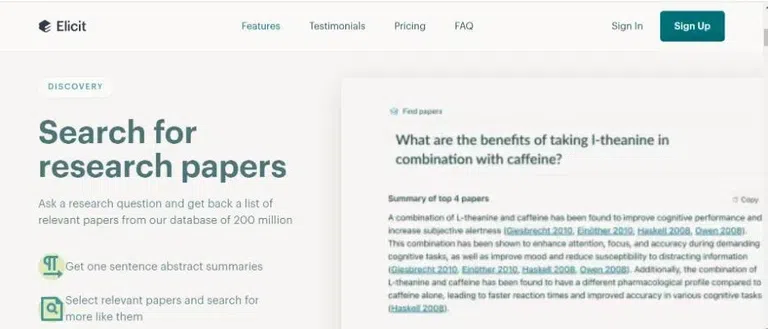
Elicit AI will use LLMs to find the research papers you want and learn them in-depth. It automates research work entirely and focuses on providing open-ended reasoning. Searching, summarizing, and learning research articles will be streamlined. You can get critical information and insights from the research papers.
Elicit will use machine learning algorithms and natural language processing to generate responses and research papers relevant to the context. It is a free online literature review generator that consumes a lot of information to train the model to understand the language and grammar to respond with context-aware responses.
Pros
Cons
Pricing
Link:https://elicit.com/
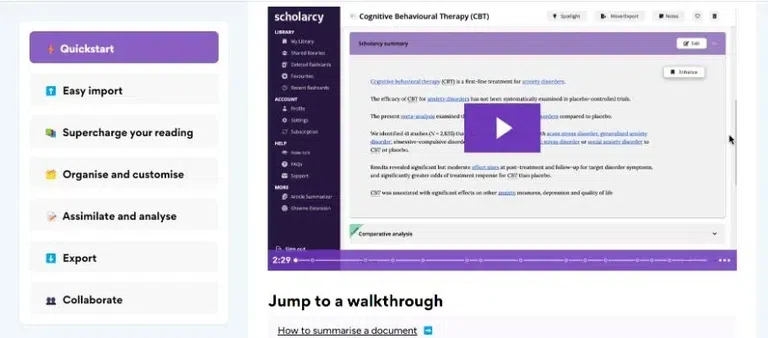
Scholarcy is one of the free AI tools for research paper writing that is used to summarize articles, books, or even long reports quickly. It will help you create bite-sized sections with ease.
There are browser extensions available for you to add to the browsers, such as Firefox, Chrome, and Edge, to give the summary you want. It also offers you a personalized summary research library with summary cards.
You will have to pay for a monthly subscription to use this tool. The automatic text summarizer is exclusively used by academic researchers, journalists, and students who want to read and summarize lengthy documents.
Scholarcy, the best AI for research insights, will scan through the lengthy research paper or document to find the critical information, references, and figures you want in no time. You can quickly generate and export the research paper summary to Word, PowerPoint, or Markdown.
Pros
Cons
Pricing
Link: https://www.scholarcy.com/
Both Elicit and Scholars are the best literature review and research summarizer tools that help you in the review process and research findings. Using them, the process of finding research papers becomes a breeze. The best way to measure the best is to experience it firsthand.
The following table provides a comparison between Elicit and Scholarcy tools:
Category to compare | Elicit | Scholarcy |
|---|---|---|
Platforms supported | SaaS/web | SaaS/web |
Audience | Research professionals | Schools who want to turn research papers to book chapters. |
Support | Online | Online. |
Pricing | It is a free version, but free trail is not available. | Free version and Free trail. |
Categories | Academic research and AI summaries. | AI summaries. |
Integrations | No | Google Chrome, Microsoft Edge, Scholarcy Library, and Microsoft Word. |
AI is taking the literature world by storm by introducing tools like Elicit and Scholarcy. These tools can help the researchers and students find the relevant research papers on which they are working to summarize the information. It saves a lot of their valuable time in manually reading and refining the information.