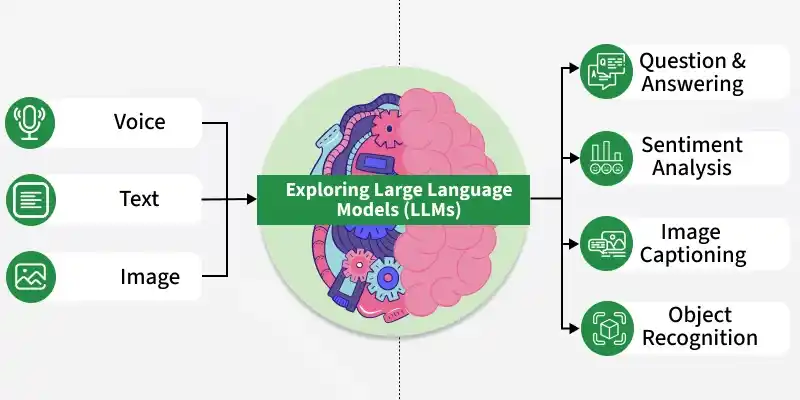
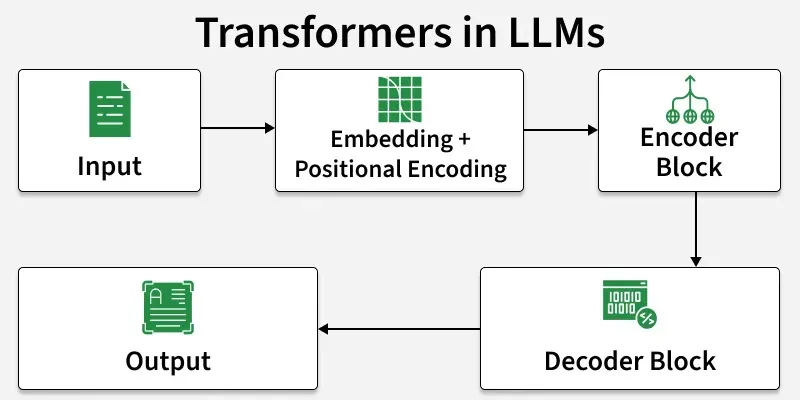
LLMs are primarily based on the Transformer architecture which enables them to learn long range dependencies and contextual meaning in text. At a high level, they work through
BLOOM: Large open-source multilingual model, collaboratively developed.
Applications
Code Generation: LLMs can generate accurate code based on user instructions for specific tasks.
Debugging and Documentation: They assist in identifying code errors, suggesting fixes and even automating project documentation.
Question Answering: Users can ask both casual and complex questions, receiving detailed, context-aware responses.
Language Translation and Correction: LLMs can translate across many languages (often dozens to 100+).
Prompt-Based Versatility: By crafting creative prompts, users can unlock endless possibilities, as LLMs excel in one-shot and zero-shot learning scenarios.
Advantages
Can perform new tasks using zero-shot and few-shot learning without retraining
Efficiently process and understand large amounts of text data
Adapt easily to specific domains through fine-tuning
Automate repetitive language-based tasks, reducing human effort
Work effectively across multiple domains like healthcare, education and business
Limitations
Require very high computational resources, making them expensive to train
Training can take a long time, often weeks or months
Depend on large amounts of high-quality and unbiased data
Consume significant energy, contributing to environmental impact
Can introduce bias and misinformation, raising ethical concerns