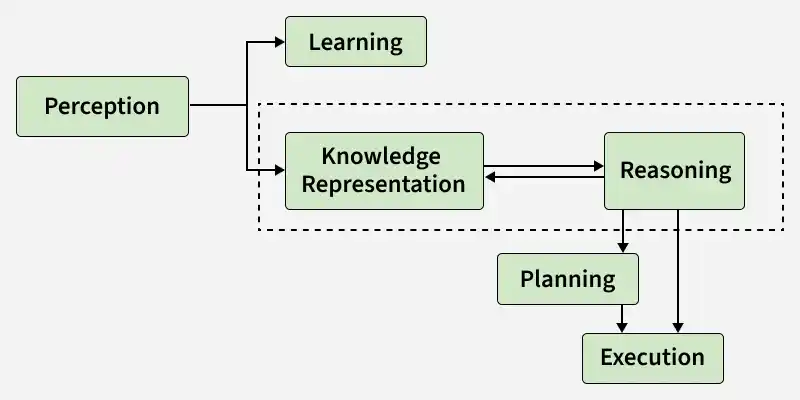
Knowledge Representation (KR) in AI focuses on how machines store and organize real-world information so they can reason, learn, and make intelligent decisions like humans.
Represents knowledge in a structured form that computers can process.
Helps AI systems perform reasoning and problem-solving tasks.
Enables intelligent applications like medical diagnosis and language understanding.
Allows machines to use stored knowledge and past experiences effectively.
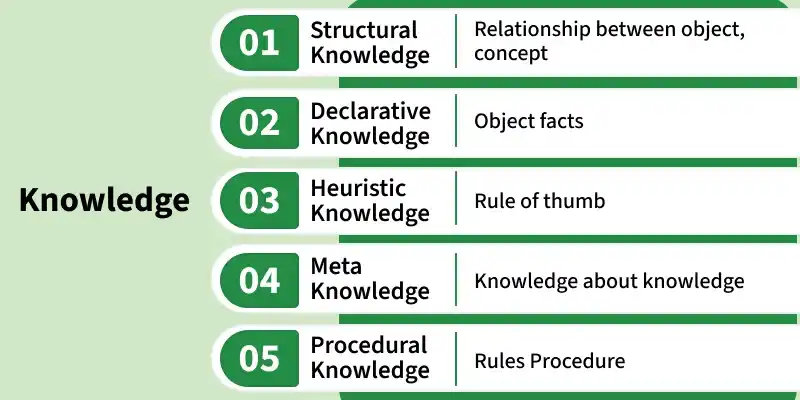
Declarative Knowledge: Knowledge about facts and concepts it answers what something is . Example: Paris is the capital of France.
Procedural Knowledge: Knowledge about how to perform a task or solve a problem. Example: Steps to sort numbers using an algorithm.
Meta knowledge: Knowledge about other knowledge or how knowledge is used. Example: Knowing that a certain rule works better for solving math problems.
Heuristic Knowledge: Experience based knowledge or rules of thumb used by experts. Example: A doctor using past experience to guess a possible disease.
Structural Knowledge: Knowledge that shows relationships between concepts. Example: A car is a type of vehicle.
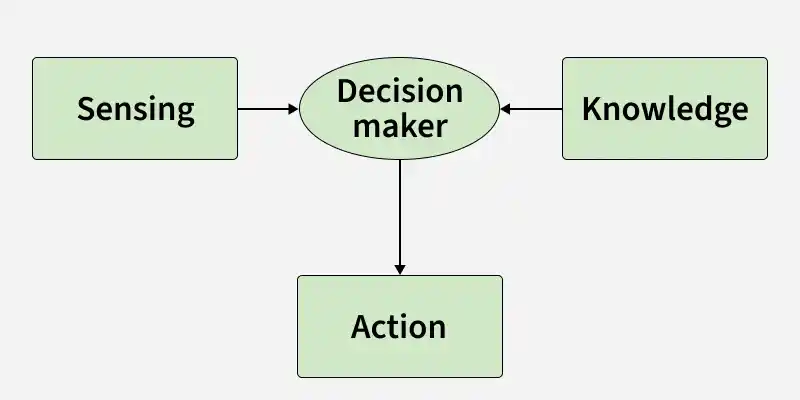
Knowledge is essential for intelligence in both humans and AI systems. AI agents use knowledge and past experience to understand situations, make decisions, and respond intelligently.
The diagram shows that intelligent behavior is possible only when a decision-maker uses knowledge from the environment. This relation can be understood as follows:
Knowledge about the real world is essential for building intelligent AI systems
AI agents use knowledge to understand inputs and take appropriate actions.
An agent can respond correctly only if it has knowledge or prior experience.
Without knowledge, an AI system cannot display intelligent behaviour.
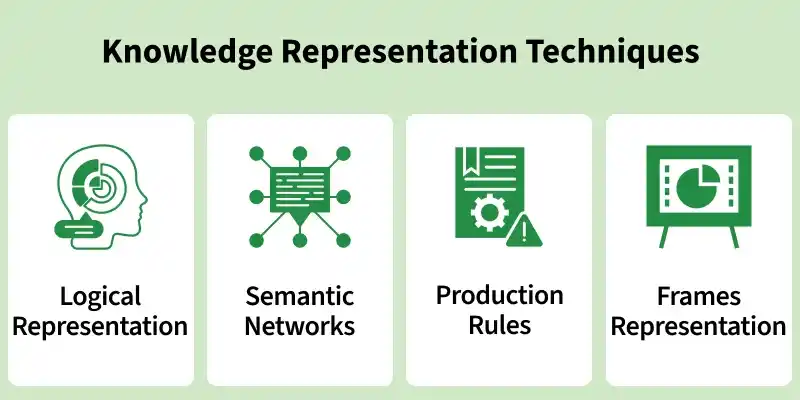
Logical representation uses formal rules and logic to represent knowledge in AI and helps systems draw conclusions based on given conditions. It includes the following ideas:
Syntax: Rules that decide how symbols and sentences are written in logic.
Semantics: Rules that give meaning to logical sentences.
Reasoning using logic can sometimes be slow or inefficient.
2. Semantic Network Representation
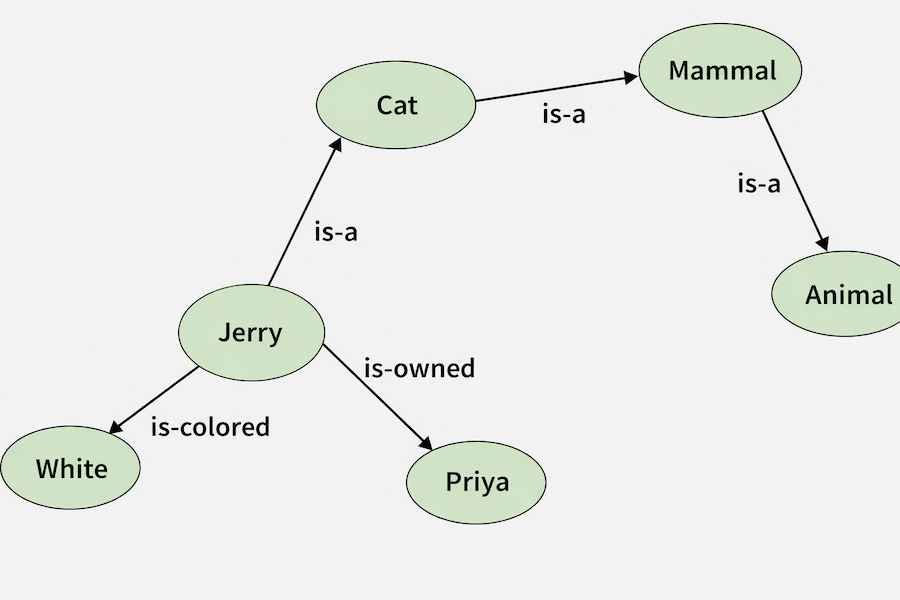
A semantic network represents knowledge using a graph structure with nodes (concepts or objects) and arcs (relationships). It helps show connections between different concepts.
IS-A relation: Shows inheritance (e.g. Cat is a Mammal).
Difficult to create very large networks like human memory.
Lacks clear standards for link names and logical expressions.
3. Frame Representation
A frame is a data structure used to represent knowledge about an object or situation using slots (attributes) and values. It organizes related information together and is widely used in NLP and computer vision.
Example: A frame for a Book may include slots such as title, author, year and pages.
Advantages
Groups related information together, making programming easier.
Flexible and easy to extend by adding new attributes.
Easy to understand and visualize.
Disadvantages
Inference and reasoning are not always efficient.
Sometimes too generalized for complex reasoning.
4. Production Rules
Production rules represent knowledge in the form of IF–THEN rules. When a condition is satisfied, the system performs the corresponding action. A production rule system has three main parts:
Set of rules
Working memory (current problem state)
Recognize act cycle (process of checking conditions and applying rules)
Example: IF (bus arrives) THEN (get into the bus).
Advantages
Easy to understand because rules are written in simple language.
Highly modular; rules can be added, removed, or modified easily.
Disadvantages
Systems usually do not learn from past results.
Many active rules can make the system slower or inefficient.
Applications
Used in expert systems to provide advice and support decision-making in specialized fields such as medical diagnosis.
Helps NLP systems understand and generate human language in applications like chatbots and translation tools.
Enables robots to understand their environment and perform tasks such as navigation and obstacle avoidance.
Supports the semantic web by helping machines organize and understand relationships between web information.
Assists cognitive computing systems in analyzing large datasets to generate insights in areas like healthcare research.
Challenges
Complexity makes it difficult to represent complete domain knowledge accurately.
Ambiguity occurs when words have multiple meanings that confuse AI systems.
Scalability becomes challenging when handling very large amounts of data.
Knowledge Acquisition involves difficulty in collecting and storing expert knowledge.