|
VOOZH | about |
|
VOOZH | about |
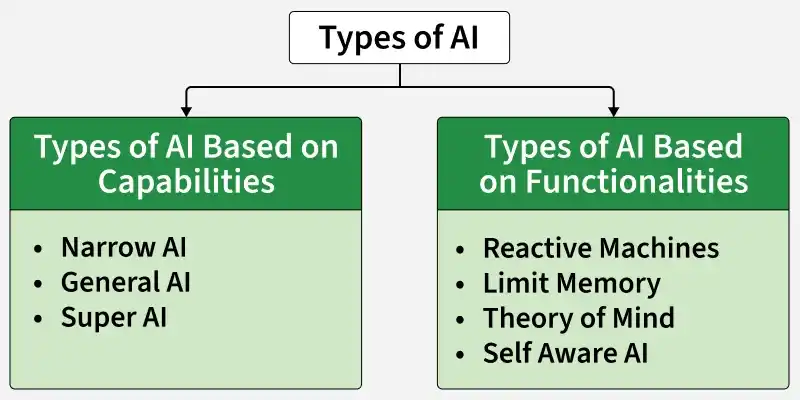
Artificial Intelligence can be classified into different types based on its capabilities and functionality, ranging from task specific systems to advanced systems with human like intelligence.
AI-based on Capabilities focuses on how intelligent an AI system can be. It describes the level of intelligence AI can achieve, from task-specific systems to advanced systems that may match or exceed human thinking.
Narrow AI is designed and trained on a specific task or a narrow range tasks. They performs their designated tasks but mainly lack in the ability to generalize tasks.
Examples:
Despite being highly efficient at specific tasks, they lacks the ability to function beyond its predefined scope. These systems do not possess understanding or awareness.
General AI refers to machines that can perform any intellectual task like humans, with the ability to learn and adapt across tasks, though it remains theoretical and still not fully developed.
Potential Applications:
Super AI is a theoretical concept where AI surpasses human intelligence. They are able to make decisions of their own and solve problem of its own.
AI-based on Functionalities shows how AI systems operate and process information. It is based on how AI handles data, memory and decision-making in different scenarios.
Reactive machines purely operates based on the present data and do not store any previous experiences or learn from past actions. These systems respond to specific inputs with fixed outputs and are unable to adapt.
Examples:
Limited Memory AI uses past data to make better decisions and predictions but lacks long-term memory, and most modern AI applications belong to this type.
Examples:
Theory of Mind AI seeks to understand human emotions, beliefs, and intentions, enabling more sophisticated and responsive interactions.
Potential Applications:
Self-Aware AI is an advanced AI that possesses consciousness, enabling it to understand emotions and have self-awareness like humans.
Potential Applications:
Traditionally, AI was classified by capability and functionality, but nowadays Practical AI Types are often listed as types. Instead of focusing on “how intelligent” they are, this category focuses on what they do in real-world scenarios.
Gen AI creates new content like text, images, audio or code by learning patterns from data. Uses deep learning models like transformers.
Example:
Agentic AI acts autonomously to achieve goals making decisions and executing tasks without constant human input. It can plan, execute and adapt.
Example:
NLP enables machines to understand, interpret and communicate using human language. Works with text and speech.
Example:
Computer Vison enables machines to analyze, recognize and interpret images and videos. Detects objects, faces and patterns from visuals.
Example: